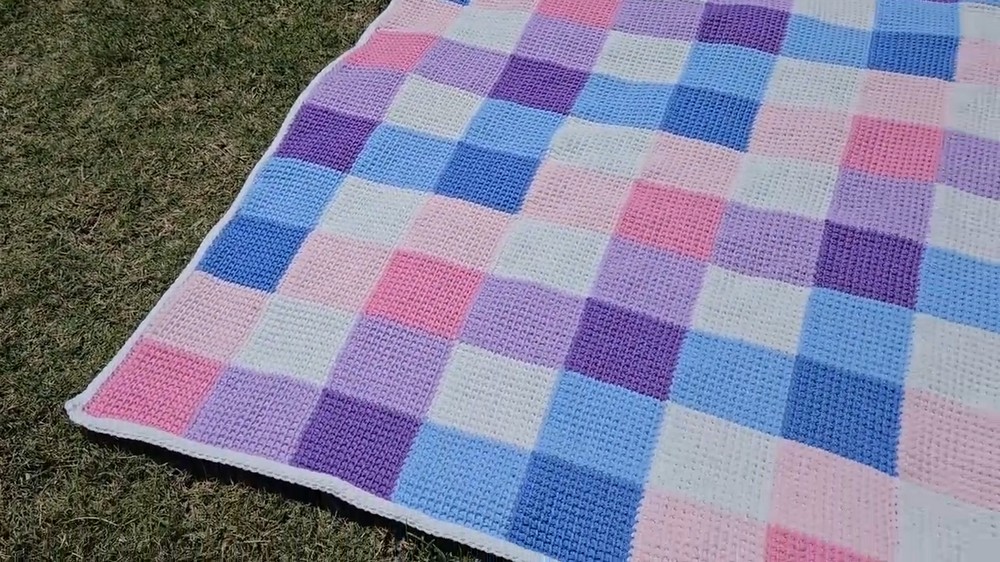
Tunisian Gingham Blanket Crochet Pattern with Join-As-You-Go Squares
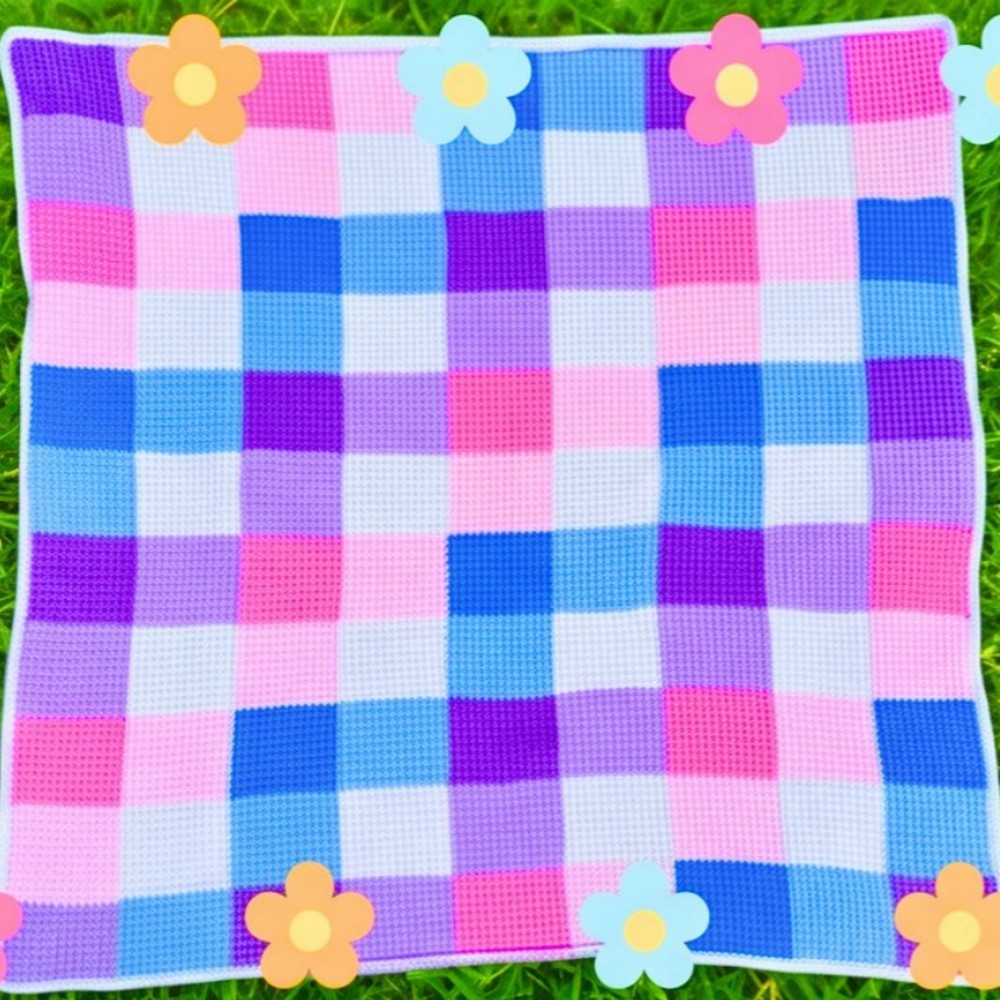
Looking for a soft checkered crochet look? This Tunisian gingham blanket builds crisp 15-stitch squares in vertical strips, with pastel colors joined as you go.
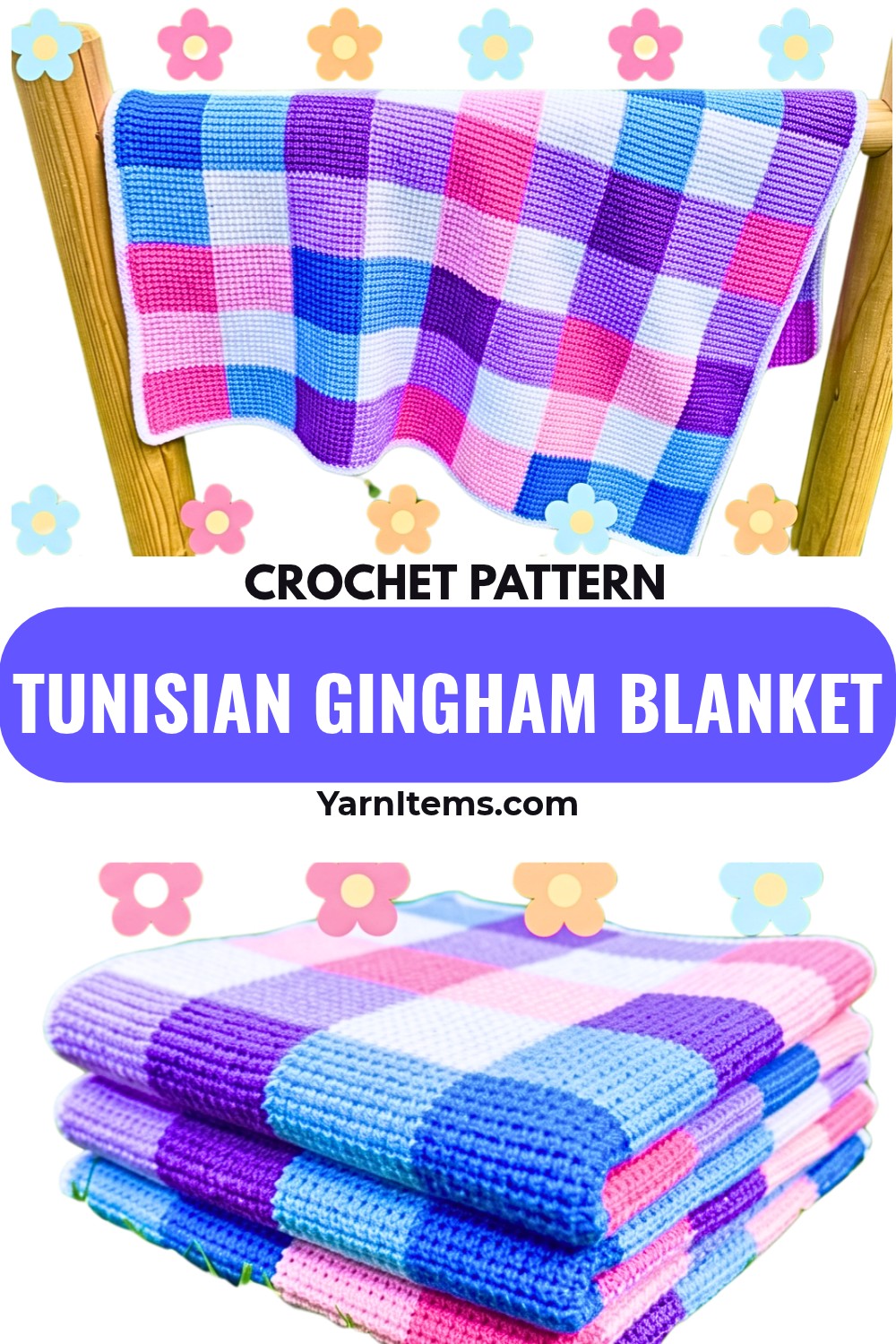
Soft pastel checks give this Tunisian crochet blanket its familiar gingham look, but the real charm is in how the squares come together. Each color block has a neat, even shape, while the finished fabric has the distinctive texture of Tunisian Simple Stitch. Its flexible size makes it useful as a cozy lap blanket, baby blanket, or a larger blanket for the home.
The tutorial builds the crochet blanket vertically rather than asking you to make a pile of separate squares and sew them together afterward. You’ll work each block at 15 stitches wide and 12 rows tall, change colors as the strip grows, and then learn how each new strip is joined to the one beside it during the return pass. The color palette can also be changed for different seasons while keeping the crochet gingham idea intact.Learn how to crochet a Tunisian gingham blanket with 15-stitch by 12-row color blocks, vertical strips, clean color changes, and join-as-you-go construction.
Credit Needy Cat Crafts
Know the Block Pattern
The easiest way to understand this blanket is to stop thinking of it as one large piece at first. Each color square is 15 stitches wide and 12 rows tall, and the blanket grows by stacking those blocks vertically.
The tutorial blanket is flexible in both yardage and final dimensions because you decide how many squares and strips to make. The supplied tutorial size is suitable for a cozy lap blanket or baby blanket, but the same 15 × 12 block dimensions can be repeated to create a different overall size.
There is also an important difference between the first strip and the strips that follow. The first vertical strip is worked on its own. When you begin the next strip, each return pass is used to connect that new square to the neighboring square. Understanding this now will make the joining instructions much easier to follow later.
Pick the Gingham Colors
The spring version uses medium-weight yarn in:
- Pink
- Light Pink
- Blue
- Light Blue
- Purple
- Light Purple
- White
The palette is completely customizable. For a Halloween-inspired blanket, the spring pastels can be replaced with orange, black, and grey.
For the gingham effect, keep one rule in mind: use two shades of the same color together with white. The lighter and darker shades are what create the checked appearance rather than a collection of unrelated color blocks.
Hook and Supplies
- Yarn: Medium weight yarn in your selected spring or custom colors
- Crochet Hook: 9 mm regular crochet hook; a straight handle is recommended
- Tapestry Needle: For weaving in ends
- Scissors
The 9 mm hook is intentional. Tunisian crochet naturally curls, so the larger gauge helps create a more relaxed fabric.
First Vertical Strip: Establish the Rhythm
The first strip is where you learn the basic Tunisian rhythm without having to worry about joining another square yet.
Each row has two parts:
- Forward Pass (Fwd): loops are pulled up and collected on the hook from right to left.
- Return Pass (Ret): those loops are worked off from left to right.
Once that rhythm is established, the most important thing to watch is the 15-loop count. Every color square must finish at 15 stitches wide and 12 rows tall.
Blue Bottom-Left Square
Foundation Chain: With the Blue yarn, Ch 15.
The 15-chain foundation sets the width of the first block. Starting with exactly 15 chains makes it easier to maintain the intended square size throughout the strip.
Row 1 (Fwd): Working into the back loops of the chain starting with the second chain from the hook, insert your hook, YO, and pull up a loop. Repeat this in each back loop across. You should have exactly 15 loops on your hook.
The final loop count is your first useful check. If there are not 15 loops on the hook, correct the foundation row before continuing.
Row 1 (Ret): YO, pull through 1 loop. Then, YO, pull through 2 loops. Repeat from * to * all the way to the end.
This completes the first Tunisian row. From here onward, remember that a row consists of both the forward and return passes.
Rows 2-12 (Fwd): For your TSS forward pass, insert your hook under the front vertical bar of the next stitch. YO and pull up a loop. Repeat across. For the very last stitch of the row, turn your work slightly to the side to locate the two end loops. Insert your hook under both of those edge loops, YO, and pull up a loop (15 loops on hook).
The regular front vertical bars are easy to identify once you see the rhythm, but the final edge stitch can be less obvious. Turning the work slightly exposes the two end loops needed for that last insertion.
Rows 2-12 (Ret): Complete the return pass the exact same way as Row 1. Stop when you have completed exactly 12 rows for the Blue square.
Your first Blue block is now complete. It should contain 15 stitches across and 12 rows in height. The next square will use the same width and row count, but the yarn color changes.

Change Color Without Leaving a Gap
The color change happens directly after the completed Blue square and allows the Light Pink block to continue from the existing work.
Color Change (To Light Pink): Cut the Blue yarn, leaving a short tail. Take your Light Pink yarn, drape it over the hook, and pull it directly through the remaining blue loop.
Pull the blue tail to tighten the loop around the pink yarn, drop both tails behind your work, and continue seamlessly with the Light Pink yarn.
The goal here is simply to replace the working yarn without creating a separate joined square. The new color becomes the working yarn for the next block.
Light Pink Square: Complete 12 rows of TSS for the Light Pink square.
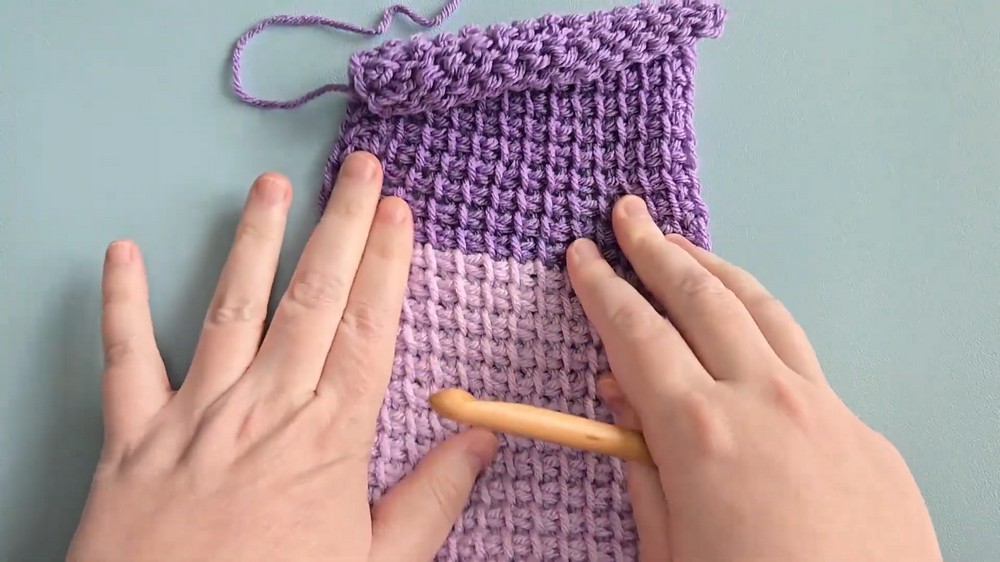
Continue this same process moving vertically block-by-block according to your color chart, finishing the top-left square of the strip, which is Dark Purple in the tutorial.
As each block is completed, keep the two measurements in mind: 15 stitches wide and 12 rows tall. That consistent block size is what keeps the gingham checks aligned.
Finish the First Strip at the Top
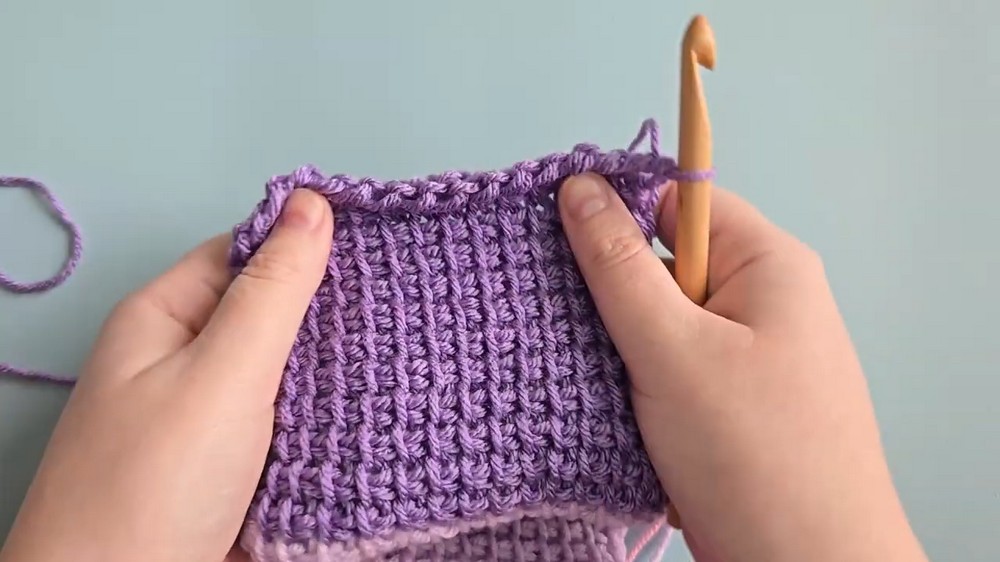
Once the final 12 rows of the top square are complete, the top edge needs a clean finish before moving on to the next vertical strip.
Top Edge: Insert your hook into the front post, YO, pull through the stitch, and then immediately pull through the loop on your hook (slip stitch bind off).
Repeat across. For the final stitch, insert under the last two edge loops, YO, pull through, and pull through the loop on the hook.
Chain 1 to secure, and cut the yarn.
The first strip is now finished from bottom to top. The next strip will be different because it will be attached to this strip as you crochet it.
Join the Next Vertical Strip as You Work
This is the part that saves you from making every square separately and returning later with a needle to join them.
For the second strip, begin again at the bottom. Its foundation chain attaches at the bottom-right corner of the first Blue square, and each completed return pass connects the new strip to the adjacent strip.
Light Blue Square
Foundation: Locate the starting chain of 15 at the very bottom of your first Blue square. Insert your hook under the V-stitch located in the bottom right corner. Attach your Light Blue yarn, Ch 1, and then chain 14 more (for a total of 15 chains).
The complete foundation is still 15 chains, but this time its placement is important because the new strip needs to begin directly beside the first one.
Row 1 (Fwd): Work into the back loops of the chain starting in the 2nd chain from the hook, pulling up a loop in each chain (15 loops on hook).
Again, the 15-loop count confirms that the new square has the correct width before the joining begins.
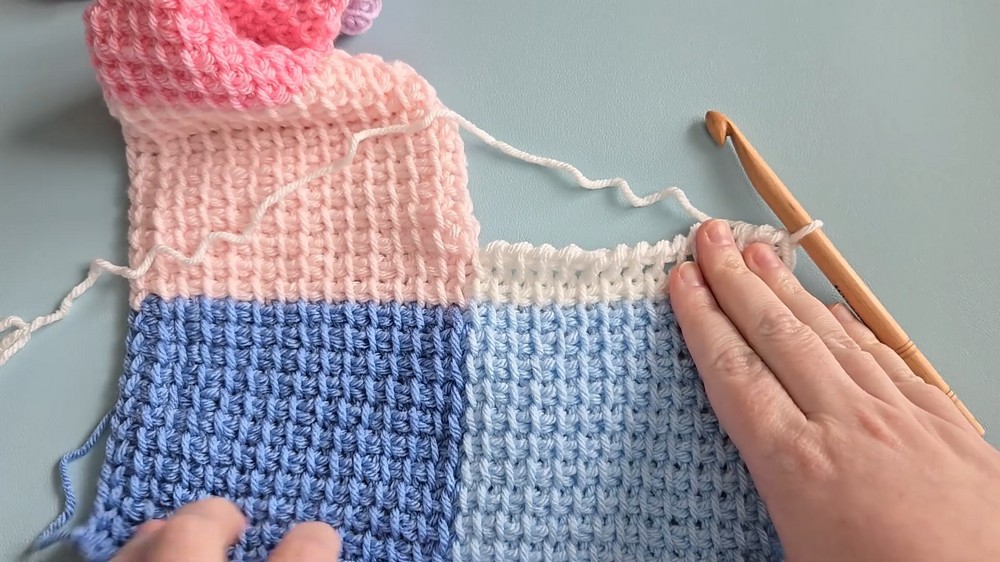
Row 1 Joining (Ret): Locate the edge of the first row of the adjacent Blue square. Find the side V-stitch. Insert your hook into the second loop of the V-stitch as well as the small back loop directly behind it. YO, pull through the edge stitch, and pull through one more loop on your hook. Then, YO, pull through 2 loops all the way down.
This joining movement is what connects the new Light Blue block to the Blue block beside it. Rather than finishing the row independently, you are using the neighboring square’s edge as the anchor.
Continue the Joined Rows
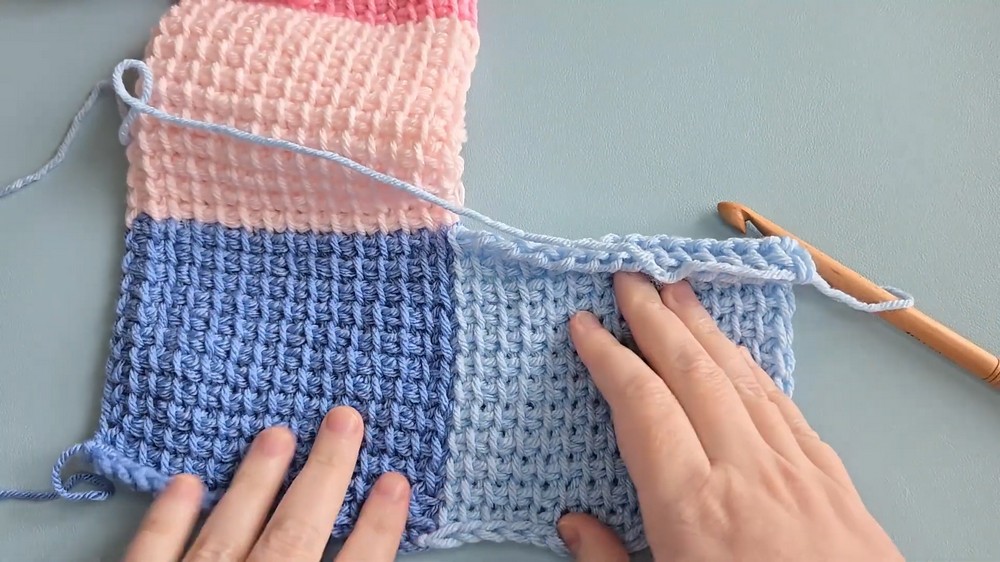
Rows 2-12: Continue your TSS forward pass as normal. For every return pass, remember to anchor the row by inserting your hook into the corresponding side V-stitch (second loop + back loop) of the adjacent square, YO, pull through, pull through 1, and then YO, pull through 2 across.
The forward pass continues to behave like ordinary TSS. The important difference appears during every return pass: each row is connected to the corresponding edge of the neighboring square.
As you work upward, the two strips should remain aligned row by row. If the new square begins drifting away from the edge, check that the hook is entering the corresponding side V-stitch on every joined return pass.
Change to White on the Joined Strip
The color change works in the same basic way as before, but the new White block must continue the joining rhythm with the adjacent Light Pink square.
Color Change on a Joined Row (To White): Once 12 rows are complete, cut the Light Blue yarn. Drape the White yarn over the hook, pull through, and tighten the previous tail.
White Square: Complete 12 rows for the White square, remembering to join each return pass row-by-row into the adjacent Light Pink square.
The important visual check here is that the White square should remain the same 15-stitch width and 12-row height as the other blocks while its side edge stays connected to the neighboring strip.
Continue building the remaining vertical strips according to the color chart, using the same block dimensions and the same join-as-you-go method for each new strip.
Keep the Checks Aligned
Because the blanket is built from repeated blocks, a small mistake in one square can become noticeable several rows or strips later.
When checking your work, focus on three things rather than trying to judge the entire blanket at once:
- Each color block is 15 stitches wide.
- Each color block is 12 rows tall.
- Every new joined strip stays attached to the corresponding side stitches of the strip beside it.
The color pattern should gradually form recognizable gingham checks as the vertical strips accumulate. If the blocks are the correct size but the checks appear displaced, look first at the color sequence and the point where the new strip was joined.
Secure the Finished Blanket
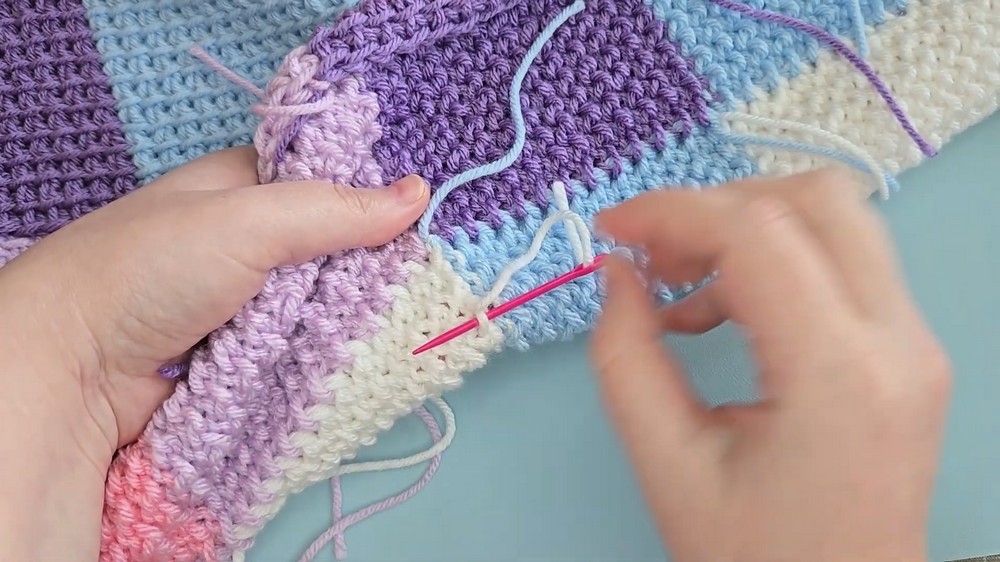
Once all squares and vertical strips are connected, turn the blanket over to the back where all the yarn tails are resting.
Tighten the color-block corners: Gently pull the tails to tighten up the corners where the color blocks intersect, making the color transitions look crisp.
Secure the ends: Double knot the matching tails together for added security, then use a tapestry needle to weave in all ends.
Trim: Cut off any excess woven string.
Working from the back makes this finishing stage easier because all the tails are already visible. Tightening the matching tails before weaving them in also helps sharpen the points where the color blocks meet.
Give the Edges a Finished Border
Tunisian crochet can naturally curl, so the blanket benefits from a substantial border once the gingham body is complete.
Border: Add a chunky border of your choice around the entire perimeter of the blanket to give it a polished finish and help weigh down the edges so the Tunisian crochet doesn’t curl.
The border is intentionally left open to your choice, allowing the finished blanket to suit the colors and size you selected rather than locking the tutorial into one specific edging.
With the strips joined, the color transitions secured, and the perimeter bordered, the gingham pattern has its complete checked appearance.