Crochet Puff-Stitch Yoke Sweater for 3–4 Year Olds
This child’s puff-stitch sweater combines soft texture, neat ribbed borders, and seamless top-down shaping, with simple hook-size changes for different fits.
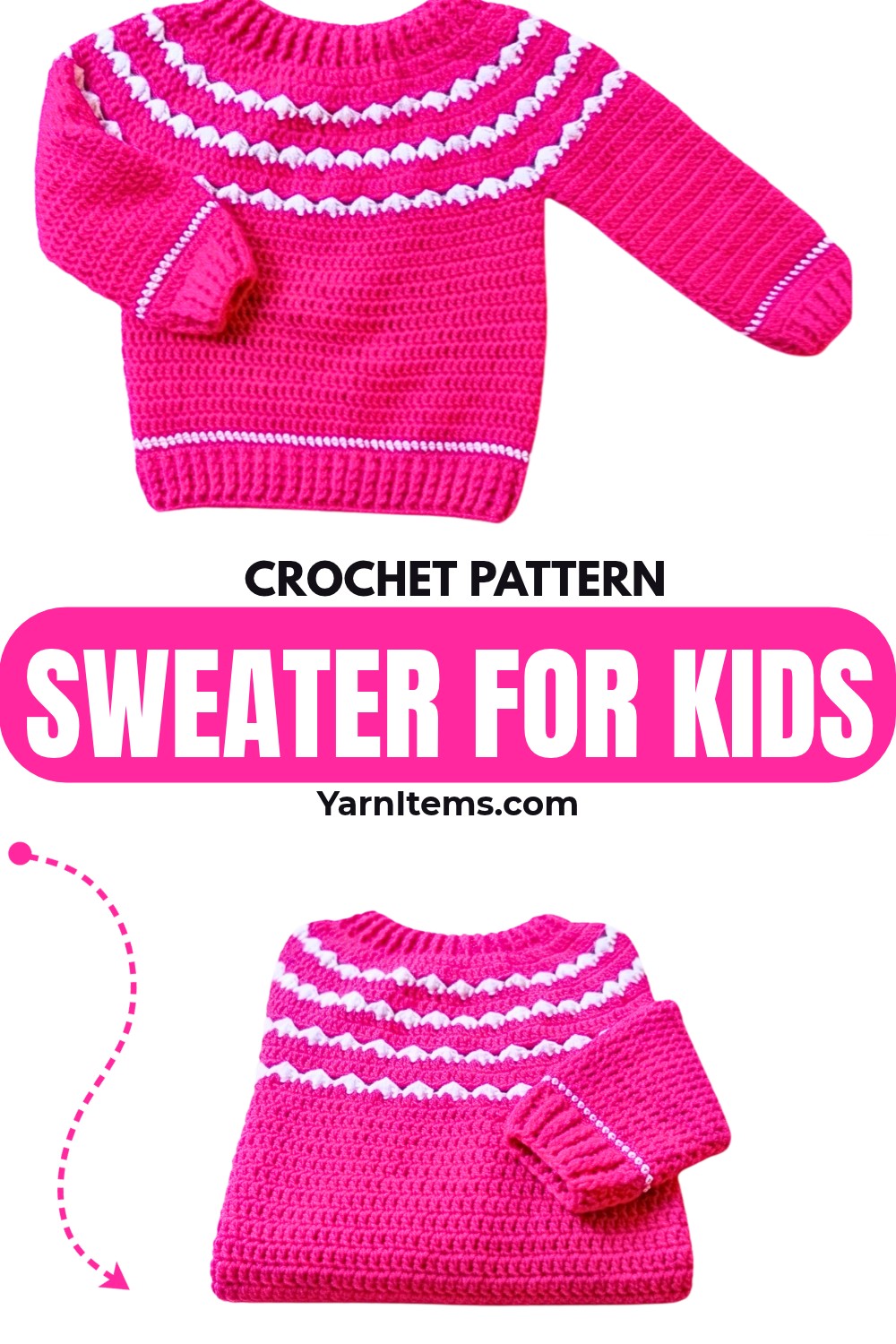
Soft 4-ply yarn and raised puff stitches give this child’s crochet sweater playful texture without making its body difficult to follow. Contrasting color rows add small bursts of crochet detail, while tighter ribbing along the hem, cuffs, and neckline helps create neat edges and a comfortable fit.
Worked from neckline downward, the crochet sweater stays seamless from yoke through body and sleeves, so no separate body pieces need sewing together. Stitch counts become especially important as the yoke expands, then armholes are divided to form front and back sections. Keeping joins straight and checking measurements along the way will help maintain balanced shape.
Credit Mom’s Crochet & Craft
Materials & Tools Needed
- Yarn: 4-ply yarn, approximately 240–280 grams total
- Main Color (MC): Pink or another chosen main shade
- Contrasting Color (CC): White or another contrasting shade
- 3.50 mm crochet hook: Main body and yoke
- 3.00 mm crochet hook: Bottom, cuffs, and neckline borders for tighter ribbing
- Scissors
- Yarn needle: For weaving in loose ends
- Stitch markers
Finished Size & Fit Adjustments
Finished sweater is designed for approximately 3- to 4-year-old children.
Approximate measurements:
- Underarm to bottom: 8.5-9 inches
- Underarm to wrist: 9.5-10 inches
Hook size can change overall fit while keeping the same yarn and stitch counts:
- For 4-5 years: Use 4.00 mm hook for main body with same stitch counts
- For 2-3 years: Use 3.00 mm hook for main body with same stitch counts
For length changes, continue or reduce body and sleeve rounds according to desired measurements rather than relying only on listed round numbers.
Pattern Abbreviations
- ch: Chain
- st(s): Stitch(es)
- sl st: Slip stitch
- sc: Single crochet
- hdc: Half double crochet
- dc: Double crochet
- fpdc: Front post double crochet
- bpdc: Back post double crochet
- dc2tog: Double crochet 2 together, used as a decrease
- MC: Main Color
- CC: Contrasting Color

Puff Stitch
Yarn over, insert hook into stitch, and pull up loop; repeat 2 more times in same stitch until 7 loops are on hook. Yarn over and pull through 6 loops. Yarn over and pull through remaining 2 loops.
Build Puff-Stitch Yoke
Yoke is worked top-down in joined rounds. First three rounds establish starting stitch count, while later puff-stitch rounds create textured expansion.
Row 1 (MC): Ch 75; make sure chain is not twisted; sl st to back bump of first ch to form circle; ch 1; work 1 dc in same st; work 1 dc in back bump of each ch around; sl st to first dc to join. 75 sts.
Check chain before joining. Any twist in foundation chain will remain visible throughout yoke.
Row 2 (MC): Ch 1; work 1 dc in first st, 1 dc in next st, 2 dc in 3rd st; repeat [1 dc in next 2 sts, 2 dc in next st] around; sl st to first dc to join. 100 sts.

Row 3 (MC): Ch 1; work 1 dc in first 3 sts, 2 dc in 4th st; repeat [1 dc in next 3 sts, 2 dc in next st] around; in final stitch work only 1 dc instead of 2 dc to avoid ending with an odd number; sl st to first dc to join; fasten off MC. 124 sts.
That final adjustment is intentional. Follow it even if repeat appears to suggest another increase, because an exact 124-stitch count is needed for the next section.
Add First Puff-Stitch Section
Row 4 (CC – Puff Stitch Row): Join CC where sl st was made; ch 3, counting as hdc + ch-1 space; work 1 Puff st in same st, then 1 hdc in same st; repeat [skip 3 sts, then in 4th st work 1 hdc, ch 1, Puff st, 1 hdc] around; skip final 3 sts; sl st into 2nd ch of starting ch-3; fasten off CC.
Keep tension slightly loose during this round. Puff stitches need enough room to form their raised shape without pulling surrounding stitches inward.
Row 5 (MC): Join MC; ch 1; work 1 dc in same st; work 1 dc in every stitch and ch-1 space around, placing 1 dc in each hdc, each Puff st, and each ch-1 space; sl st to first dc to join. 124 sts.
Row 6 (MC): Ch 1; work 1 dc in each st around; sl st to first dc to join. 124 sts.

Expand Through Second Puff Section
Row 7 (MC – Puff Stitch Row): Ch 3, counting as hdc + ch-1 space; work 1 Puff st in same st, then 1 hdc in same st; repeat [skip 2 sts, then in 3rd st work 1 hdc, ch 1, Puff st, 1 hdc] around; if 4 sts remain at end, place final cluster in next stitch instead of skipping to prevent large gap; sl st to 2nd ch to join.
Puff placement changes here from every 4th stitch to every 3rd stitch. Watch spacing closely because this change increases yoke fullness.
Row 8 (MC): Ch 1; work 1 dc in each st around, placing 1 dc in each hdc, Puff st, and ch-1 space; if work feels too tight, place 2 dc in ch-1 spaces; sl st to first dc to join. 164 sts.
Row 9 (MC): Ch 1; work 1 dc in each st around; sl st to first dc to join. 164 sts.

Complete Puff-Stitch Yoke
Row 10 (MC – Puff Stitch Row): Ch 3; work 1 Puff st in same st, then 1 hdc in same st; repeat [skip 3 sts, then in 4th st work 1 hdc, ch 1, Puff st, 1 hdc] around; sl st to 2nd ch to join.
Row 11 (MC): Ch 1; work 1 dc in each st around; sl st to first dc to join. 164 sts.
Before dividing armholes, check yoke circumference and overall drape. This is last major point where yoke size can be evaluated before front, back, and sleeve sections become separated.

Divide Armholes and Body
Row 12 changes circular yoke into separate body sections. 164 stitches are divided into front, back, and two armholes.
Row 12 (MC): Ch 1; work 1 dc in same st as first front/back body stitch; skip 34 sts for first armhole; work 1 dc in 35th st and 1 dc in next 47 sts for 48-st back panel; skip 34 sts for second armhole; work 1 dc in next 47 sts for 48-st front panel; sl st to first dc to join. 96 body sts total.
Check that both skipped armhole sections contain exactly 34 sts. Matching armhole counts help keep sleeve openings equal on both sides.
Work Body
Rounds 13–27 (MC): Ch 1; work 1 dc in each st around; sl st to first dc to join; continue for approximately 15 rounds from armhole division; keep joining seam straight along side for neat finish.
Keep checking side seam as rounds progress. If join begins drifting diagonally, correct placement early rather than waiting until bottom border.
Round 28 (CC): Fasten off MC; join CC; ch 1; work 1 sc in each st around; keep tension relaxed so sweater does not cinch inward; sl st to first sc to join; fasten off CC.
Round 29 (MC): Join MC; ch 1; work 1 sc in each st around; sl st to first sc to join.
Rounds 30–31 (MC): Ch 1; work 1 dc in each st around; sl st to first dc to join.
Create Ribbed Bottom Border
Switch to 3.00 mm hook for tighter ribbing.
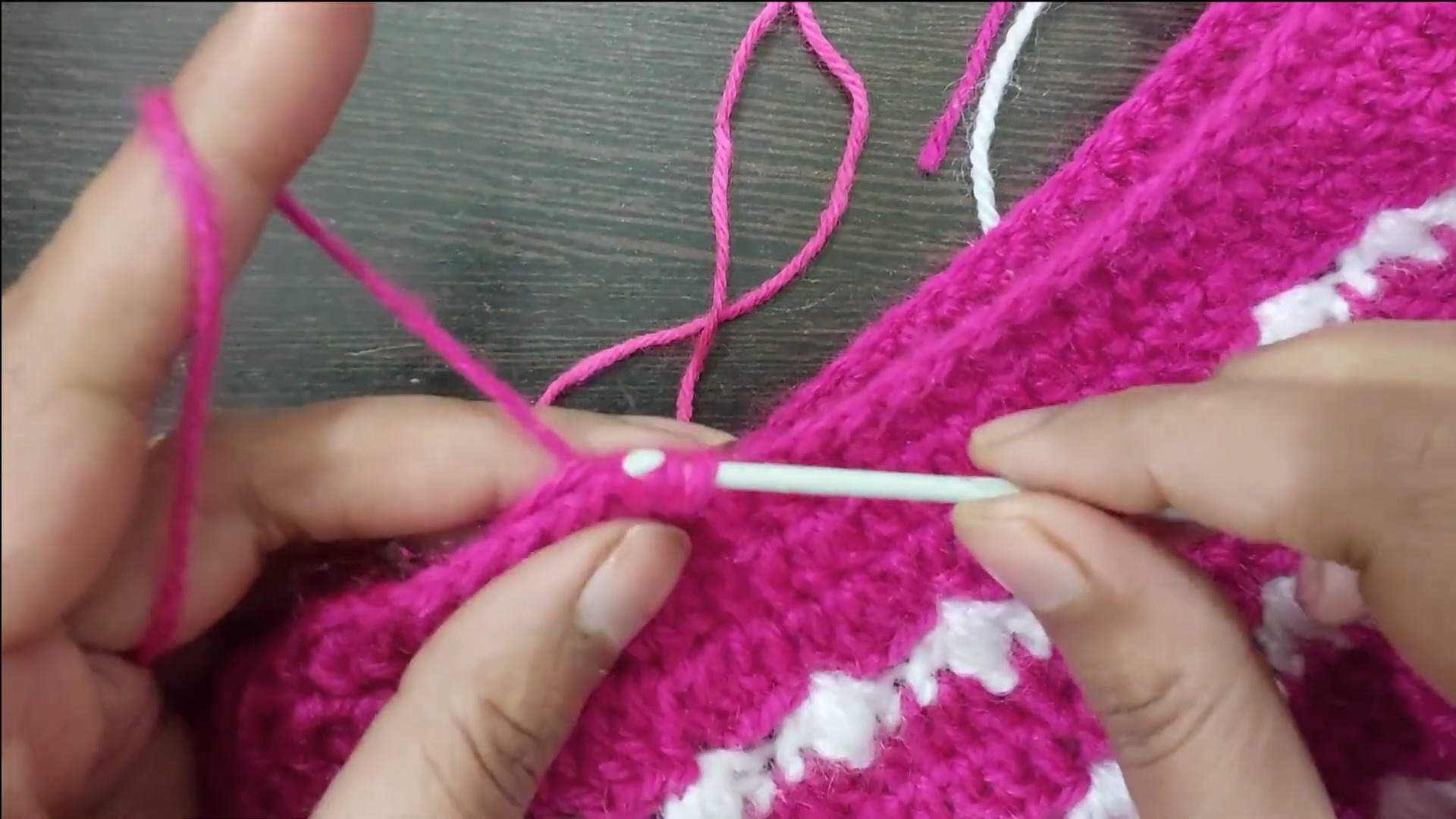
Rounds 32–35 (Bottom Border): Ch 1; repeat [1 fpdc in next st, 1 bpdc in next st] around; sl st to first fpdc to join; repeat ribbed round 3–4 more times until body measures approximately 8.5–9 inches from underarm; fasten off.
Measure from underarm rather than neckline when checking length. This gives more useful indication of finished body coverage.
Work Sleeves
Make 2 sleeves. Sleeves begin directly at armhole openings, keeping sweater seamless.
Round 1 (MC): Using 3.50 mm hook, join MC at underarm; join through both edges of gap at same time to prevent hole; ch 1; work 1 dc in same space; work 1 dc in each of 34 skipped armhole sts around; sl st to first dc to join.
Joining through both edges at underarm closes any opening that could otherwise become noticeable once sleeve is worn.
Rounds 2-15: Ch 1; work 1 dc in each st around; sl st to first dc to join. 15 rounds total.
Add Sleeve Color Details
Round 16 (CC): Fasten off MC; join CC; ch 1; work 1 sc in each st around; sl st to first sc to join; fasten off CC.
Round 17 (MC): Join MC; ch 1; work 1 sc in each st around; sl st to first sc to join.
Round 18 (MC): Ch 1; work 1 dc in each st around; sl st to first dc to join.
Shape Sleeve Before Ribbing
Round 19 (Decrease Round): Ch 1; work 1 dc in same st; repeat [dc2tog over next 2 sts, 1 dc in next st] around; sl st to first dc to join.
This decrease round reduces sleeve circumference before tighter cuff ribbing begins.
Finish Ribbed Cuffs
Rounds 20–24 (Cuff Border): Switch to 3.00 mm hook; ch 1; repeat [1 fpdc in next st, 1 bpdc in decreased st] around; sl st to first fpdc to join; work ribbing for 4–5 rounds until sleeve measures approximately 9.5–10 inches from underarm; fasten off.
Measure sleeve from underarm before finishing. If child’s arm length differs from listed measurement, continue or stop ribbing according to actual desired wrist length.
Repeat complete sleeve instructions for second armhole.
Finish Neckline
Smaller hook draws neckline inward slightly and gives ribbing cleaner definition.
Round 1 (MC): Using 3.00 mm hook, join MC anywhere along foundation chain of neckline; ch 1; repeat [1 fpdc around first chain post, 1 bpdc around next chain post] around; sl st to first fpdc to join.
Rounds 2–3: Continue alternating fpdc and bpdc ribbing for 2–3 total rounds; fasten off.
Keep neckline tension even. Pulling stitches too tightly can make the collar uncomfortable, while loose tension can reduce its snug ribbed effect.
Finishing
Sweater is worked seamlessly from top down, so no sewing is required.
Turn sweater inside out and weave all loose yarn ends securely through inner stitches using a yarn needle. Hide ends thoroughly so they remain secure during wear and washing.
Fit Check Before Finishing
Before weaving in every end, place sweater flat and compare body and sleeve measurements with desired size. Check:
- Body length: approximately 8.5–9 inches from underarm
- Sleeve length: approximately 9.5–10 inches from underarm to wrist
- Armholes: both sides should have matching skipped-stitch counts
- Side join: joining seam should remain straight
- Ribbing: hem, cuffs, and neckline should draw in slightly without becoming tight
For larger 4-5-year sizing, use a 4.00 mm hook with the same yarn and stitch counts. For smaller 2–3-year sizing, use a 3.00 mm hook for the main body with the same stitch counts.

The finished sweater combines puff-stitch texture through the upper section with a simple double crochet body and snug ribbed edges. Seamless top-down shaping keeps assembly simple while hook-size changes provide an easy way to adjust overall fit.