Crochet V-Neck Sweater Vest with Adjustable Fit & Ribbed Edges
Here’s a custom-fit crochet vest with sharp V-neck shaping, simple hdc panels, and stretchy ribbed edges you can size to your measurements.
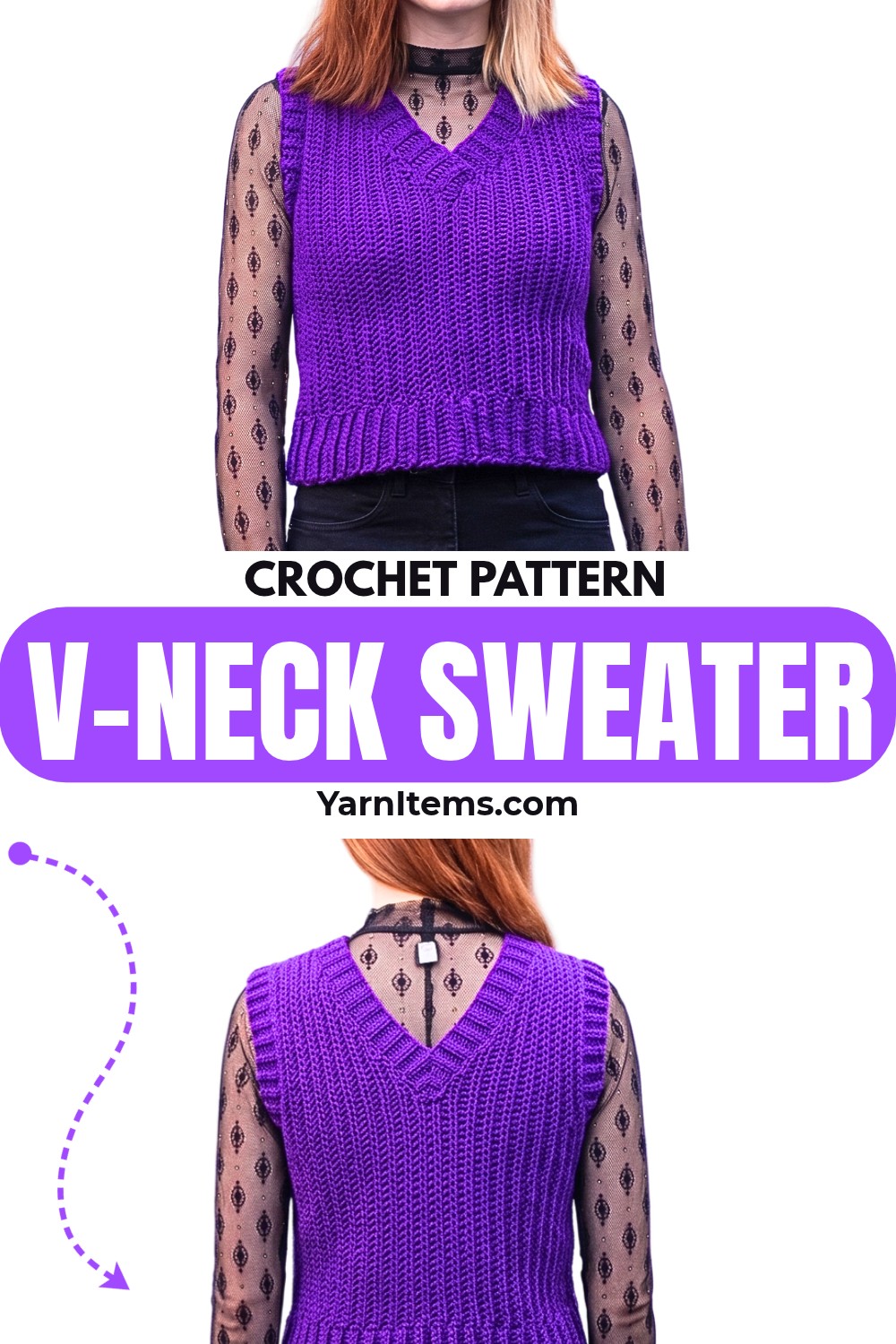
Solid DK yarn gives this V-neck crochet sweater vest clean, understated texture, while shaped front and back panels create its fitted silhouette. Separate ribbing strips add stretch around the neckline, waist, and armholes, giving each edge definition without making panel crochet stitches complicated.
Fit depends on measurements rather than one fixed size. Panel rows, strap length, V-neck depth, and ribbing widths can all be adjusted, so it helps to measure as you work and compare both sides before joining. Matching decreases and increases on opposite edges is especially important for keeping crochet neckline and armhole shaping balanced.
Credit Krafty Station
Materials & Tools
- Yarn: DK-weight yarn; creator uses solid black acrylic yarn
- Hook: 4.5 mm crochet hook
- Scissors
- Tapestry needle: For sewing and weaving in yarn ends
Fit & Customization
This vest is designed for flexible, measurement-based sizing. Adjust panel width and strap length according to your own body measurements.
V-neck depth can also be changed. For deeper or shallower shaping, alter how many stitches remain unworked at the top before beginning neckline decreases.
Ribbing widths used in tutorial are:
- Neckline: 7 sts wide
- Waist: 11 sts wide
- Armholes: 4 sts wide
For different ribbing widths, chain more or fewer stitches at the beginning of each strip.
Abbreviations
- ch: Chain
- st(s): Stitch(es)
- hdc: Half double crochet
- hdc flo: Half double crochet through front loop only
- inc: Increase – 2 hdc in same stitch
- dec: Decrease – yarn over, insert hook into first st and pull up loop; yarn over, insert hook into next st and pull up loop; yarn over and pull through all loops on hook

Shape Back Panel
Back panel begins with straight hdc rows, then increases along one edge to create diagonal shaping. Keeping the increase side consistent is important because opposite edges will later form matching vest structure.
Foundation: Make a slip knot and ch 30.
Row 1: Hdc in 2nd ch from hook and in each st across.
Row 2: Ch 1, turn; hdc in each st across.
Row 3: Ch 1, turn; hdc across until 1 st remains; work inc in final st by placing 2 hdc in same st.
Row 4: Ch 1, turn; work inc in first st, then hdc across remaining sts.
Rows 5–10: Repeat increase pattern on same side, creating slight diagonal rise along one edge while keeping opposite bottom edge straight.
Watch which edge receives each increase. Switching sides midway will change panel direction and can prevent later sections from lining up.

Build First Arm Strap
Row 11: Ch 1, turn; hdc across row; at end of row ch 30 to create foundation for shoulder strap.
Rows 12–16: Ch 1, turn; hdc in each st across, including newly added chains; do not increase or decrease.
At this stage, strap length is being established. Keep chain tension consistent, so the strap does not become noticeably narrower or wider than the panel body.
Shape Scoop Neckline
Back panel uses scoop-style neckline shaping before reaching opposite side.
Row 17: Ch 1, turn; hdc across until 2 sts remain at top neckline edge; work dec.
Row 18: Ch 1, turn; work dec in first st, then hdc across remaining sts.
Rows 19-27: Continue decreases only along neckline edge, working regular hdc across remaining portion of each row.
Rows 28-31: Ch 1, turn; hdc straight across with no increases or decreases to form flat center section of scoop neckline.
This short straight section creates separation between decreasing and increasing sides of neckline. Keep row count consistent because opposite side must eventually meet first strap at matching height.

Increase Toward Opposite Strap
Row 32: Ch 1, turn; work inc on neckline edge, then hdc across remaining sts.
Rows 33–42: Continue hdc rows with 1 inc on neckline side of each row. Continue until this side reaches the length needed to match the first strap.
Compare both sides before continuing. Strap and neckline heights should match so shoulder seams sit evenly after joining.
Row 43: Ch 1, turn; hdc across.
Rows 44-48: Ch 1, turn; hdc in each st across with no increases or decreases.
Shape Opposite Armhole
Row 49: Ch 1, turn; hdc across exactly 40 sts, leaving remaining stitches unworked to match armhole depth from opposite side.
Rows 50-57: Ch 1, turn; work dec on armhole side, then hdc across; continue decreasing along same side to mirror diagonal shaping from beginning section.
Rows 58-59: Ch 1, turn; hdc evenly across with no increases or decreases; fasten off.
Back panel is now complete.

Build Front Panel with V-Neck
Front panel begins exactly like back panel, but neckline shaping changes from scoop to sharper V.
Rows 1–16: Follow same instructions used for Back Panel, including ch 30 shoulder strap.
Begin V-Neck
Row 17: Ch 1, turn; hdc across until 15 sts remain unworked at top neckline edge. This unworked section establishes starting point for V-neck slope.
Leaving more or fewer stitches here changes V-neck depth. Fewer unworked stitches begin shaping sooner, while more unworked stitches leave neckline higher.
Rows 18–29: Ch 1, turn; make 2 decreases along neckline edge, then hdc across remaining stitches; repeat through Row 29 to create sharp downward slope forming half of V.
Keep both decreases close together and maintain the same placement on every row. Consistency controls the angle of V.
Row 30: Ch 1, turn; work normal hdc across.
Shape Opposite Side of V
Rows 31-42: Ch 1, turn; hdc across until reaching neckline edge; make 2 increases along neckline edge; repeat through Row 42 to rebuild width toward opposite strap.
Row 43: Hdc across to end; ch 15 to match strap height on opposite side.
Rows 44-48: Ch 1, turn; hdc evenly across.
Row 49: Ch 1, turn; hdc across exactly 40 sts to match armhole drop on opposite side.
Rows 50-57: Ch 1, turn; hdc across while making decreases along neckline/armhole edge to create matching diagonal shaping.
Row 58: Hdc normally across; fasten off.
Before moving to ribbing, lay front and back panels together and compare shoulder and armhole positions. Matching lengths here will make later sewing much easier.

Make Neckline Ribbing
Four separate ribbing strips are created using hdc flo. Front-loop-only rows naturally create flexible ridged fabric that can stretch around curved edges.
Neckline Ribbing
Foundation: Ch 8.
Row 1: Hdc in 2nd ch from hook and across. 7 sts.
Row 2 and onward: Ch 1, turn; hdc flo across all 7 sts.
Repeat until strip is long enough to stretch around entire neckline. Fasten off.
Do not judge length only while strip is relaxed. Stretch it gently around neckline to check whether it reaches comfortably without excessive pulling.
Waist Ribbing
Foundation: Ch 12.
Work hdc flo rows in the same manner until the strip wraps comfortably around the waist. Fasten off.
Armhole Ribbing – Make 2
Foundation: Ch 5.
Repeat hdc flo rows until each strip wraps around the corresponding armhole. Fasten off.
Keep both armhole strips equal in length so finished openings remain balanced.
Join Panels
Lay front panel directly over back panel.
Thread tapestry needle with matching black yarn.
Shoulder Seams: Secure knot at outer corner of strap; sew corresponding front and back stitches together using whip stitch or mattress-style stitch; continue stitch by stitch across strap.
Side Seams: Repeat same stitch-by-stitch sewing method along both side edges, matching front and back panels carefully.
Check armhole openings while sewing. Stop periodically to confirm both openings remain equal in depth and width.
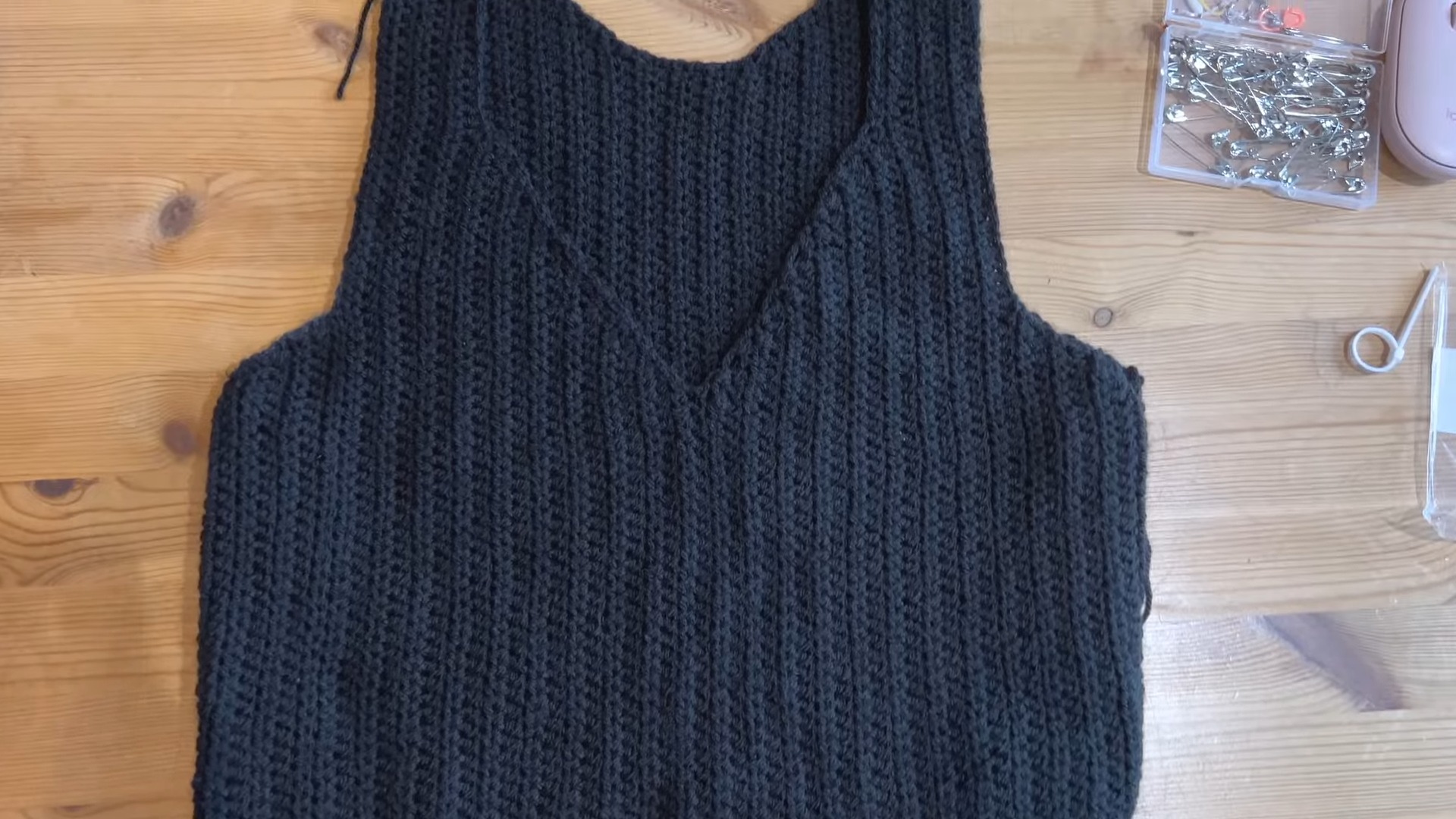
Attach V-Neck Ribbing
Longest ribbing strip is attached around neckline. V center requires careful overlapping so finished point stays sharp.
Position Ribbing: Wrap longest ribbing around neckline and measure its placement before sewing.
Form V Point: At center V, position both ends so one ribbing flap crosses directly over other, creating sharp V shape.
Secure Center: Tie knot at exact center point of vest V to hold overlapping ribbing in position.
Sew Ribbing: Sew ribbing to vest stitch by stitch around neckline.
Secure V Overlap: When reaching overlapping V section, pass needle directly through both ribbing layers and vest body. Sew through all layers to anchor overlapping flaps permanently.
Check V point from outside before completing nearby stitches. If overlap shifts even slightly, V can look uneven once ribbing is fully attached.
Attach Waist and Armhole Ribbing
Sew waist ribbing onto lower vest edge using same stitch-by-stitch method.
Attach each armhole ribbing strip around corresponding armhole, matching strip edges carefully.
Keep ribbing relaxed while sewing. Pulling strip excessively can cause armhole or waist edge to pucker.
Final Finishing
Tie off all loose yarn ends securely.
Use tapestry needle to weave remaining yarn tails back and forth through dense stitches on inside, or wrong side, of vest. Once ends are secure, snip excess yarn.
Before wearing, check shoulder seams, side seams, V center, and all ribbing joins. Ribbing should sit smoothly around each edge without twisting.

Fit Check Before Final Wear
Try vest on or compare it against intended body measurements before trimming every remaining yarn tail.
Check:
- Shoulder straps meet evenly.
- V point sits at intended depth.
- Both armholes have matching openings.
- Waist ribbing reaches comfortably around body.
- Neckline ribbing lies flat around V shape.
- Side seams remain straight.
- Ribbing has enough stretch for comfortable movement.
For future size adjustments, change panel row counts, strap length, V-neck starting point, or ribbing strip widths rather than changing every section at once. Keeping one adjustment at a time makes final fit easier to control.
This vest combines simple hdc fabric with shaped increases and decreases, allowing its silhouette to be adjusted closely to individual measurements. Separate flo ribbing then adds stretch and definition around neckline, waist, and armholes, while careful V-point assembly keeps its most noticeable detail crisp.