Crochet Daisy Flower Baby Blanket for Beginners
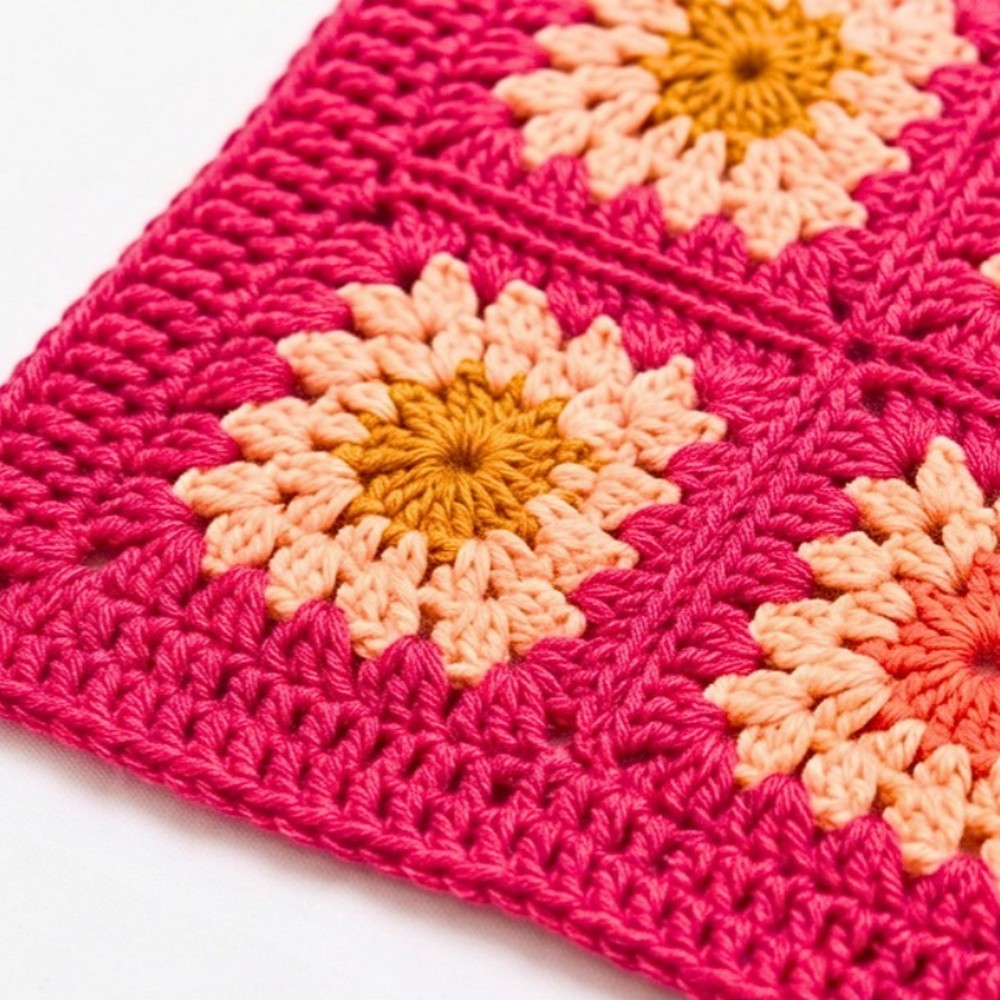
Bring soft floral texture to a baby blanket with these daisy squares, designed so the raised petals become the feature of the finished crochet piece.
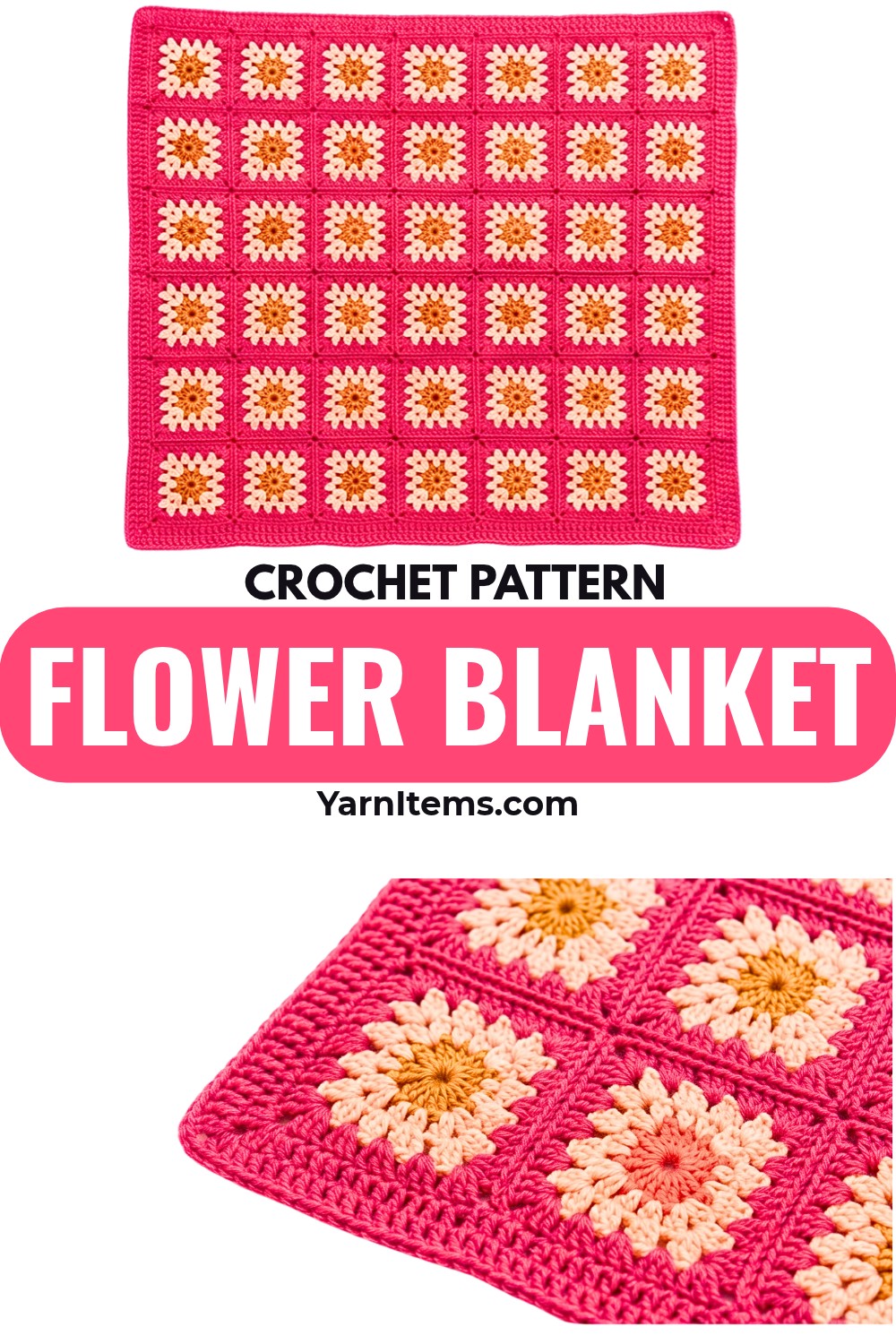
Crochet Daisy Flower Baby Blanket
A daisy crochet granny square can turn a simple baby blanket into something much more charming without requiring complicated stitches throughout. Each square begins with a small center, grows into a four-cornered shape, and then develops raised flower petals that give the blanket its distinctive 3D texture. The finished squares can be repeated in a simple grid for a sweet handmade crochet blanket.
This crochet pattern is especially useful when you want to see exactly how the flower develops from round to round rather than trying to guess where the clusters belong. You’ll find the square sizing and blanket layout first, followed by the materials and terminology, then the complete four-round square, joining method, and final edge finish. The stitch counts and placement details are kept with each stage so you can check your work before moving on.
Credit Diy crochet-crosia
Decide Your Square Size and Blanket Layout
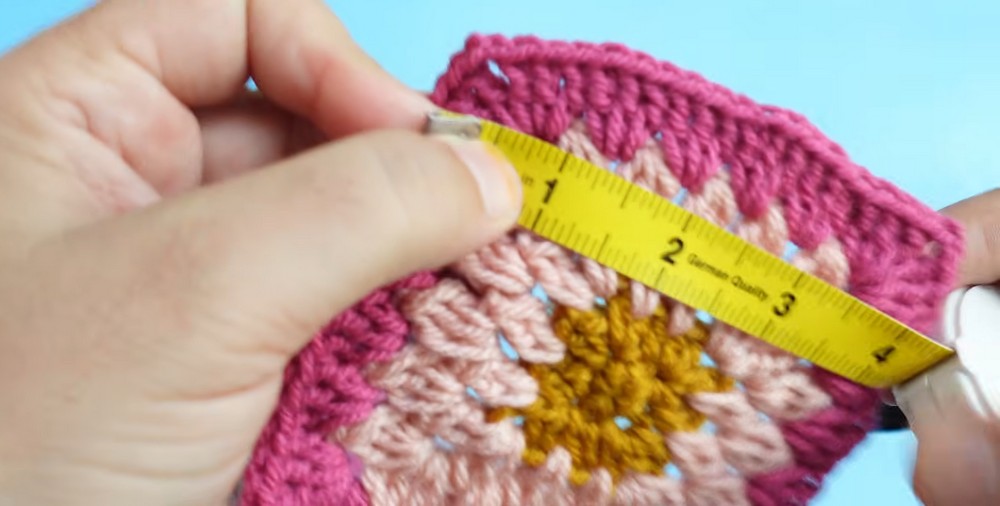
The square size determines how many pieces you may need, so it helps to decide this before making a whole batch. With a 4.0 mm hook, one finished square measures about 4 × 4 inches (11 × 11 cm). Switching to a 5.0 mm hook produces a larger square of about 5 × 5 inches (13 × 13 cm).
The demonstrated blanket uses a 4 × 4 grid, or 16 squares total. At approximately 4 inches per square, the joined grid is about 16 × 16 inches, extending to roughly 17–18 inches (46–47 cm) with the joining and final border. For a larger blanket, you can either make additional squares using the same pattern or use a larger hook such as the 5.0 mm option.
This is worth deciding early because the same four-round square is simply repeated to build the larger baby blanket.
Materials & Tools
- Yarn: Medium weight (4-ply) wool yarn in 3 colors:
- Color A: Center color / Brown
- Color B: Petal color / White
- Color C: Border and joining color
- Crochet hook: 4.0 mm
- Use a 5.0 mm hook for a larger square.
- Scissors
- Yarn needle for weaving in ends
Crochet Terms
This pattern uses standard US crochet terminology.
- ch: chain
- sc: single crochet
- hdc: half double crochet
- dc: double crochet
- sl st: slip stitch
- sp: space
- st / sts: stitch / stitches
- dc-cluster: 3 Double Crochet Cluster. Yarn over, insert the hook into the space, yarn over and pull up a loop, yarn over and pull through 2 loops, leaving 2 loops on the hook. Repeat this process 2 more times in the same space until 4 loops are on the hook, then yarn over and pull through all 4 loops.
Step-by-Step: Crochet the Daisy Granny Square
The square develops in a very deliberate order: first you create the small center, then turn that center into a square, then build the first and second petal rounds around it. The important checks are the four corners, the cluster placement, and the number of clusters along each side. Checking those details as you go makes the joining stage much easier.
Round 1 – Create the Center
Using Color A, make a magic circle, or chain 4 and join with a sl st to form a ring. Ch 1, then make 8 sc directly into the circle. Join with a sl st to the first sc to close the round. Stitch count: 8 sc.
At this point, you should have a small, closed center. Keep the round neat because the next round uses these stitches to establish the four corners.
Round 2 – Turn the Center into a Square
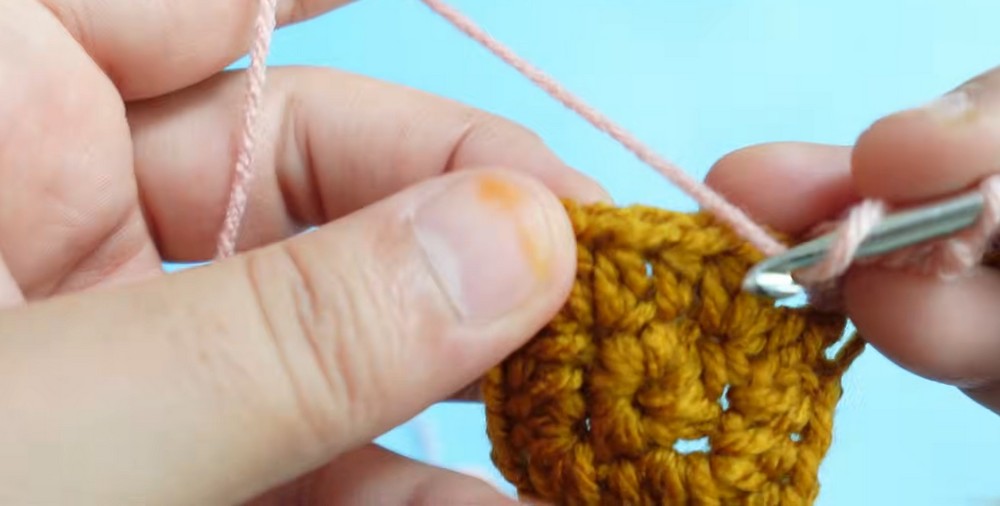
Continue with Color A. Ch 2, which counts as the first hdc, then work 1 hdc in the exact same stitch, ch 2, and 2 hdc in that same stitch to create the first corner. In the next st, make 1 hdc; in the next st, make (2 hdc, ch 2, 2 hdc) for the second corner; make 1 hdc in the next st; make the third corner (2 hdc, ch 2, 2 hdc); make 1 hdc in the next st; make the final corner (2 hdc, ch 2, 2 hdc); make 1 hdc in the last st, then join with a sl st into the 2nd chain of the starting ch-2 and fasten off Color A. Stitch count: 5 hdc per side, with four ch-2 corners.
The key point here is that the corners are created in alternating stitches around the original 8-sc center. Before continuing, check that you can clearly identify four ch-2 corner spaces. Those spaces become the main placement points for the flower rounds.
Round 3 – Build the First Petal Round
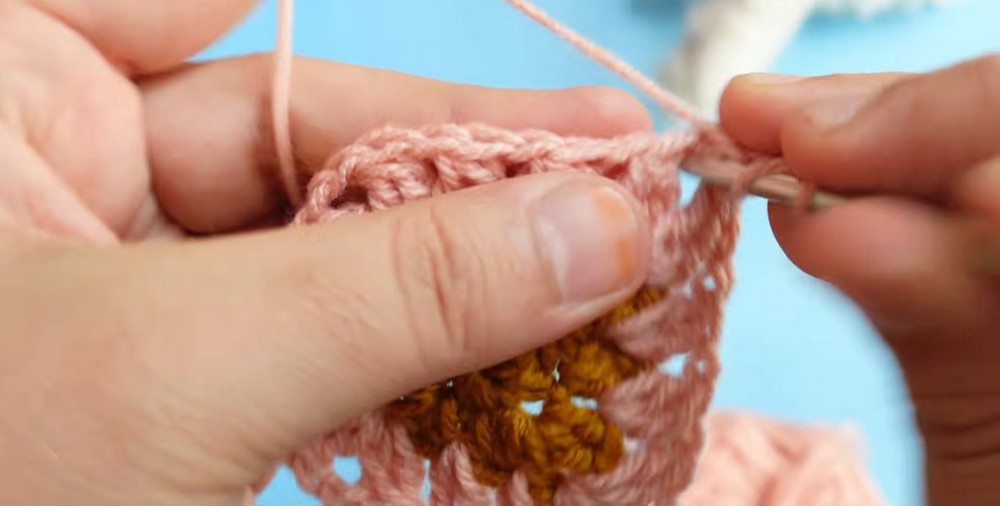
Join Color B into any ch-2 corner space. In that corner, make (dc-cluster, ch 2, dc-cluster). Ch 1, skip the next 2 sts, and make a dc-cluster in the space directly after them; ch 1, skip the next 2 sts, and make another dc-cluster in the next space; ch 1, then in the next ch-2 corner space make (dc-cluster, ch 2, dc-cluster). Continue the same sequence around the square, repeating the two side clusters and corner across every side. Join with a sl st into the top of the first dc-cluster and do not fasten off. Stitch count: 4 clusters per side, with four ch-2 corners.
The important placement detail in this round is the skip-2, cluster-in-the-next-space rhythm. The clusters begin forming the first layer of petals, while the ch-2 spaces keep the corners open enough for the square to continue growing.
Before moving on, look around the square and check that each side follows the same pattern and that each corner contains two clusters separated by ch 2.
Round 4 – Add the Second Petal Layer
Continue with Color B. Sl st into the ch-2 corner space, then make the corner as (dc-cluster, ch 2, dc-cluster). Ch 1 and make a dc-cluster in the first ch-1 space along the side; ch 1 and make a dc-cluster in the second ch-1 space; ch 1 and make a dc-cluster in the third ch-1 space; ch 1, then make the next corner as (dc-cluster, ch 2, dc-cluster). Repeat the sequence of 3 clusters along the side, separated by ch-1 spaces, followed by a corner around the entire square. Join with a sl st to the first dc-cluster and fasten off Color B. Stitch count: 5 clusters per side, with four ch-2 corners.
This round is where the flower texture becomes more noticeable. The three ch-1 spaces created along each side in the previous round now provide the placement points for the additional clusters. Keep the corners consistent as you work around so the square stays balanced rather than pulling unevenly.
When Round 4 is complete, you should be able to see the raised flower effect clearly and still have four defined ch-2 corner spaces ready for the final border.
Round 5 – Add the Solid Granny Border
Join Color C into any ch-2 corner space. In that corner, make 3 dc, ch 2, 3 dc. Moving along the side, you will have four ch-1 spaces; make 3 dc in each of those four spaces, giving 12 dc along the side edge. In the next ch-2 corner space, make (3 dc, ch 2, 3 dc). Repeat the side and corner sequence around the entire square, then join with a sl st into the top of the first dc and fasten off Color C. Stitch count: 18 dc per side, yielding 20 total structural stitches from chain-to-chain on each side.
The purpose of this round is to give the textured flower square a solid outer frame. The four corner spaces remain important because they determine where the square changes direction and later provide the points used while joining the squares.
At the end of the round, check that all four sides have the same stitch structure before making the remaining squares.
Repeat the Square Before Joining
Once one square is complete, use it as your visual reference while making the remaining squares. Keeping the flower, corners, and outer border consistent will make the 4 × 4 grid line up more cleanly during joining.
For the demonstrated layout, make 16 squares total and arrange them into four rows of four.
Joining the Daisy Squares
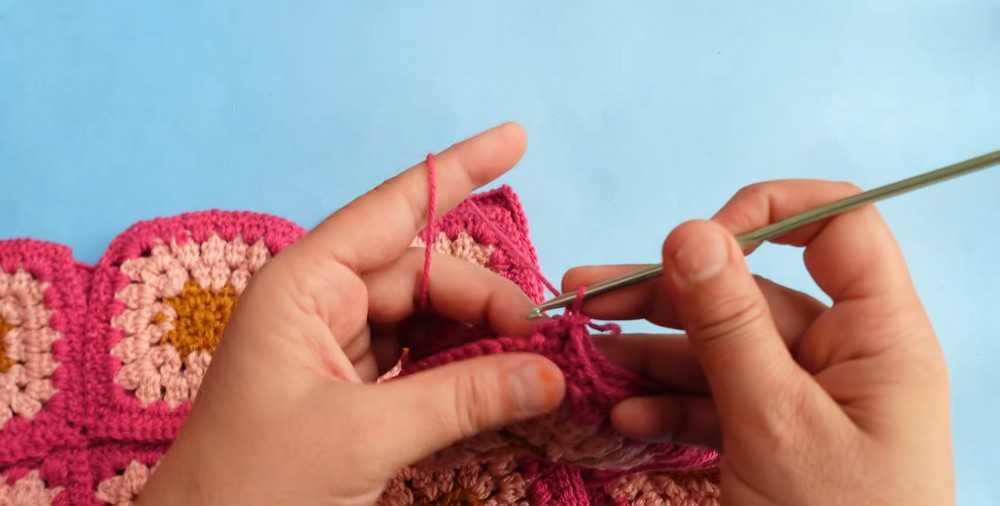
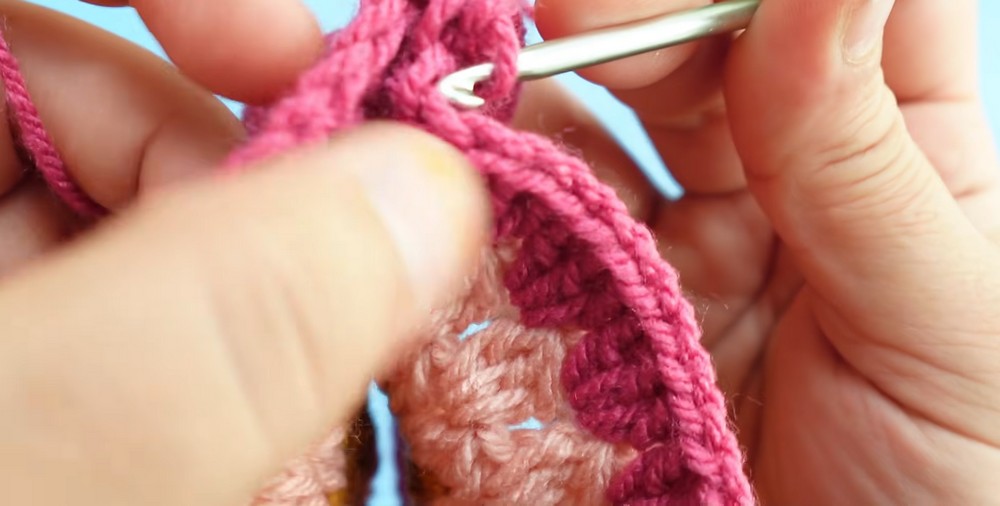
The squares are joined with an invisible slip stitch method designed to create a flat, neat seam. The important part of this method is not working through all four loops of the two stitches. The joining hook uses the two inner loops instead.
Lay two squares with their right sides facing together, leaving their wrong sides facing outward. Make a slip knot with Color C on your hook and ch 1.
For the first joining stitch, skip the two outer loops-the front loop of the square closest to you and the back loop of the back square. Insert the hook only through the two inner loops: the back loop of the front square and the front loop of the back square. Make a sl st to join them.
Continue slip stitching across the 18 double crochets. When you reach the ch-2 corner space, make 1 sl st directly in the middle of the corner. Pick up the next set of two squares, make 1 sl st in their starting corner, and continue straight down the line.
Join all the rows horizontally first. Once those horizontal joins are complete, repeat the same joining process vertically to lock the entire 4 × 4 grid together.
A Useful Joining Check
Before joining a long row, place the squares beside each other and confirm that the flower centers are facing the same direction and the corner spaces line up. The joining method depends on picking up the specified inner loops, so checking the orientation before stitching saves you from having to undo a long seam.
Finish the Blanket Edge
After all the squares have been joined into the blanket, use Color C for the final border. Attach the yarn to any outer corner.
Work 1 sc in every double crochet stitch along the straight edges, giving 18 sc per square edge. At each very outer corner of the blanket, make 2 sc to help the edge lay flat. Fasten off and weave in all loose ends with the yarn needle.
The result is a blanket made from repeated daisy squares, with the raised flower texture preserved across the joined grid and a simple solid edge framing the outside.