Crochet Raglan Cardigan Pattern with Adjustable Fit & Sleeves
Here’s a flexible crochet raglan cardigan with an easy V-opening, adjustable fit, and sleeve options that take it from a light layer to a cozy seasonal favorite.
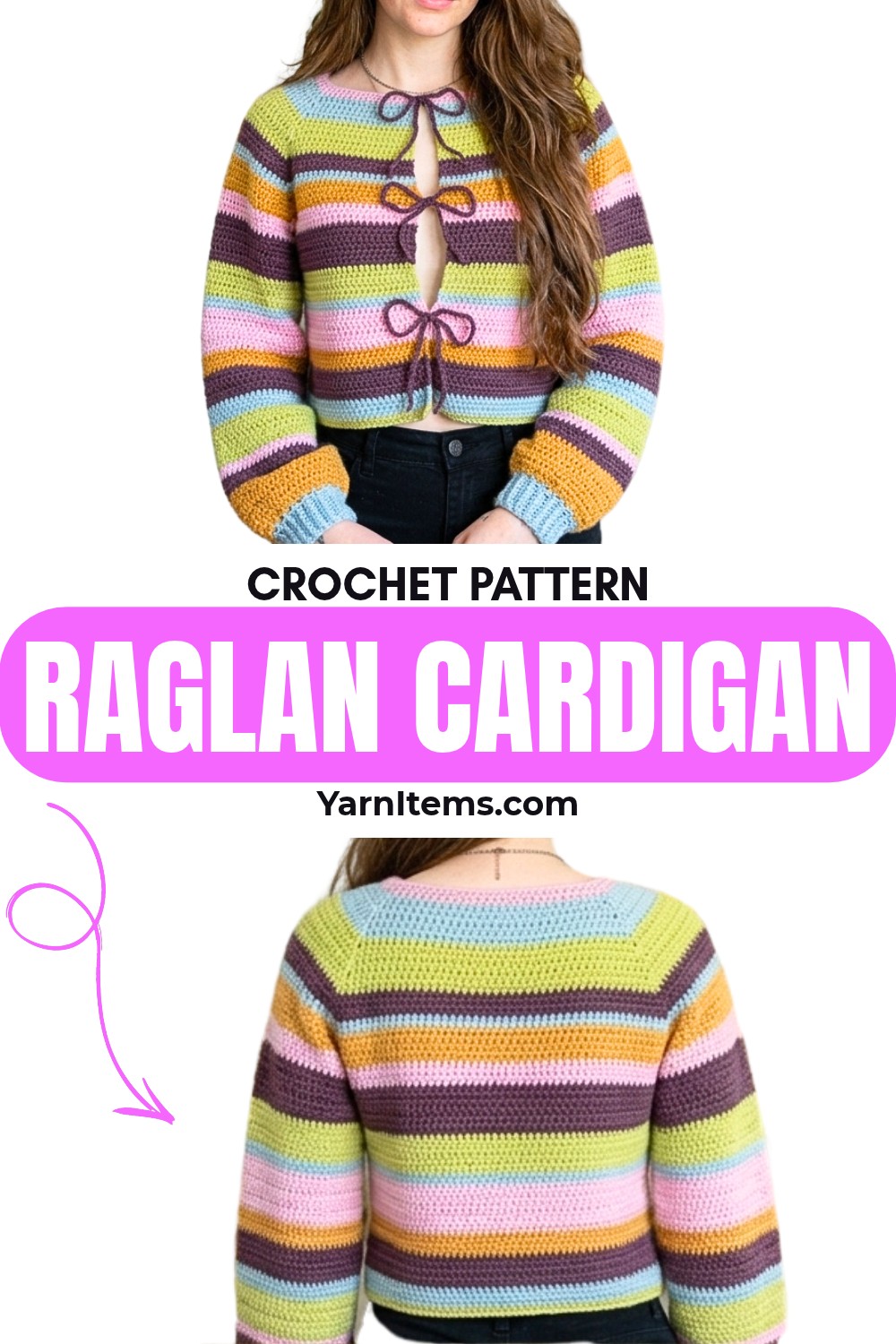
Flowing double-crochet rows give this raglan cardigan a relaxed shape that is easy to adapt as you work. The tutorial demonstrates a women’s Medium using worsted-weight yarn and a 5.0 mm hook, with the starting chain setting the neckline width and the finished body able to be cropped, waist length, or long and flowing. Color changes can create stripes, while a single shade gives the crochet cardigan a simple, clean look.
Everything is worked from the top down, so you can check the fit while the yoke is growing instead of waiting until the crochet cardigan is finished.
Four marked raglan corners guide the increases, then the shoulder sections are separated with underarm chains before the body continues straight down. From there, you can choose short sleeves or continue with turned sleeve rounds for a longer version, with optional front bows and edging added at the end.
Credit Hannah Drapinski
Materials & Tools Needed
- Yarn: Worsted-weight yarn, Size 4. The tutorial features both a striped version using vintage Berroco yarn and a solid short-sleeve version using Darn Good Yarn worsted merino wool.
- Crochet Hook: 5.0 mm
- Stitch Markers: 4 markers for the raglan corners
- Measuring tape
- Tapestry needle
- Scissors
- Optional: Ribbon yarn for the front bows

Finished Size & Customization Ideas
The tutorial demonstrates a women’s Size Medium, but several points in the pattern can be adjusted for a more personal fit.
Neckline
The starting chain controls the neckline width. For the demonstrated Medium, begin with 120 chains.
Before crocheting the first row, lay the chain flat and fold the ends inward toward the middle to create the front opening. The chain should sit loosely around your neck with a small gap at the front.
Bust & Arm Width
The number of chains added at each underarm directly affects the finished bust and bicep width. The tutorial uses 11 chains for each underarm split, but this can be increased or decreased when more or less room is needed.
Body Length
Continue the lower-body rows until the cardigan reaches the desired length. This allows the same basic pattern to become cropped, waist length, or long and flowing.
Sleeve Options
Leave the armholes without extended sleeves for a short-sleeve summer cardigan, or continue the sleeve rounds to create a longer fall or winter version.
Starting Chain & Setting the Yoke Markers
The cardigan starts with one long foundation chain. Before adding any double crochet, the chain is folded and measured to establish the four raglan sections.
Make the Neckline Chain
The Neckline Chain: Leave a medium-length yarn tail, make a slip knot, and ch 120 for the demonstrated Size Medium.
Fold & Measure
Folding and Measuring: Lay the long chain flat on a table; fold the two ends inward toward the middle so they meet and form the front opening; make sure the chain is not twisted; the folded piece should measure approximately 9 inches wide.
Checking for a twist here matters because the foundation chain determines the orientation of the entire cardigan. A twisted chain can make the yoke sit incorrectly once the increases begin.

Place the Four Markers
Placing Markers: Measure 1.5 inches inward from the left folded edge on both the top and bottom chain layers and place a stitch marker in each; measure 1.5 inches inward from the right folded edge on both layers and place the remaining two markers; these four markers divide the back, arms, and front panels; count the stitches between the markers to make sure the left and right sides match identically.
Crochet the Yoke
The body uses double crochet throughout the yoke. For these body rows, remember that the beginning ch 2 does not count as a stitch.
The stitch markers identify the four increase points. Each increase creates 1 dc, ch 1, 1 dc in the same space, and the new ch-1 space becomes the marker point for the following row.
Row 1: Reinsert your hook into the working loop; ch 2; work 1 dc into the 3rd chain from the hook; work 1 dc in each chain until reaching the first stitch marker.
First Increase: Remove the first marker; in the marked stitch, work an Inc (1 dc, ch 1, 1 dc); place the stitch marker back into the new ch-1 space.
Keeping the marker in the new ch-1 space is important because that space becomes the increase point for the next row.
Continuing Row 1: Work 1 dc in each stitch until reaching the next marker; work an Inc (1 dc, ch 1, 1 dc) in the marked stitch; repeat the same increase at the third and fourth markers; work 1 dc in each remaining stitch to the end of the chain.
Row 2: Ch 2, turn; because the ch 2 does not count as a stitch, place the first dc into the very first stitch; work 1 dc in each stitch until reaching the first ch-1 space.
Row 2 Increases: Work an Inc (1 dc, ch 1, 1 dc) directly into the ch-1 space; continue around by working 1 dc in each stitch and an Inc in every ch-1 space; finish with 1 dc in the last stitch and do not crochet into the turning chain.
Rows 3 to 14: Repeat Row 2; work ch 2 at the beginning of each row, place 1 dc in every regular stitch, and work an Inc in every ch-1 space; change yarn colors as desired by cutting the old yarn and attaching the new color at the start of a row; the tutorial originally stopped after 13 rows for a fitting check and added one additional row for a total of 14 rows before splitting the armholes.
Yoke Fit Check
Try the yoke on before moving to the armhole split.
The neckline should sit comfortably without pulling, while the developing fabric should extend naturally toward the shoulders and upper body. If the neckline feels too tight or too loose, this is the stage where the starting-chain measurement and yoke proportions are easiest to reconsider.
For the demonstrated cardigan, the extra 14th row was added after trying on the first 13 rows. This is a useful reminder that row count does not have to be treated as untouchable when the pattern is being fitted to an individual body.
Split the Armholes
Once the yoke reaches the desired fit, the shoulder sections are skipped and connected with chains to create the underarm openings.
Armhole Split
Row 15: Ch 2, turn; work 1 dc in each stitch until reaching the first ch-1 space.
First Underarm: Work 1 dc into the ch-1 space; ch 11 to create the underarm gap, adjusting the number of chains if a wider or narrower armhole is needed.
Joining the Front to Back: Skip all stitches belonging to the shoulder/sleeve section; locate the second ch-1 space, yarn over, and work 1 dc directly into that second ch-1 space to form the first armhole.
The Back Panel: Work 1 dc in each stitch across the back panel until reaching the third ch-1 space.
Second Underarm: Work 1 dc into the third ch-1 space; ch 11; skip the shoulder stitches; work 1 dc into the fourth ch-1 space; work 1 dc in each remaining stitch to the end of the row.
At this point, the cardigan should clearly have two armhole openings with the front and back joined into one continuous lower body.
Crochet the Lower Body
Once the armholes are divided, the cardigan becomes much more straightforward because the increases stop and the lower body is worked in rows of double crochet.
Row 16: Ch 2, turn; work 1 dc in each stitch until reaching the 11 underarm chains.
Work Across the Underarm Chains
Working the Chains: Work 1 dc directly into each of the 11 individual underarm chains; work 1 dc in each stitch across the back panel; work 1 dc into each of the 11 chains at the second underarm; work 1 dc in each remaining stitch to the end.
Working into every underarm chain helps fill the opening cleanly rather than leaving gaps between the body and sleeve areas.
Row 17 and beyond: Ch 2, turn; work 1 dc in the first stitch and in every stitch across; repeat this row until the cardigan reaches the desired length; fasten off.
Continue checking the length as you go. Cropped, waist-length, and long versions all come from the same straight-row sequence, so there is no need to redesign the lower body for each option.
Crochet the Sleeves
For the sleeves, the beginning ch 2 does count as a double crochet, unlike the body rows.
Turn after every sleeve round to preserve the intended texture and keep the sleeve seam running neatly down the arm.

Set Up the Sleeve
Round 1: Flip the work so the sleeve begins at the back of the armpit to hide the seam; join yarn to a stitch at the bottom center of the underarm opening; ch 2; work 1 dc in the next stitch and continue around the armhole opening.
Closing the Horizontal Gaps: When reaching the side of the armhole where a dc post from Row 15 lies completely horizontally, work exactly 2 dc into the side of that horizontal post; continue by working 1 dc into the unworked loops of the underarm chains; when reaching the horizontal dc post on the opposite side, work 2 dc into the side of it as well; sl st into the top of the starting ch 2 to join.
Those two extra dc worked into each horizontal post help prevent visible holes at the points where the armhole was divided.
Round 2: Ch 2, turn; because the ch 2 counts as a stitch, skip the base stitch and place the first dc into the next stitch; work 1 dc in each stitch around; sl st into the top of the ch 2 to join.
Continuing the Sleeve
Continuing the Sleeve: Repeat Round 2, making sure to ch 2 and turn at the beginning of every round, until the sleeve reaches the desired length; fasten off.
Repeat the complete sleeve process for the second armhole.
Short-Sleeve Option
For a lighter warm-weather cardigan, simply leave the armholes without continuing the longer sleeve rounds.
For a cooler-season version, continue the sleeve rounds until the desired arm length is reached.
Add Front Ties
The cardigan can be finished with optional front bows. These can be crocheted from matching yarn or made with ribbon yarn.
Crochet Front Ties
Crochet Version: Make a slip knot and ch 120; fasten off, pull the tail tight to secure, and cut the ends close; tuck the chain behind the first dc post on the cardigan’s inner edge; repeat on the opposite side and tie the chains into a bow; space 3 pairs approximately 6 inches apart down the front panels.
Ribbon Front Ties
Ribbon Version: Cut equal lengths of thick ribbon yarn; thread them onto a tapestry needle; pass them behind the first dc posts along the inner edge of the cardigan; tie them into large bows and space the pairs approximately 6 inches apart.
Before attaching all the ties, place the cardigan flat and check their spacing. Even placement makes the front opening look balanced when the bows are tied.
Optional Front & Neckline Border
If the inner front edges or neckline feel unfinished, a simple single crochet border can give them a cleaner appearance.
Optional Border: Attach yarn at the bottom corner and work one row of single crochet evenly up the front panel, around the neckline, and down the opposite side; keep the spacing even so the edge remains flat instead of ruffling.

Finishing the Cardigan
Weave in the Ends
Because the cardigan is worked top down without separate panels that need to be sewn together, finishing mainly involves securing the remaining yarn tails.
Use a tapestry needle to weave all loose ends securely on the inside of the cardigan.
Block the Finished Cardigan
After weaving in the ends, block the finished cardigan according to the yarn’s needs. Lay it flat and gently shape the neckline, front edges, body, and sleeves so they settle into their intended proportions.
Final Fit Check
Before wearing the cardigan, check the neckline, bust area, underarms, body length, and sleeve length. Make sure the front opening falls comfortably and that the sleeve seams remain straight.
This top-down design makes the cardigan especially flexible: a striped version can emphasize the growing yoke and flowing body, while a solid version keeps attention on the relaxed raglan shape and optional bows.