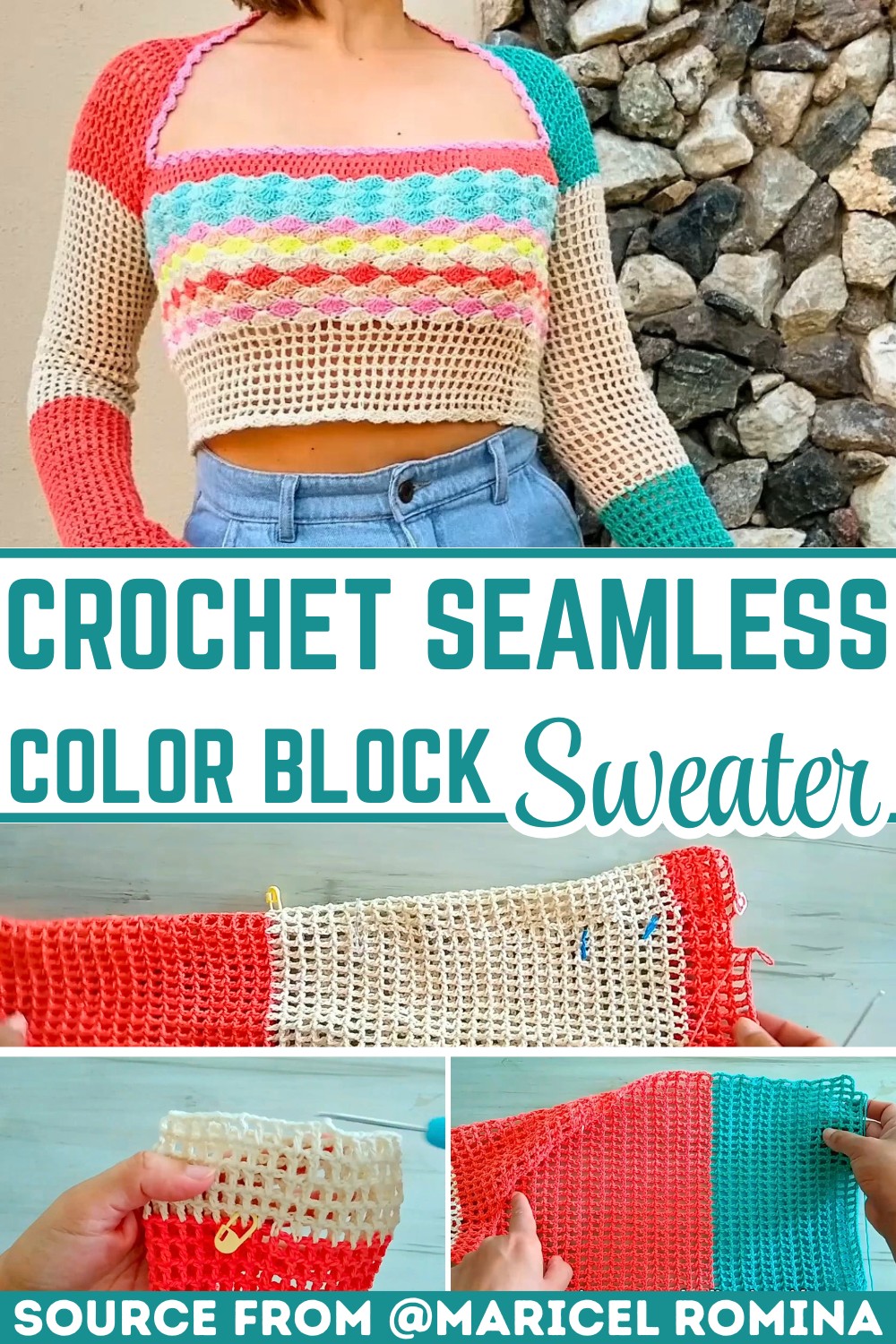
Seamless Crochet Color Block Sweater Pattern Free
A seamless color block design brings together comfort, clean construction, and eye-catching style in one handmade piece. This crochet sweater is worked as a single piece, eliminating bulky seams while creating a smooth, comfortable fit from sleeve to sleeve.
Bold color sections give the design a modern look, and the flexible construction makes it easy to customize the length and overall appearance. It’s an excellent choice for crocheters who enjoy practical garments with a creative touch.
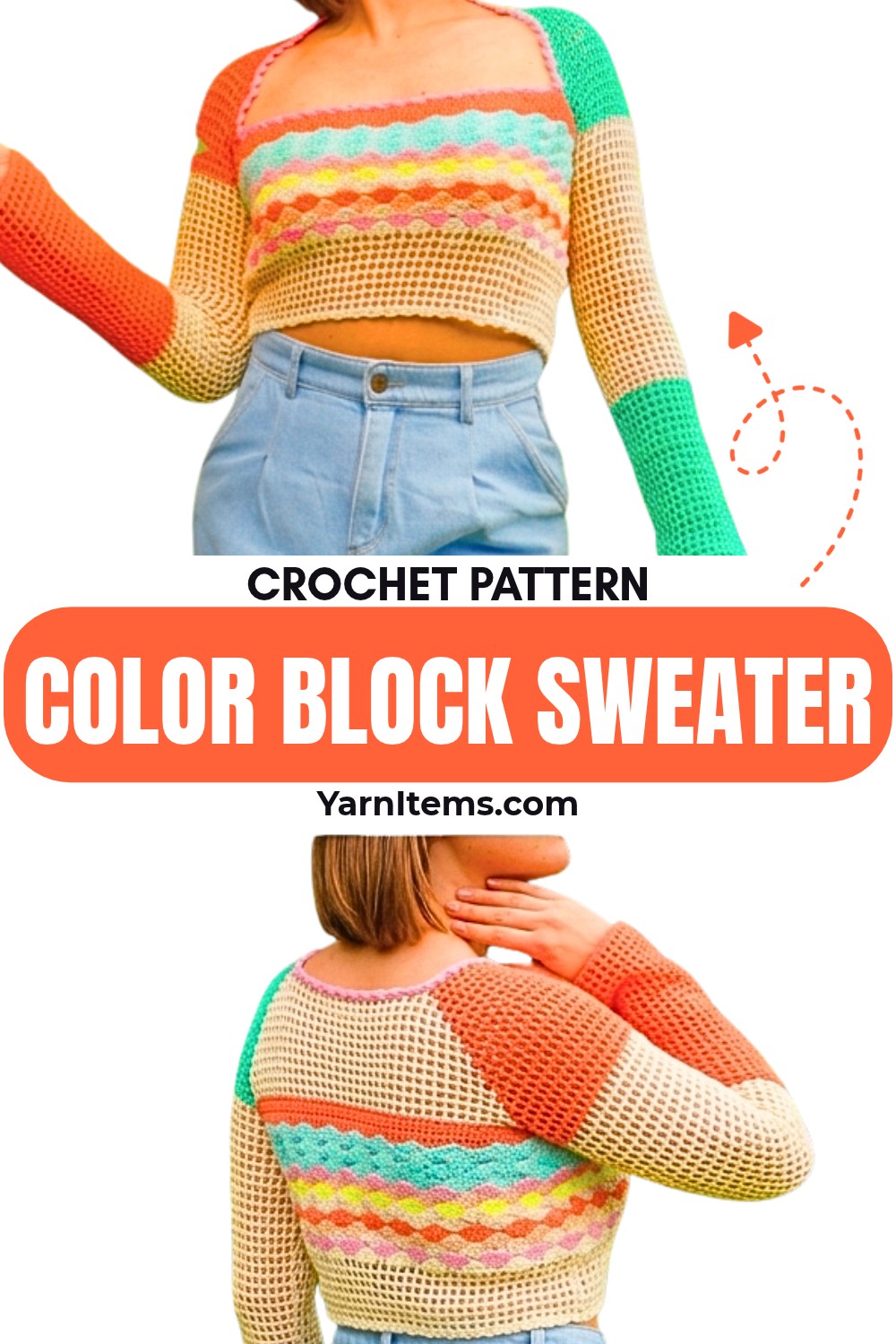
Thoughtful shaping and simple stitch combinations make this crochet sweater both enjoyable to create and easy to personalize. The guide below includes the materials, gauge, stitch abbreviations, detailed construction steps, finishing instructions, and customization ideas needed to complete the design with confidence.
Whether you’re using carefully selected shades or leftover yarn for colorful blocks, every version can have its own unique character. The finished piece offers everyday comfort while showcasing the beauty of seamless crochet construction.
Credit Maricel Romina
Yarn Choice Tips
Best Yarn Fibers for the Pattern
- Cotton:
- Great for lightweight, breathable projects like summer tops, dishcloths, and market bags.
- Holds its shape well but lacks elasticity.
- Acrylic:
- Budget-friendly and versatile, ideal for beginner patterns, blankets, and kids’ items.
- Durable and easy to care for but may lack breathability.
- Wool:
- Perfect for warmth and elasticity, making it ideal for cozy sweaters, scarves, and hats.
- Some types like Merino wool are less scratchy and more suitable for sensitive skin.
- Blends:
- Combine the best properties of multiple fibers. For example:
- Cotton/acrylic blends are lightweight and stretchy.
- Wool/silk blends add warmth and a luxurious drape.
- Combine the best properties of multiple fibers. For example:
Recommended Yarn Weight
- Lightweight yarns (fingering/sport): Best for delicate, intricate designs or lighter garments.
- Medium weights (DK/worsted): Ideal for most patterns, offering a balance of durability, drape, and ease of use.
- Bulky or super-bulky yarns: Great for quick patterns like chunky scarves or blankets, but might sacrifice precision in stitch definition.
Materials & Tools Needed
- Yarn: Fine to semi-thick (DK or Sport weight) in 3–4 contrasting colors. Perfect for using scrap yarn!
- Crochet Hook: 3.5 mm – 4.5 mm (appropriate size for yarn chosen).
- Notions:
- 4–6 stitch markers
- Yarn/tapestry needle
- Scissors
- Measuring tape
Gauge
- Mesh Window Grid:
$1\text{ dc} + 1\text{ ch}$ space = 1 window box. - Starting Chain Reference:
61 chains yield 30 window grid spaces in the round.
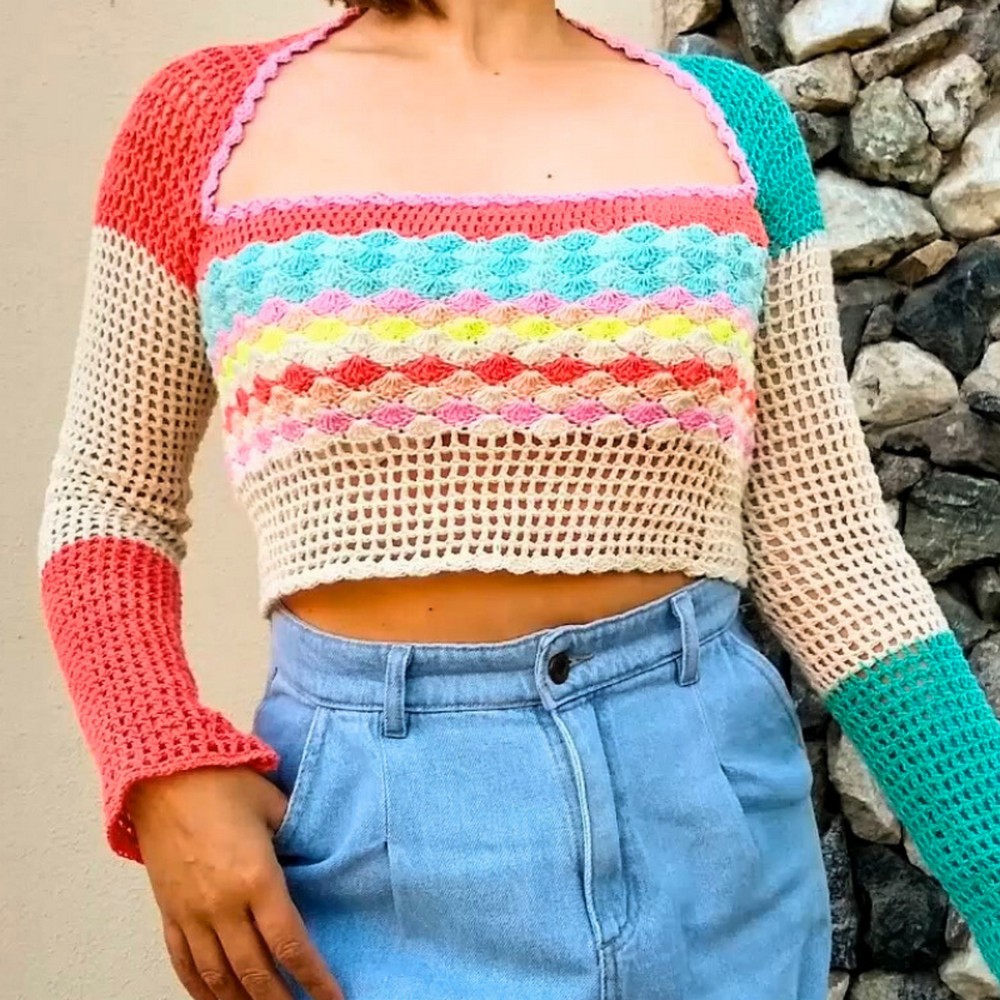
Finished Size & Customization Ideas for Your Sweater
Reference Size
- Women’s Medium/Large (M/L): The suggested size for this pattern.
Size Adjustments
- Size Small (S):
- Start with 55 chains (approximately 27 window spaces).
- Adjusting Length:
- Cropped Sweater: Reduce the number of torso rounds.
- Full-Length Sweater: Add extra torso rounds as needed to achieve your desired length.
Color Customization
- Color Blocking:
- Switch out yarn colors for distinct sections of the sweater (e.g., waistband, torso, sleeves).
- Plan a vibrant or minimalist contrast for a bold or understated look.
- Scrap Yarn Design:
- Use leftover yarn scraps for a multi-colored, textured appearance by blending them between sections.
- Create a gradient effect by introducing colors gradually.
Pattern Abbreviations & Terminology (US Terms)
- ch: chain
- sl st: slip stitch
- sc: single crochet
- dc: double crochet
- st(s): stitch(es)
- sp: space
- inc: increase ($2\text{ dc}$ in the same mesh space, separated by $\text{ch } 1$)
- dec: decrease (shaping row edge)
Step-by-Step Crochet Instructions
Phase 1: Right Sleeve (Sleeve A)
- Foundation Chain & Cuff:
- Ch 61 (M/L) or Ch 55 (S). Form a ring with sl st.
- Round 1: $1\text{ sc}$ per chain, sl st to join $[60 \text{ sc}]$.
- First Mesh Round:
- Ch 4, skip 1 st. $1\text{ dc}, \text{ch }1$; repeat. Sl st to join $[30 \text{ windows}]$.
- Straight Sleeve Rounds:
- Work 22 mesh rounds in Color A.
- Sleeve Increase Section:
- Switch to Color B. Every 6 rounds, add 1 mesh window via $[1\text{ dc}, \text{ch }1, 1\text{ dc}]$ into the same space. Continue until Round 49.
Phase 2: Underarm & Right Shoulder Shaping
- Underarm Transition:
- Work 3 rounds in Color C with no increases.
- Shoulder Decrease Rows (Worked Flat):
- Work 10 rows with $1\text{ dc}$ decrease at the shoulder edge.
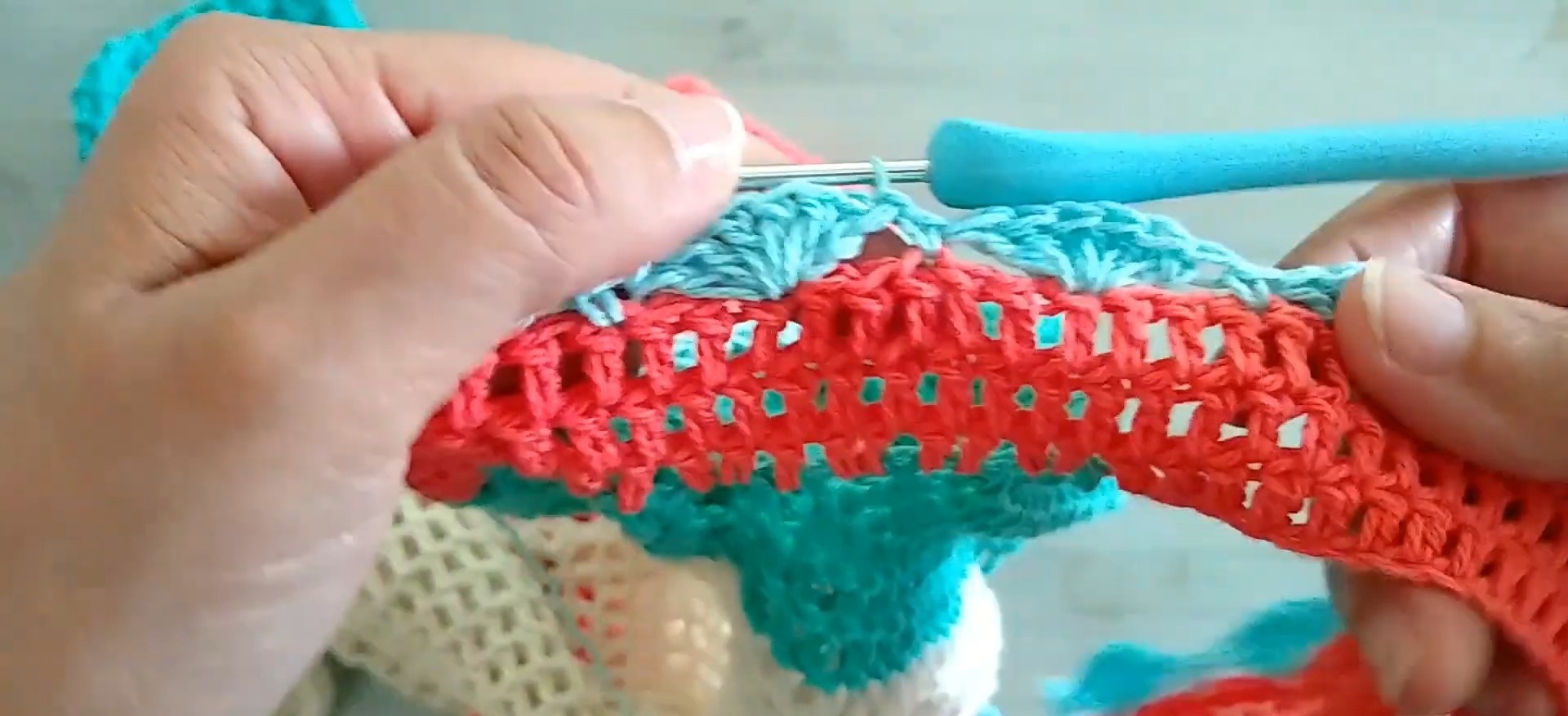
Phase 3: Back & Upper Torso Panel
- First Back Extension:
- Straight mesh rows in Color C for 12 rows.
- Second Back Extension:
- Switch to Color D. Work 15 rows based on shoulder width.
Phase 4: Left Shoulder Shaping & Rejoining
- Shoulder Increase Rows:
- Mirror the decrease rows with increases for armhole reshaping.
- Armhole Closure:
- Work sl sts to close the armhole loop. Verify same window count ($30 \text{ windows}$).
Phase 5: Left Sleeve (Sleeve B)
- Underarm Transition:
- Work 3 rounds straight.
- Sleeve Taper Decreases:
- Mirror sleeve increments from Sleeve A every 5–6 rounds.
- Cuff:
- $1\text{ sc}$ around wrist window spaces to finish.
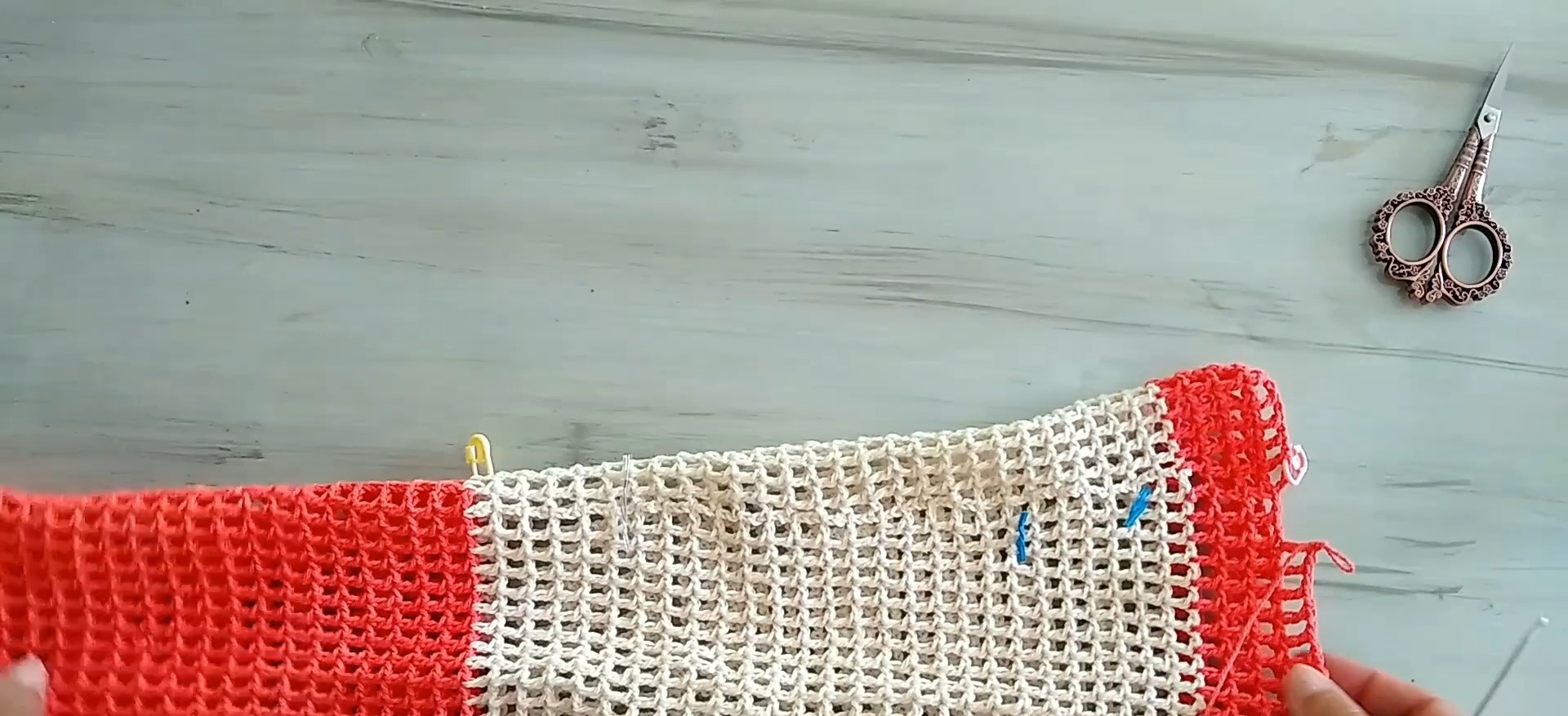
Phase 6: Torso & Lower Body Extension
- Neckline / Chest Foundation:
- Ch 55–60 across the chest gap.
- Torso Base Round:
- Work $1\text{ dc}$ across chains and side bars. Total st count must be a multiple of 7 for fan/shell texture.
- Lower Body Pattern:
- Option A (Fan Stitch): Work $6\text{ dc}$ in same st, skip sts, $1\text{ sc}$; repeat.
- Option B (Mesh Windows): Standard mesh $1\text{ dc}, \text{ch }1$ for a lighter finish.
- Decorative Hem Edging:
- Work $[ \text{ch } 3, 3\text{ dc} ]$ in one space, $1\text{ sc}$ in next gap.
Finishing
- Cut yarn.
- Weave in all loose tails using a tapestry needle.
Customization Ideas:
- Length adjustments: Add or reduce torso rounds for desired crop/full fit.
- Color blocking: Experiment with scrap yarn for an ombré or multicolor sweater.
Fit & Style Guide
- Fit Type: Oversized (cozy), Relaxed (casual), Classic (timeless), Fitted (polished).
- Drape: Oversized flows loosely, relaxed skims the body, classic is clean and structured, fitted hugs curves.
- Pairing: Wear with jeans, skirts, or leggings for versatile looks.
- Layering: Add turtlenecks, button-downs, or jackets for extra depth and style.
- Suitable For: Any age or body type; oversized and relaxed are universally flattering, while fitted styles enhance contours.
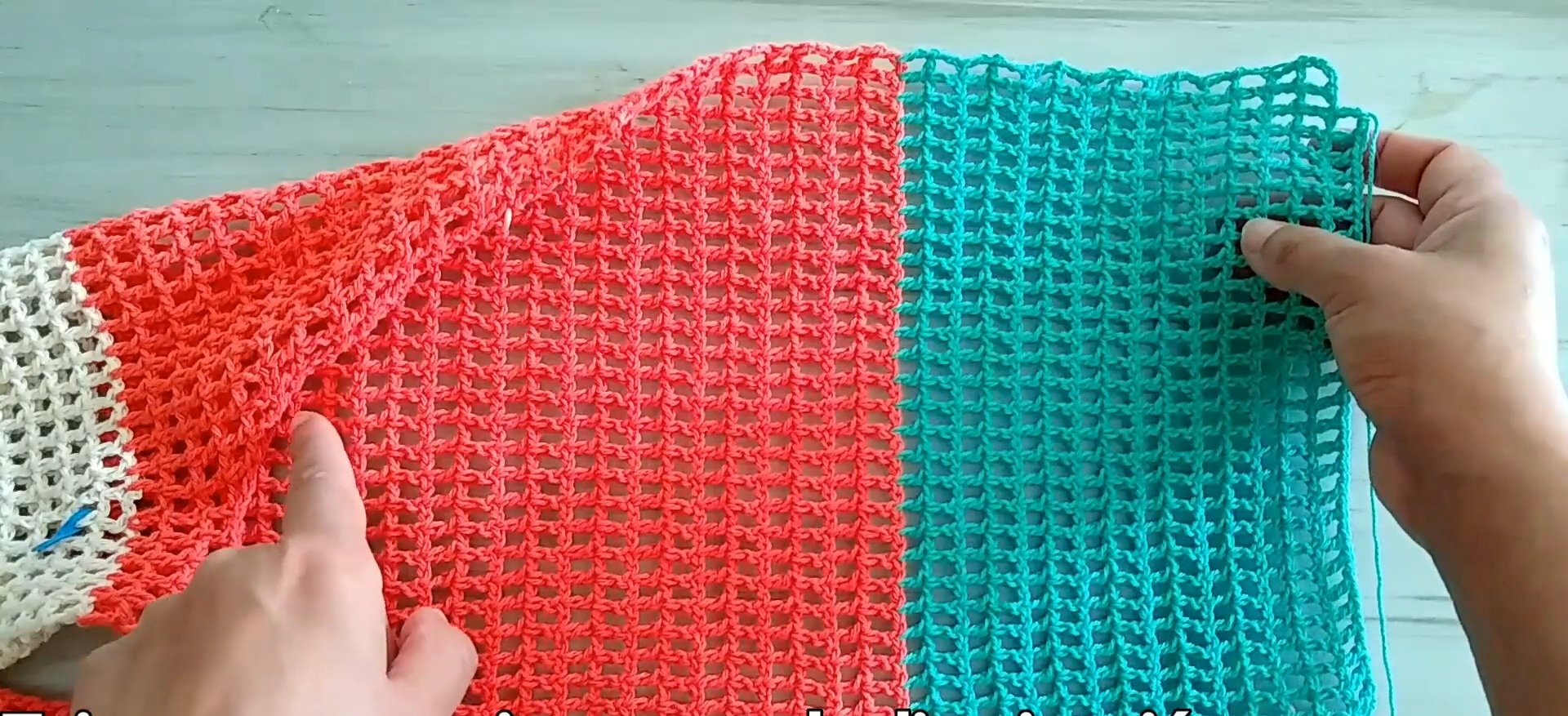
Professional Finishing Tips
- Weave in ends neatly – Use a tapestry needle to secure ends on the wrong side of the fabric.
- Block the sweater – Soak, shape, and dry flat to smooth stitches and refine dimensions.
- Align seams – Pin pieces carefully and use mattress stitch for invisible joins.
- Check sleeve symmetry – Ensure sleeves match in length, width, and alignment.
- Shape ribbing – Stretch ribbing during blocking for even cuffs, hems, and necklines.
- Trim loose tails – Snip visible yarn ends only after blocking for a tidy finish.