Crochet Flower Bouquet Blanket Pattern with Roses and Leaves
Add a garden-inspired edge to a round crochet blanket by pairing simple chain spaces with handmade leaves and dimensional roses.
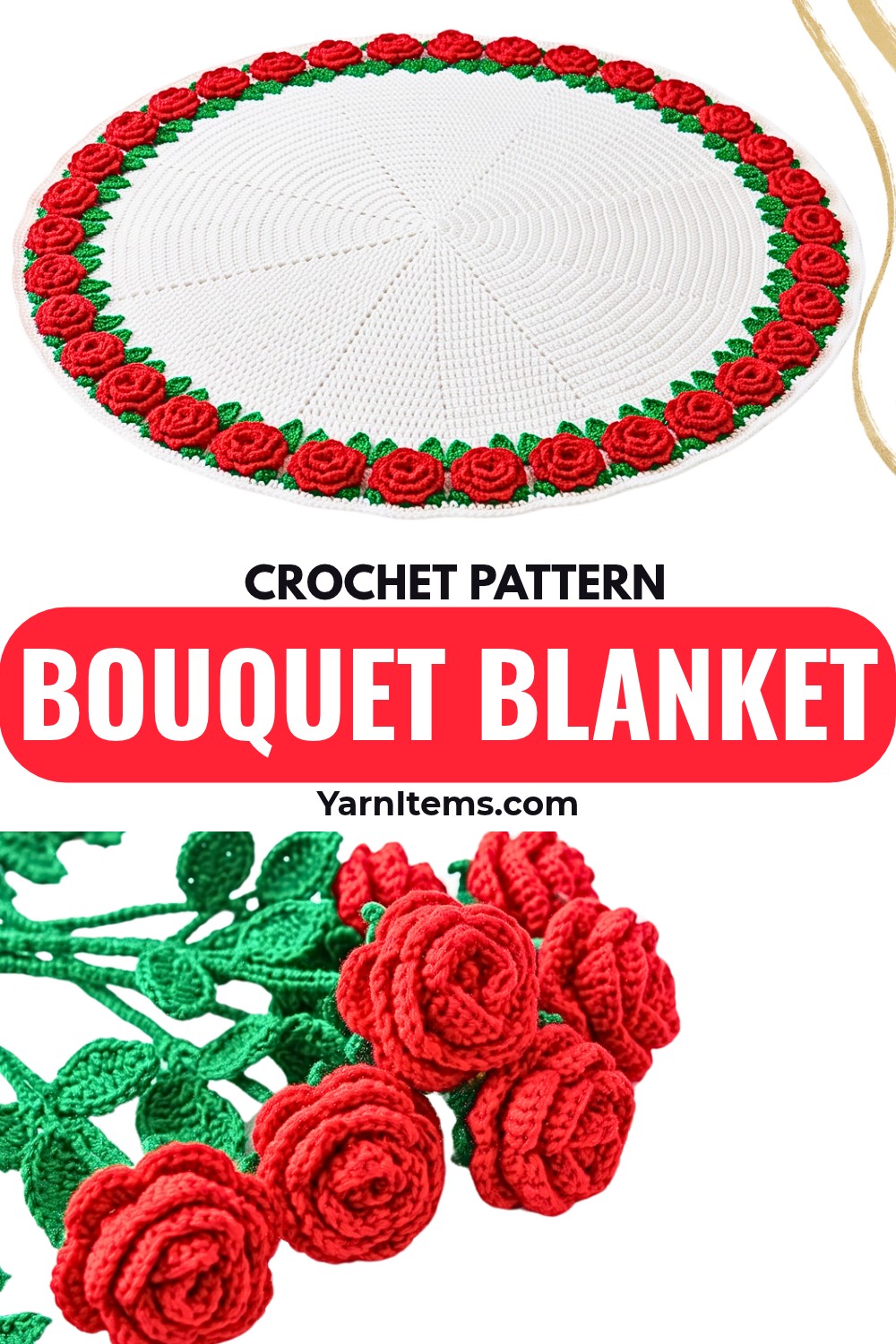
Bring a garden-like touch to your crochet with a blanket that begins as a small circle and gradually expands through a repeating increase pattern. The changing number of double crochets in each section gives the blanket its distinctive growing shape, while the green border and raised roses add the floral detail around the outside.
This tutorial takes you through the blanket body first, including the repeat that lets you stop at 25 rounds or continue for a different size. You’ll then add the green border, shape individual leaves directly into its chain spaces, crochet the rose pieces, and roll and sew them into flowers so the finished edge has a dimensional bouquet effect.
Plan the Blanket Size Before Adding the Flowers
The blanket body is the part that determines how large the finished piece will be. In the original tutorial, the main body reaches 25 rounds before the border is started.
You can stop at Round 25 for a similar size, continue the same growth pattern for a larger blanket, or work fewer rounds for a smaller baby blanket or lovey. Since the leaves and roses are added afterward, make your size decision before switching to the green yarn.
Materials & Tools Needed
- 5 mm Crochet Hook
- Yarn
- Main color – blanket body
- Green – border and leaves
- Desired flower color – roses
- Tapestry Needle – for sewing the roses and weaving in ends
- Scissors
Pattern Abbreviations & Terminology
- ch: Chain
- sl st: Slip Stitch
- sc: Single Crochet
- hdc: Half Double Crochet
- dc: Double Crochet
- tr: Treble Crochet / Triple Crochet
- inc: Increase — 2 stitches worked into the same stitch
- st(s): Stitch(es)
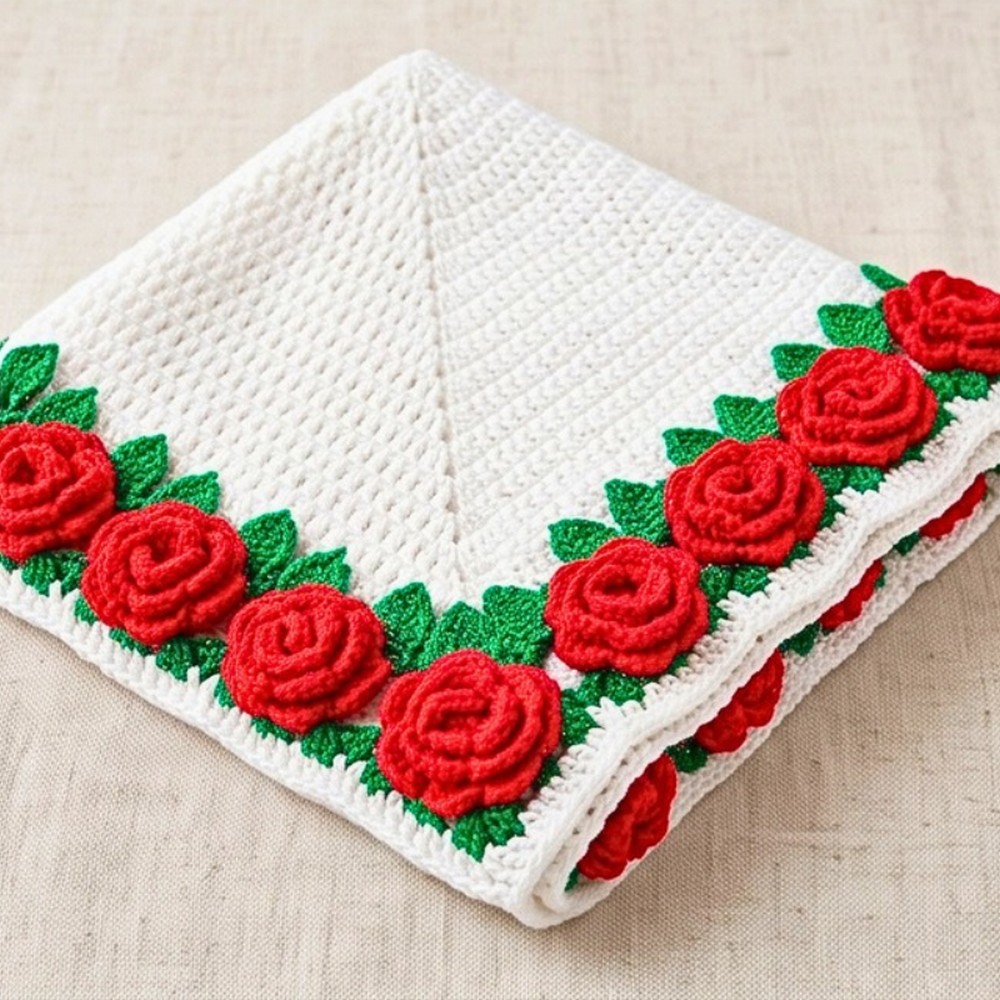
Grow the Blanket From the Center
Begin with the main-color yarn and build the blanket outward one round at a time. The key point to watch is the position of the increase: each new round adds one more regular dc before the increase in each repeating section.
That gradual change is what keeps the blanket expanding while developing its characteristic shape. Once you understand that rhythm in Rounds 3–5, the later rounds simply continue the same idea.
Round 1: Create a magic ring, ch 2, work 12 dc into the magic ring, pull the string behind it to close the ring, then sl st into the very first dc—not into the ch 2—to end the round. (12 sts)
Round 2: ch 2, work 2 dc (inc) into the same st right below the ch 2, ch 1, then repeat (2 dc into the next st, ch 1) all the way around; sl st into the first dc to close.
Round 3: ch 2, work 1 dc into the first st right below the ch 2, work an inc (2 dc) into the next st, ch 1, then repeat (1 dc into the next st, inc into the next st, ch 1) around; sl st into the first dc.
Round 4: ch 2, work 1 dc into each of the next 2 sts, work an inc (2 dc) into the next st, ch 1, then repeat (1 dc into the next 2 sts, inc into the next st, ch 1) around; sl st into the first dc.
Round 5: ch 2, work 1 dc into each of the next 3 sts, work an inc (2 dc) into the next st, ch 1, then repeat (1 dc into the next 3 sts, inc into the next st, ch 1) around; sl st into the first dc.
Rounds 6–25 or until your desired size: Continue the same growth pattern: ch 2, add one additional dc per section before the increase, work an inc into the very last stitch of that section, ch 1, and repeat the sequence all the way around; always sl st into the first dc to end the round.
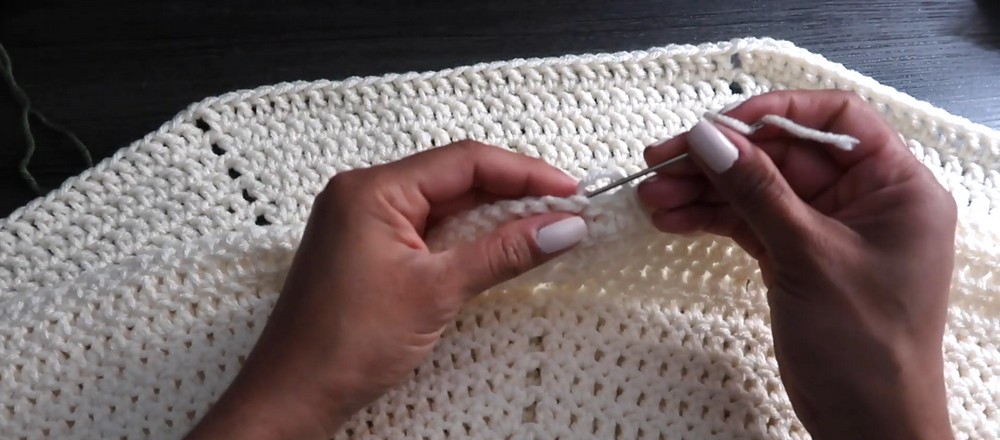
Teaching Check: Follow the Increase Rhythm
If you are unsure what should change from one round to the next, look only at the number of regular dc stitches before each increase.
Round 3 has 1 dc before the increase, Round 4 has 2, and Round 5 has 3. The next rounds continue that same progression. Keeping this rhythm consistent is more useful than trying to memorize every later round separately.
Also pay attention to the joining point. The tutorial specifically joins into the first dc rather than the starting ch 2, so checking that placement each round helps keep the circular sequence consistent.
When the blanket reaches your desired size, sl st to close the final round, fasten off, and cut the main-color yarn.
Create the Green Border
Once the main body is complete, change to green yarn for the border. The first two rounds establish the spaces and stitches that will support the leaves, so keep the chain spaces easy to identify as you work around.
Border – Round 1: Attach the green yarn, ch 1, sc into the same st, then repeat (ch 2, skip 2 sts, sc into the next st) all the way around the blanket.
Border – Round 2: Work sc into every stitch around, and whenever you reach a 2-chain space, work 2 sc directly into that space.
Shape the Leaves Inside the Border Spaces
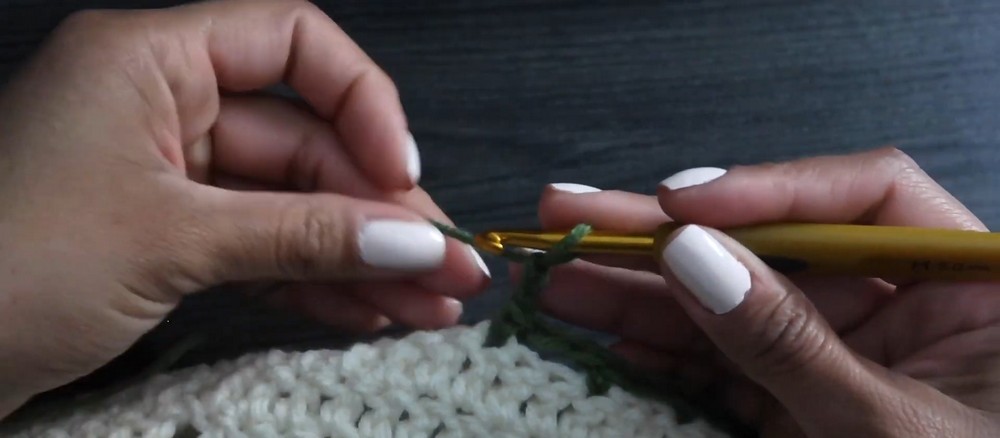
The leaves are worked directly into the ch-2 spaces created in the first green border round. Each one is made from a short chain and a few different stitches worked back along that chain.
This is one place where stitch placement matters more than speed: after making the leaf, the final sl st and sc bring you back to the same border space, so the leaf stays attached to the edge rather than becoming a loose piece.
Leaf – Step 1: Attach green yarn to a ch-2 space.
Leaf – Step 2: ch 5.
Leaf – Step 3: sl st into the 2nd ch from your hook.
Leaf – Step 4: sc into the 3rd ch.
Leaf – Step 5: hdc into the 4th ch.
Leaf – Step 6: dc into the 5th (last) ch, then sl st into that same 5th ch.
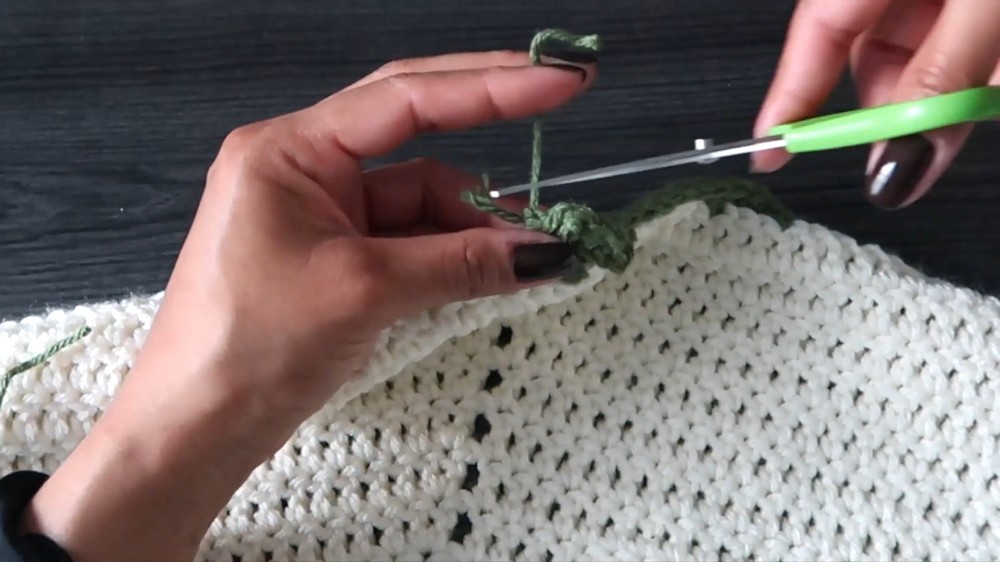
Leaf – Step 7: sc directly into the same ch-2 space on the border, then cut the yarn.
Check the Leaves Before Adding Roses
Take a quick look around the edge once the leaves are in place. The leaves should sit directly on the green border spaces, leaving the surrounding border sections available for the roses.
This is also a useful point to check the direction and size of the leaves. Because each leaf is made from the same five-chain foundation, keeping the stitch sequence consistent helps them look uniform around the blanket.
Crochet the Rose Petal Pieces
The roses are attached to the border sections between the leaves. Unlike the leaves, these begin as a long petal strip that becomes a flower only after you roll it inward.
The stitch heights also change toward the end of the chain: the earlier section uses dc, while the final five chains use treble crochet. That change helps give the finished rose its fuller, curved shape.
Rose – Step 1: Attach the rose-colored yarn to a border section and ch 16.
Rose – Step 2: Work 1 dc into the 3rd ch from your hook.
Rose – Step 3: Work an inc (2 dc) into the next ch.
Rose – Step 4: Work 3 dc into each of the next 7 chains.
Rose – Step 5: Work 3 tr into each of the next 5 chains.
Rose – Step 6: Sl st into that same last st to finish the row.
Rose – Step 7: sc directly into the border section to anchor the petal piece, fasten off, and leave a long tail for sewing.
Roll the Petals Into a Rose
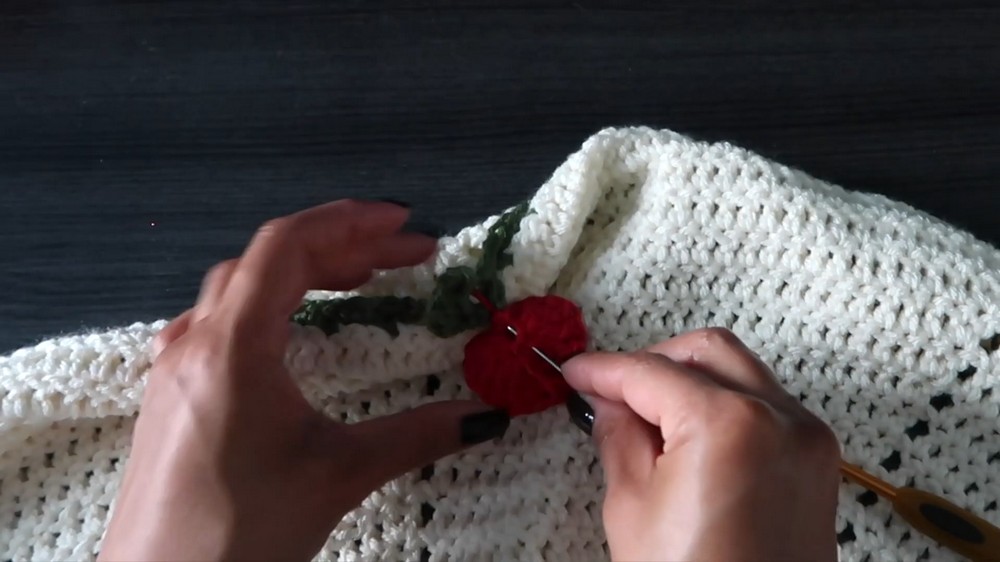
The petal piece will look quite different before and after rolling, so keep the base of the strip together as you shape it. Starting from one end, gently roll the crocheted piece inward on itself until it forms a spiral flower.
Thread the long yarn tail onto your tapestry needle and pass the needle completely across the base of the curled rose several times. This secures the layered folds and prevents the flower from unrolling.
Once the layers are held together, knot securely and weave in any remaining ends.
Keep the Floral Border Balanced
As you attach each rose, check its position in relation to the nearby leaves. The roses belong in the border sections between the leaves, so centering them before securing the base will help the floral edge look more even.
You do not need to pull the rose flat while sewing. The rolled layers are what give the flowers their dimensional appearance, so secure the base firmly while allowing the upper petals to remain raised.
Once all the leaves and roses are securely attached and the loose ends are woven in, your flower bouquet blanket is complete. The repeating center gives you flexibility over the size, while the green leaves and rolled flowers provide the decorative finish that makes the blanket look like a crochet bouquet.