Crochet Daisy Granny Square Cardigan for Ages 3–4
Looking for a sweet handmade cardigan for a little one? Daisy-filled granny squares create a cheerful V-neck style with simple ways to adjust the fit.
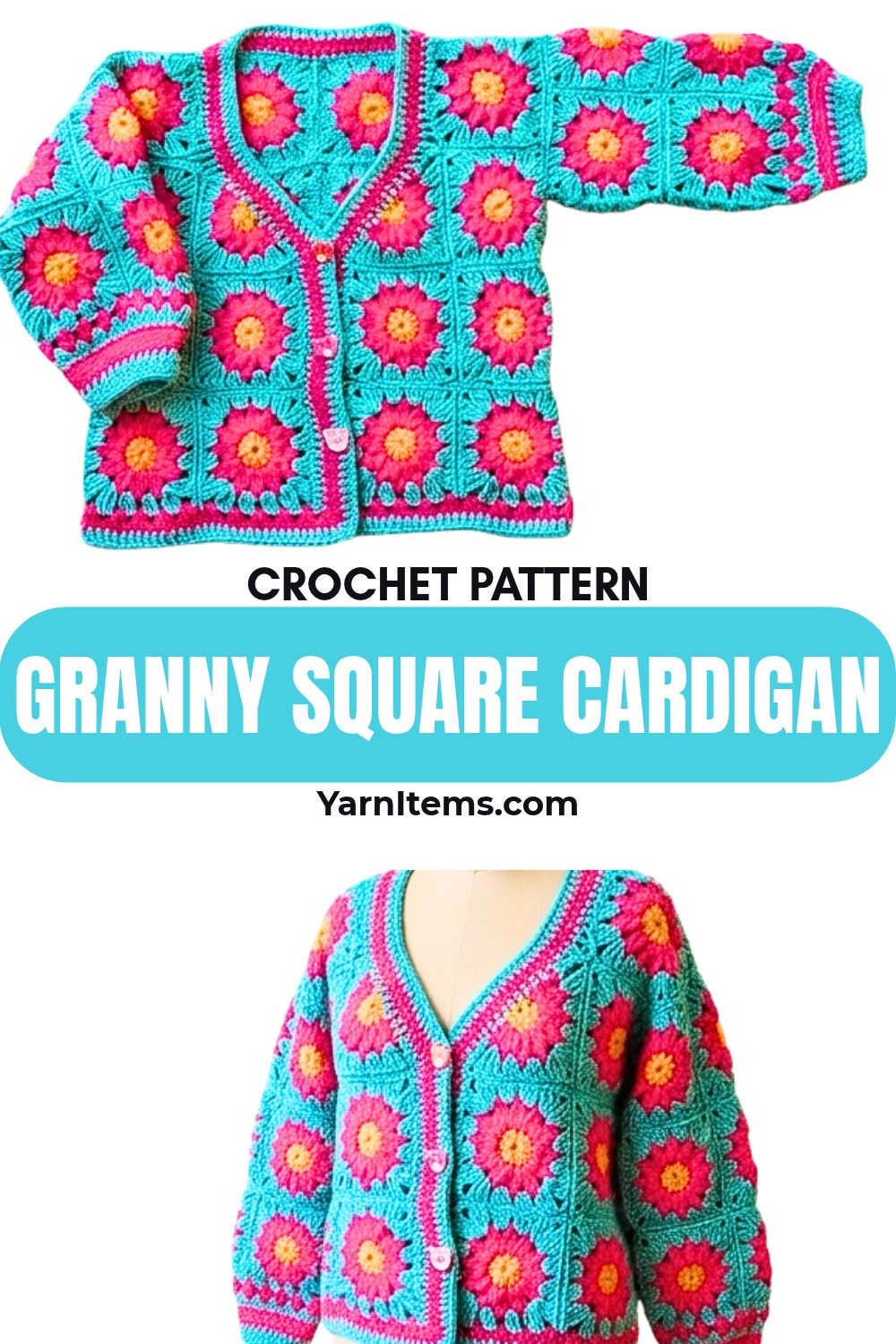
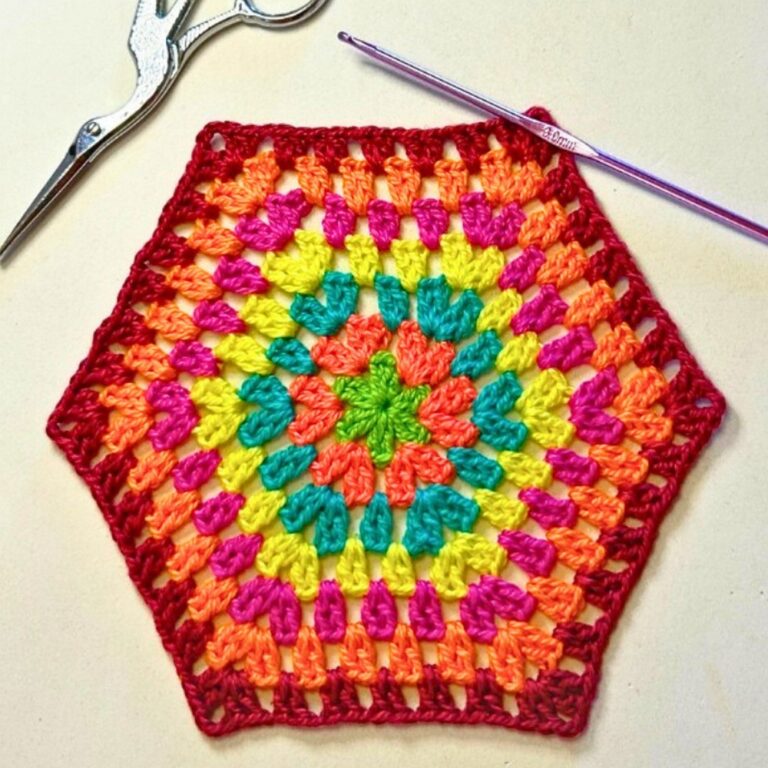
Bright flower centers, contrasting petals, and a neat Main Color border give this child-size cardigan its cheerful crochet granny square look.
Designed for ages 3–4, it uses 38 full squares measuring exactly 3 x 3 inches, plus two half squares for the neckline. Once joined, those little flowers form an approximately 12-inch-wide back, a pretty V-neck, sleeves, and a button front that feels playful without becoming overly fussy.
Making begins with one complete crochet daisy square so you can check its size and shape before repeating it 37 more times. From there, you’ll make two half squares, arrange the pieces into the back, front, and sleeve panels, and join them carefully stitch for stitch.
Sleeve cuffs are shaped with simple decreases, while the final neckline and button band use hdc and dc edging to smooth the V-neck. Small checkpoints along the way help keep the crochet squares even, the front panels mirrored, and the neckline sitting neatly.
Credit Mom’s Crochet & Craft
Materials & Tools
- Yarn: 220–240 grams of 3-ply extra-soft knitting yarn, DK / Light Worsted weight
- Color A: Flower center
- Color B: Flower petals
- Main Color: Square border and joining
- Crochet hook: 3.00 mm
- Yarn needle: For weaving in ends and joining
- Scissors
- Matching buttons
Three colors give the cardigan its daisy appearance. Keeping the Main Color consistent around every square also helps the separate motifs blend together once the panels are joined.
Finished Size & Customization
This cardigan is designed for ages 3–4.
- Back chest width: Approximately 12 inches
- Individual square: 3 x 3 inches
- Full squares: 38
- Half squares: 2
Before making all the squares, measure one completed square. Reaching the 3 x 3-inch measurement will give you a much better indication of how closely your finished cardigan will match the intended size.
Need a little more chest width or armhole depth? You can add extra rows of 3 dc, ch 1 granny clusters along the vertical edges of the panels instead of automatically adding another full 3-inch square.
Crochet Abbreviations
US crochet terms are used throughout.
- ch: Chain
- st(s): Stitch(es)
- sl st: Slip stitch
- sc: Single crochet
- hdc: Half double crochet
- dc: Double crochet
- tr: Treble crochet
- tr3tog: 3 Treble Crochet Cluster
- dc2tog: Double Crochet 2 together
- sp: Space
Special Stitch: tr3tog
Yarn over twice, insert the hook into the space, pull up a loop, and pull through 2 loops twice, leaving the final loop on the hook. Repeat two more times in the same space. Pull through all 4 loops on the hook to complete the cluster.

Make the Full Daisy Granny Squares
Make 38 full squares.
Starting with one complete square is useful because it lets you confirm your tension, colors, and finished measurement before repeating the motif many times.
Color A
Round 1: Make a slip knot and ch 4, sl st to the first chain to form a ring; ch 3 (counts as your first dc), work 11 dc directly into the center of the ring for a total of 12 dc; sl st into the 3rd chain of the starting ch-3 to join; fasten off and leave a tail for weaving.
You should have 12 dc forming the flower center.
Color B
Round 2: Join Color B in any space between the dc stitches of Round 1; ch 4 (counts as the first partial treble), work 2 partial treble crochets into the same space, then pull through all 3 loops on your hook to complete the first tr3tog cluster; ch 2; in the next space between the dc stitches work a full tr3tog cluster, ch 2; repeat around until you have 12 petal clusters and 12 ch-2 spaces; sl st to the top of the first cluster to join; fasten off.
Count the petals before moving forward. You should have 12 petal clusters and 12 ch-2 spaces.

Main Color
Round 3: Join the Main Color in any ch-2 space; ch 4 (counts as 1st tr), work 2 tr in the same space, ch 1; work 3 dc in the next ch-2 space, ch 1; work 3 dc in the next ch-2 space, ch 1; in the next space work (3 tr, ch 3, 3 tr) to turn the corner, ch 1; repeat the sequence [3 dc in next sp, ch 1, 3 dc in next sp, ch 1, corner in next sp, ch 1] two more times; work 3 dc in next sp, ch 1, 3 dc in next sp, ch 1; in the first starting space work 3 tr, ch 3; sl st to the top of the starting ch-4 to complete the square; fasten off.
Measure your completed square now. It should be exactly 3 x 3 inches.
If your first square is noticeably different, correct your tension or hook choice before making the remaining squares. Consistent square sizes will make joining much easier.
Make the Remaining 37 Squares
Repeat the three-round motif until you have 38 full daisy granny squares.
Keep an eye on the dimensions as you work. Even a small difference repeated across multiple squares can become noticeable when several pieces are joined into one large panel.
Make Two Half Squares for the V-Neck
Make 2 half squares.
These pieces are important for the front neckline because their straight and angled sections allow the front panels to slope toward the V-neck.
Color A
Round 1: Ch 4, sl st to form a ring; ch 3 (counts as 1st dc), work 6 dc into the ring for a total of 7 dc; fasten off.
Color B
Round 2: Join Color B to the top of the starting ch-3; ch 5 (counts as 1 tr and a ch-1 space); work a tr3tog cluster in the first space between the dc stitches; ch 2, tr3tog cluster in the next space; repeat 4 more times for a total of 6 clusters; ch 1, 1 tr in the last stitch; fasten off.
Main Color
Round 3: Join the Main Color to the 4th chain of the starting ch-5 from the previous round; ch 5 (counts as 1 tr and a ch-1 space), work 3 tr in the first ch-2 space, ch 1; work 3 dc in the next space, ch 1; work 3 dc in the next space, ch 1; in the next space work (3 tr, ch 3, 3 tr), ch 1; work 3 dc in the next space, ch 1; work 3 dc in the next space, ch 1; work 3 tr in the last ch-2 space, ch 1, work 1 tr in the final stitch; fasten off.

Arrange the Pieces Before Seaming
Lay every square flat before joining.
This is the easiest time to check the overall arrangement, flower orientation, Main Color borders, and V-neck direction. Once multiple seams have been sewn, changing the placement becomes much more time-consuming.
Back Panel
Whipstitch 16 full squares together in a 4 x 4 grid.
Front Panels
Each front panel uses a sloping arrangement for the V-neck.
Place the half square at the top inner corner of each front panel. The two half squares should mirror one another so their angled edges create the neckline slope.
Sleeves
Join the required squares for each sleeve according to the tutorial layout.
Before sewing the panels permanently, compare the two front sides. Matching their arrangement now will help the finished neckline sit evenly.
Join the Granny Squares
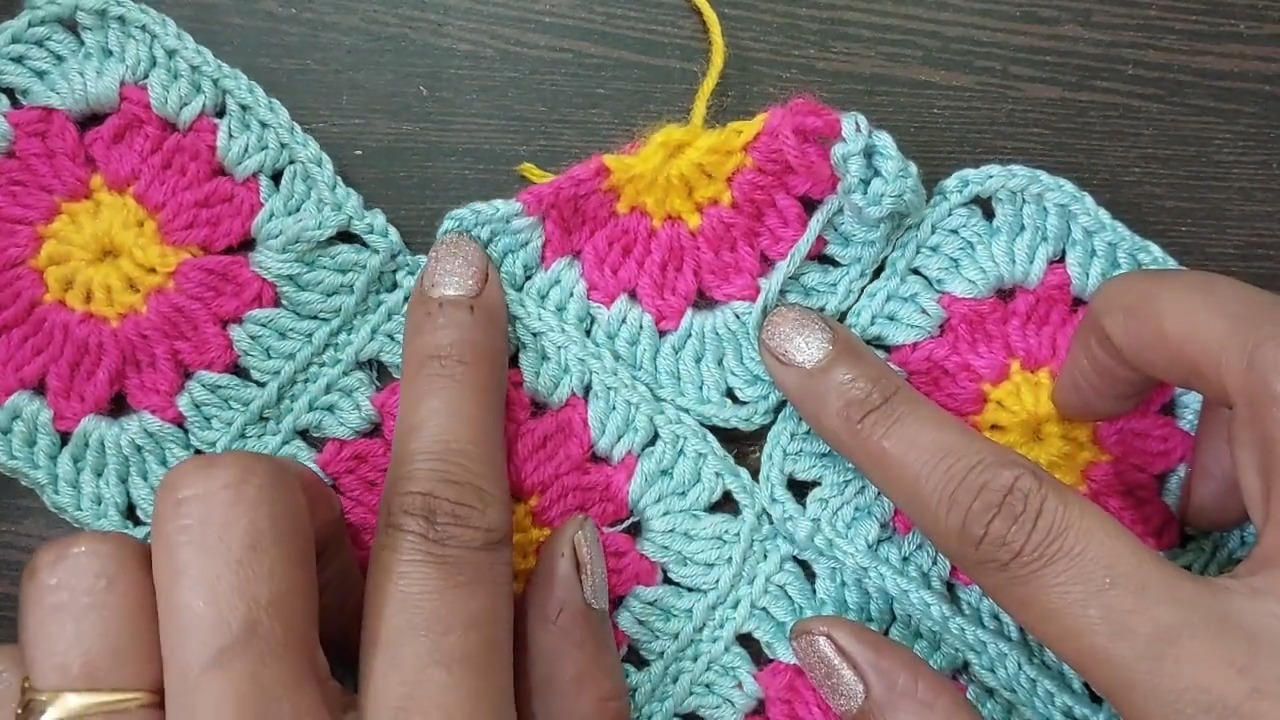
Place the squares with their right sides facing each other.
Using your yarn needle and Main Color, whipstitch through the back loops only of the corresponding stitches.
Match every stitch stitch for stitch and every corner chain for chain.
Corner alignment deserves extra attention. If one chain space is skipped or pulled too tightly, the adjoining squares may shift and the panel edges can become uneven.
Back-loop-only whipstitching keeps the front surface relatively flat and lets the daisy motifs remain the visual focus.
Join the Cardigan Panels
Once all panels are joined, align the shoulder seams and whipstitch them closed.
Attach the sleeves to the armholes.
Fold the cardigan over and seam the underarms down toward the bottom hem in one continuous line.
Open the cardigan periodically while sewing long seams to make sure the panels are sitting in the intended position before fastening off.
Crochet the Sleeve Cuffs
The sleeve cuffs begin with two granny-style rounds and then become narrower through two decrease rounds.
Round 1: Attach the Main Color at the underarm seam; ch 3, work 3 dc in every space around the sleeve opening; sl st to join.
Round 2: Ch 3, work 3 dc in each space around; sl st to join.
Decrease
Round 3: Ch 1, sc in the first 4 sts, skip the 5th st; repeat this pattern around to tighten the cuff; sl st to join.
Round 4: Ch 1, sc in the first 2 sts, skip the 3rd st; repeat around; sl st to join.
Round 5: Ch 1, sc in every st around; sl st to join, and fasten off.
Repeat the same five rounds for the second sleeve.
Check both cuffs side by side after finishing them. Matching their shaping will help the sleeves look balanced.

Shape the Neckline & Button Band
The Main Color border begins at the bottom corner of one front panel and travels around the front edge, neckline, and opposite front edge.
Shaping
Round 1: Attach the Main Color at the bottom corner of the front panel; ch 1, work a hdc evenly spaced up the front edge, skipping occasional stitches so the edge does not ruffle; when you reach the V-neck slope, work 2 dc, then 3 tr in the deepest corner indent to build up the slope and round out the V-shape; continue hdc around the back of the neck and mirror the shaping down the opposite side.
Watch the straight front edge while working this round. Too many hdc can make it ruffle, so skip occasional stitches where necessary to keep the edge flat.
At the deepest V-neck point, the 2 dc followed by 3 tr provides the additional height needed to shape the slope smoothly.
Round 2: Ch 3, work 1 dc in every stitch all the way around the cardigan; at the sharp inner corners of the V-neck, work a dc2tog to gather the fabric neatly; at the outer bottom corners of the hem, work (2 dc, ch 1, 2 dc) into the corner stitch to turn smoothly.
The dc2tog at the inner V-neck corners helps prevent the neckline from spreading as the border is added.
Round 3: Ch 3, work 1 dc in every stitch around, continuing to work a dc2tog at the inner neckline corners; fasten off.
Attach the Buttons
Weave in all remaining yarn tails securely on the wrong side.
Attach the matching buttons evenly down one side of the front band.
Separate buttonholes are not needed. The spaces created between the double-crochet posts provide openings for the buttons.
Test each button through its intended opening before sewing it permanently. This gives you an opportunity to adjust the placement if an opening feels too tight or too loose.
Size Adjustment Without Adding a Full Square
Need extra room without increasing the cardigan by another entire 3-inch square?
Add additional rows of 3 dc, ch 1 granny clusters along the vertical edges of the panels before seaming.
This method can increase the chest width or armhole depth while keeping the main floral arrangement intact.
Measure both corresponding sides after making the adjustment. Matching the added rows on the appropriate panels will help the shoulder, side, and sleeve seams meet correctly.

Daisy Square Troubleshooting
Square is not 3 x 3 inches: Check your tension before making all 38 squares. Changing your hook or adjusting tension may bring the motif closer to the intended measurement.
Petals do not look evenly spaced: Round 2 should contain exactly 12 tr3tog clusters and 12 ch-2 spaces. Recheck the spaces between the Round 1 dc stitches.
Front V-neck looks uneven: Check the placement of both half squares before seaming. They should be positioned as mirror images at the top inner corners.
Panel edges do not line up: Match stitches and corner chains carefully during whipstitching. Differences in square size can also make alignment difficult.
Neckline edge is wavy: During the first edging round, skip occasional stitches along the front edge to reduce excess fabric.
V-neck spreads too much: Make sure the dc2tog decreases are worked at the sharp inner neckline corners in both Round 2 and Round 3.
Sleeve cuff remains too loose: The two decrease rounds gradually reduce the opening. Check the sleeve after Round 3 and Round 4 before completing the final sc round.

Final Fit & Finishing Check
Before the cardigan is ready to wear, lay it flat and inspect the finished shape.
Check that the back forms its 4 x 4 square grid, both front panels mirror one another, and the half squares create an even V-neck.
Make sure both sleeves have matching cuff shaping and that the button band lies flat from top to bottom.
Finally, secure all remaining yarn tails on the wrong side and trim the excess.
Your daisy granny square cardigan is ready with colorful flower motifs, a shaped V-neck, simple sleeve cuffs, and a button front sized for a little wearer.