Hooded Crochet Blanket Pattern with Scalloped Edge
This hooded crochet blanket starts as a 28-inch square and finishes with an edging that joins the hood directly to the blanket.
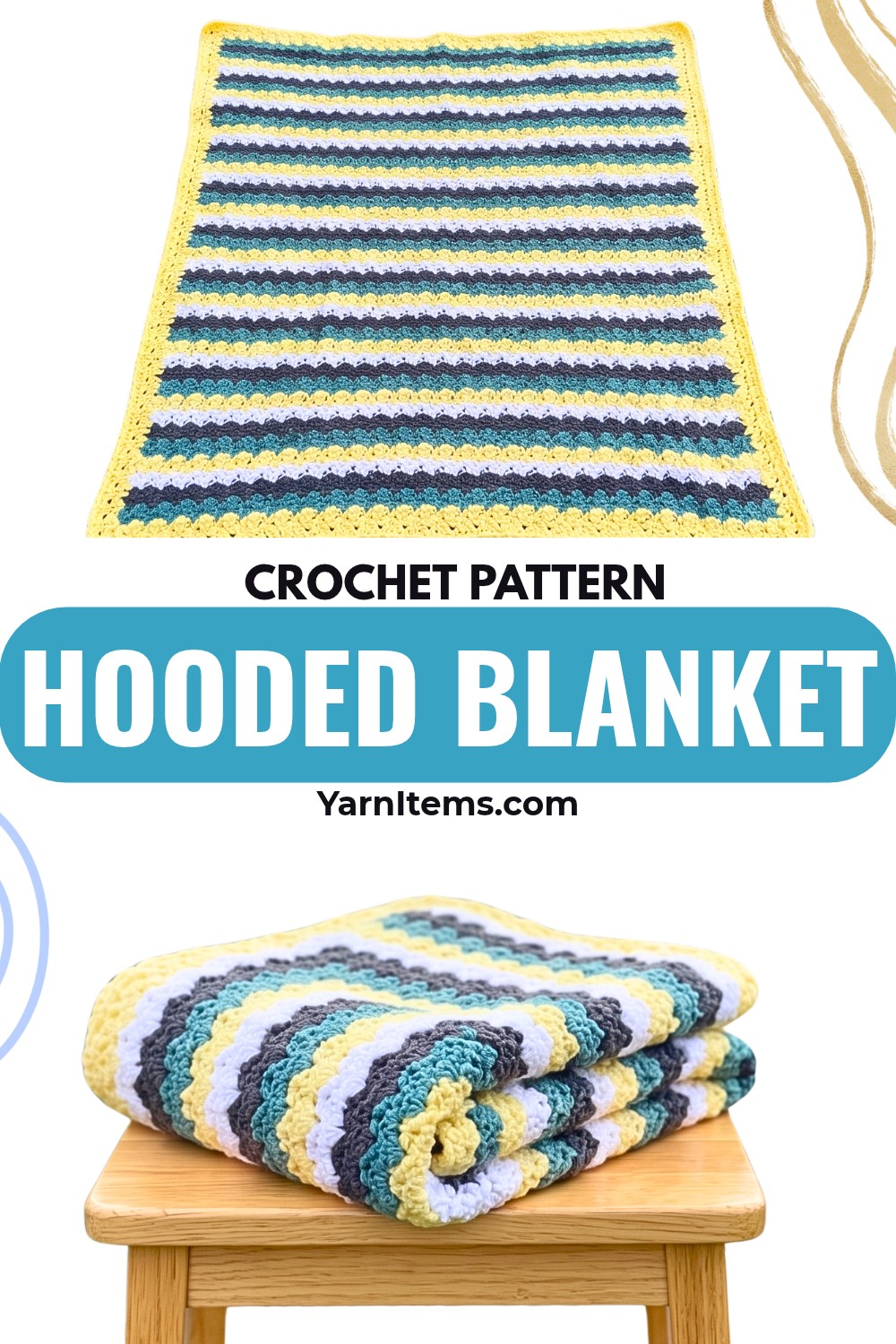
There is something especially useful about a crochet blanket that can be pulled up around a child instead of simply lying across them. The striped version combines Light Yellow, Green, Charcoal Gray, and White for a cheerful finish, while the same crochet pattern can easily be adapted to a solid shade or your own color palette.
The blanket body is built around a simple repeat, so once Row 2 is established, the main section becomes pleasantly predictable. The crochet hood has its own two-row increase rhythm, growing from a point until it reaches 48 dc across the top. You’ll also get the sizing and color plan, the exact stitch terminology, and guidance for the places where accuracy matters most, including the foundation chain, turning chains, color changes, hood increases, and the final border that joins both layers.
Credit Koala Knits and Knacks
Size and Color Plan
The blanket body measures approximately 28 × 28 inches. This gives you a versatile square that can work as a cozy wrap for infants and toddlers, while children up to about 5 or 6 years old can also wear the hood and bring the corners around themselves.
The striped version changes color every 2 rows in this order: Yellow → Green → Gray → White
Keep the final blanket row in the Main Color (Yellow). This brings the same yellow back to the outer edge so the top and bottom of the striped blanket have a more balanced appearance.
For a different look, you can make the entire blanket in one color, alternate two colors, or choose a larger palette. The stitch pattern stays the same; only the color planning changes.
Materials and Stitch Guide
- Yarn: Approximately 16 oz total of medium Worsted / Weight 4 yarn
- MC: Craft Smart Light Yellow, one 198 g / 7 oz ball
- CC1: Craft Smart Arctic (Green)
- CC2: Craft Smart Charcoal Gray
- CC3: Bernat Premium White
- Crochet Hook: J / 10 (5.75 mm) metal hook
- Notions: Stitch markers, scissors, and a yarn needle
Abbreviations
- ch = chain
- st(s) = stitch(es)
- sk = skip
- sc = single crochet
- dc = double crochet
- RS = Right Side.
US crochet terminology is used.

Crochet the Blanket Square
The foundation chain deserves a little extra attention because it establishes the width of the entire blanket. Keep your tension even and slightly loose here. If the chain is pulled too tightly, the starting edge can bow and make it harder for the blanket to settle into a square.
Foundation Chain: Using MC (Yellow), ch in multiples of 3 until the chain measures 28 inches when laid flat without stretching; the exact blanket in the tutorial uses 96 chains.
Row 1: Count back to the 3rd ch from the hook, not counting the loop on the hook, and work 2 dc into that chain; place a stitch marker in the first dc made so it is easy to identify later; *sk 2 ch, work (1 sc, 2 dc) into the next ch; repeat from * across until 3 chains remain, sk 2 ch, work 1 sc into the final ch, ch 2, turn.
The first row establishes the cluster rhythm that will carry through the body. The small sc between groups of dc is particularly important because those spaces become your working points on the next rows.
Row 2: Locate the first sc from the previous row at the base of the ch-2 and work 2 dc into this space; *sk the next 2 dc, find the small space created by the sc between the clusters, and work (1 sc, 2 dc) into that sc space; repeat from * across the row, then sk the final 2 dc and work 1 sc into the top of the turning chain, ch 2, turn.
Once Row 2 is complete, you should be able to recognize the repeat visually rather than counting every stitch individually. Each cluster sits around an sc space, while the two dc stitches between those spaces are skipped. That visual rhythm is what makes the following rows easier to navigate.
Rows 3–68: Continue repeating Row 2 until the blanket reaches 28 inches in height and forms a square; if using stripes, change color at the end of every 2nd row by completing the final sc with the new color pulled through the last two loops on the hook, weave in the ends as you go, and make sure Row 68 is worked in MC (Yellow); at the end of Row 68, work 1 sc into the turning chain, fasten off, and weave in the tail.

Check the Square Before Moving On
Lay the blanket flat without stretching it and check that the body is approximately 28 × 28 inches. This is the useful point to catch a width or height difference before the hood and border are added.
The final row should also be Yellow if you are following the striped version. That last color placement is intentional: it brings the Main Color back to the edge for a more symmetrical appearance.

Grow the Hood from the Point
The hood is worked separately as a triangle, beginning with only a few stitches at the point and gradually increasing toward the top edge. The two repeating rows are easier to remember when you focus on what happens at the beginning and end of each row.
Hood Row 1: Using MC (Yellow), make a slip knot and ch 4, work 2 dc into the 4th ch from the hook, ch 3, turn; the turning ch-3 counts as a stitch.
Hood Row 2: Work 2 dc into the first st at the base of the ch-3, work 1 dc in the next dc, work 3 dc into the top of the previous turning ch-3, ch 3, turn; 7 sts total.
Hood Row 3: Work 1 dc into the first st at the base of the ch-3, work 1 dc into each of the next 5 sts, work 2 dc into the top of the turning ch-3, ch 3, turn.
Hood Row 4: Work 2 dc into the first st at the base of the ch-3, work 1 dc into each st across, work 3 dc into the top of the turning ch-3, ch 3, turn.
Hood Row 5: Work 1 dc into the first st at the base of the ch-3, work 1 dc into each st across, work 2 dc into the top of the turning ch-3, ch 3, turn.
The easiest memory aid is to compare the two increase rows:
- Row 4: 2 dc at the beginning, 3 dc at the turning chain
- Row 5: 1 dc at the beginning, 2 dc at the turning chain
That distinction keeps the hood growing consistently without having to repeatedly return to the full instructions.
Building the Hood: Continue repeating Row 4 and Row 5 consecutively until you have exactly 48 dc across the top edge.
The 48-dc count is your stopping point. Rather than continuing until the hood merely “looks big enough,” use this count to confirm that the triangular piece has reached the stated width before adding the edging.

Add the Scalloped Hood Edge
After chaining 3 and turning from the final hood row, begin the scalloped edging directly along the top width of the hood.
Hood Edging: Work 2 dc into the first st; *sk 2 sts, work (1 sc, 2 dc) into the next st; repeat from * across the hood edge, sk the final 2 sts, work 1 sc into the top of the turning ch-3, fasten off, and weave in the end.
This creates the decorative edge before the hood is positioned on the blanket. The same (1 sc, 2 dc) rhythm will later appear around the blanket, giving the two sections a visually connected finish.
Position the Hood for Joining
Lay the completed blanket flat with the Right Side (RS) facing up and place the foundation-chain row along the bottom. Position the hood in the top right corner, keeping its RS and scalloped edge facing up.
Pin the hood along the corner edges or secure it with stitch markers. The purpose here is simply to prevent the two pieces from shifting while the border is worked.

Join the Hood While Bordering
The border does double duty at the hood area: it decorates the blanket and secures the hood to the body at the same time.
Start the Border: With MC (Yellow), make a slip knot on the hook and attach the yarn in the bottom right corner of the blanket; ch 2, work 1 dc into the same corner space.
Right Side and Hood Join: Work upward along the right side by skipping the equivalent of 2 stitches along the side of the dc rows, locate the break/seam where the rows change, and work (1 sc, 2 dc) into that seam; repeat the pattern evenly up the side, then when you reach the top right corner where the hood is positioned, continue the same pattern while inserting the hook through both the hood and blanket body so the border joins the two layers as you work.
The key orientation change happens at the hood. You are not starting a new stitch pattern there. Instead, you keep the same border rhythm and simply make sure the hook passes through both layers. Keeping the pieces aligned as you go helps prevent the hood from shifting away from the corner.
Complete the Outer Border
Top Corner and Remaining Edges: At the top corner of the hood and blanket, work (1 sc, 2 dc) to round the corner smoothly, turn your work to travel down the top left edge, and continue the (1 sc, 2 dc) skip-two pattern down the remaining sides and across the bottom foundation chain; keep the spacing visually even so the border does not pull or ruffle, return to the starting bottom right corner, work 1 sc into the starting corner space, fasten off securely, and weave in all remaining ends.
As you work around the side edges, use the appearance of the border as your guide. The stitches should sit comfortably along the edge rather than drawing it inward. If the border begins to pull, the spacing is too tight; if the edge starts to ruffle, the spacing is too full. The goal is an even scalloped rhythm that allows the blanket to remain flat.
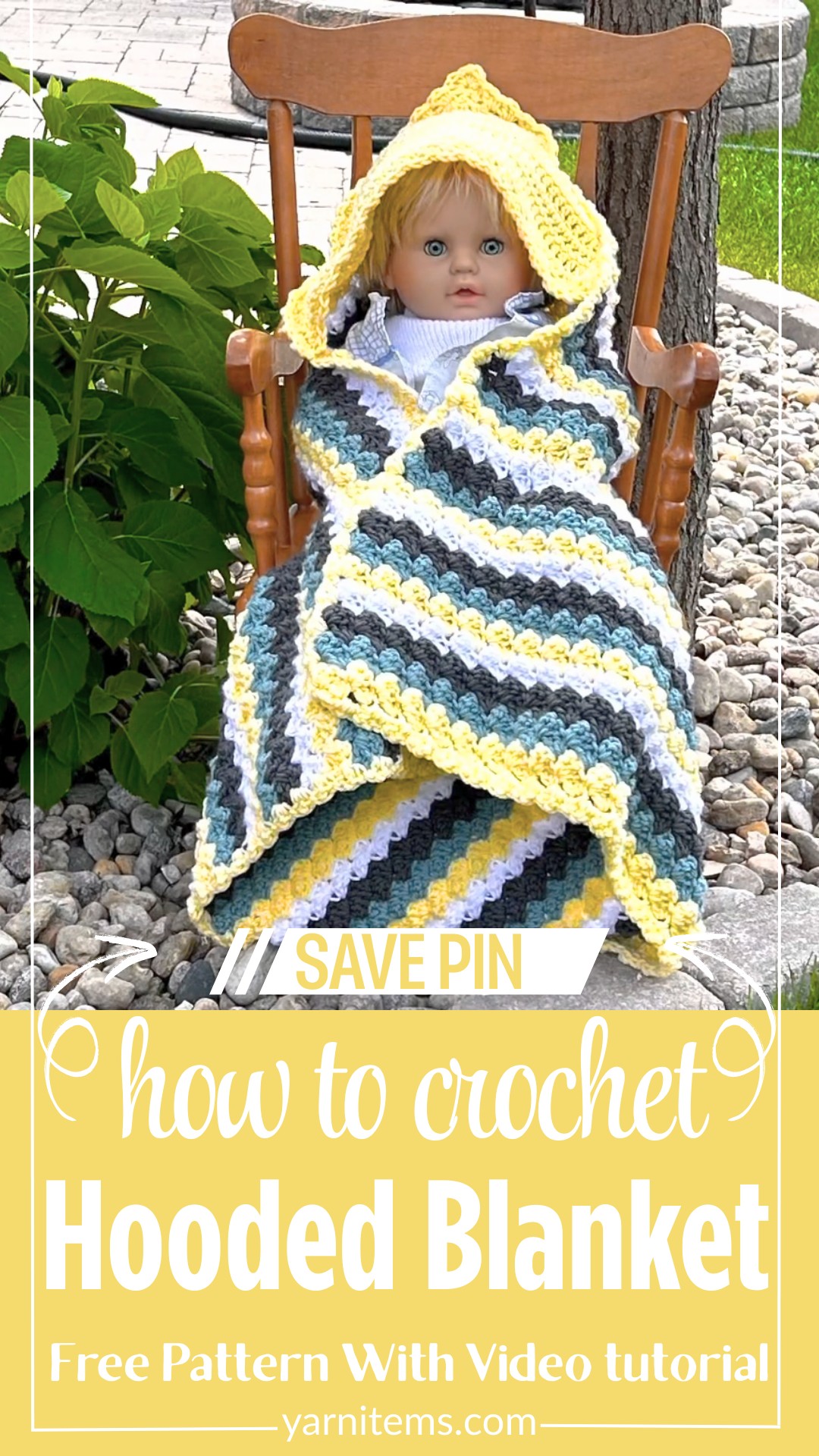
Once the final ends are woven in, the blanket body, pointed hood, and scalloped outer edge are all connected into one finished wrap.