Top-Down Seamless Crochet Raglan Cardigan Pattern
This seamless top-down cardigan grows from your neckline downward, making it easy to adjust the body, sleeves, and stripe pattern as you crochet.
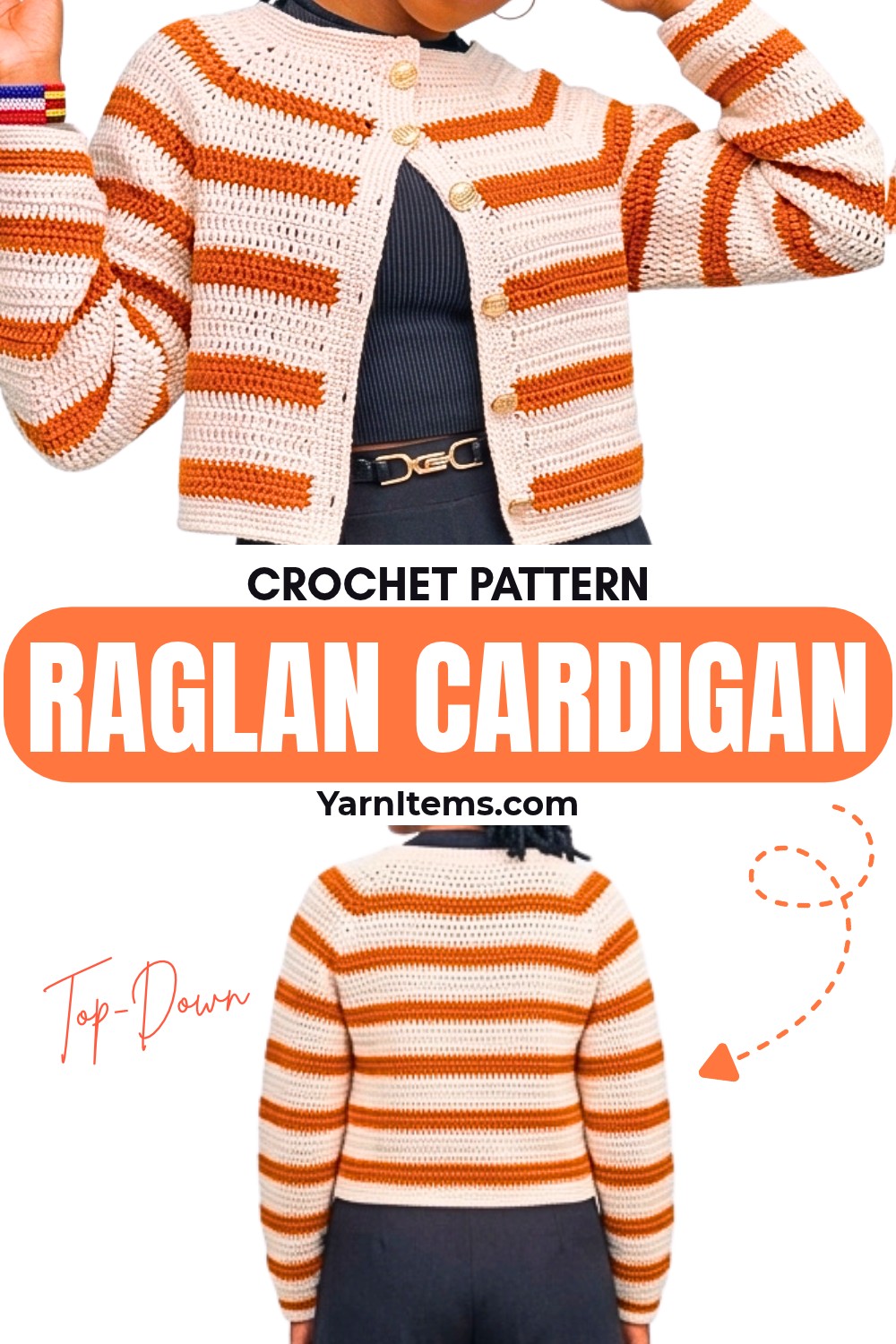
Wanting a crochet cardigan that follows your own measurements instead of forcing you into a standard size makes this top-down raglan design especially useful.
Worked from the neckline downward, it creates a comfortable shape that can be checked against a favorite garment as you crochet.
Working from the top means you can make important fit decisions while the crochet cardigan is still taking shape.
You’ll begin by measuring a well-fitting shirt, calculating the foundation chain for the front, back, and sleeves, then build the raglan yoke with increases at four corners. Once the yoke reaches your armhole depth, the sleeves are separated with underarm chains and the body continues downward.
Sleeves are then worked separately with gradual decreases before the neckline, button band, and bottom edge are finished in neat single crochet rounds.
Credit AC Crochets
Materials & Tools Needed
- Yarn: DK weight yarn. The tutorial uses U MAA by Volue, with each 50 g skein containing approximately 165 m. The blend is 51% acrylic and 49% cotton wool.
- Main color: Approximately 4 skeins of Cream for the demonstrated Small size.
- Contrast color: Approximately 2 skeins of Brown for the demonstrated striped version.
- Crochet Hook: 3.5 mm
- Measuring tape
- Reference garment: A well-fitting T-shirt, top, or jacket
- Scissors
- Pen and paper: For recording measurements and calculations
- Buttons: 6 buttons are recommended
Crochet Abbreviations
US crochet terminology is used.
- CH: Chain
- ST(s): Stitch(es)
- DC: Double crochet
- SC: Single crochet
- SL ST: Slip stitch
- SP: Space
- DC2TOG: Double crochet two together
- INC: Corner increase — 1 DC, CH 1, 1 DC worked in the same space

Start With a Garment That Fits You
This cardigan is designed to be customized using a reference garment, so choose something with a fit you already like. A T-shirt, sweater, or jacket can work as long as its neckline, body width, and overall proportions give you a useful reference.
Keep your measuring tape, pen, and paper nearby because the first part involves a few simple calculations. Write down each number as you work rather than trying to remember the measurements between steps.
Calculate the Foundation Chain
The starting chain determines the basic proportions of the raglan yoke. Your stitch gauge and reference garment measurements are used to divide that chain between the two fronts, two sleeves, and back.

Measure the Back Neckline
Measure the back neckline of your reference garment.
The tutorial example uses a back neckline measurement of approximately 5.5 inches.
Find Your Stitch Gauge
Make a sample chain and work one row of double crochet. Count how many DC stitches fit across the same back-neckline measurement.
In the example, 26 DC stitches measure approximately 5.5 inches.
Calculate Each Front Panel
Take your back stitch count, subtract 2 stitches, then divide the result by 2.
Example: 26 − 2 = 24; 24 ÷ 2 = 12 stitches per front panel.
Calculate Each Sleeve
Take the front-panel stitch count and add half of that number.
Example: 12 + 6 = 18 stitches per sleeve.
Add the Corner Chains
Add 4 corner chains, with 1 chain representing each raglan corner.
Calculate the Complete Foundation
Add the back, both fronts, both sleeves, and four corner chains together.
Example: 26 + 12 + 12 + 18 + 18 + 4 = 90 total chains.
Keep your final calculation written down because these numbers determine the stitch placement in the first yoke row.

Work the Raglan Yoke
The yoke establishes the four sections of the cardigan: front, sleeve, back, and sleeve, with a corner increase between each section.
Row 1: Chain your calculated total, such as 90 CH, then add 2 turning chains that do not count as stitches; skip the first 2 chains and DC into the 3rd CH and the next 11 CHs for Front Panel 1; in the next CH work (1 DC, CH 1, 1 DC) for Corner 1; DC in the next 18 CHs for Sleeve 1; in the next CH work (1 DC, CH 1, 1 DC) for Corner 2; DC in the next 26 CHs for the Back; in the next CH work (1 DC, CH 1, 1 DC) for Corner 3; DC in the next 18 CHs for Sleeve 2; in the next CH work (1 DC, CH 1, 1 DC) for Corner 4; DC in the final 12 CHs for Front Panel 2.
Row 2: CH 2, turn; DC in every stitch across until reaching the first CH-1 corner space; work INC (1 DC, CH 1, 1 DC) in the corner space; repeat DC in each ST and INC in each corner space across the row, placing the final DC on top of the last stitch of the previous row.
Rows 3–as needed: CH 2, turn; DC in every stitch across and work INC (1 DC, CH 1, 1 DC) in each corner space; repeat until the raglan line reaches the armhole depth of your reference garment, approximately 7 inches in the example.
Check the Yoke Before Separating the Sleeves
Lay the yoke against your reference garment when it reaches the desired depth. Check the shoulder-to-underarm distance rather than stopping at a predetermined row number.
The purpose of this measurement is to make the sleeve separation happen at the right point for your body. If the yoke is too shallow, the underarm can sit too high; if it is too deep, the cardigan may feel oversized through the upper body.
Adding Stripes
For the demonstrated color-block version, use 4 rows of Cream followed by 2 rows of Brown. Continue the chosen sequence throughout the yoke and carry the yarn up the side when changing colors.
You can also work the cardigan entirely in one color or create your own stripe sequence.
Separate the Body From the Sleeves
Before dividing the yoke, compare its back width with the full bust width of your reference garment.
For example, if the current yoke back measures 12 inches and the reference garment measures 16.5 inches across the bust, the difference is 4.5 inches.
Divide that difference by two: 4.5 ÷ 2 = 2.25 inches per underarm.
Make a small chain and measure it until it equals your required underarm length. The tutorial example uses 11 chains.
Separation Row: CH 2, turn; DC across the first front panel to the first corner; work 1 DC into the CH-1 corner space; chain your calculated underarm amount, such as 11 CH; skip all stitches of the first sleeve and work 1 DC into the next CH-1 corner space; DC across the back panel; work 1 DC into the third CH-1 corner space; chain the same underarm amount again; skip the second sleeve and work 1 DC into the final CH-1 corner space; DC across the remaining front panel.
The underarm chains replace the sleeve stitches that are skipped, giving the body enough room across the bust while leaving the sleeves open for later.

Underarm Check
Hold the cardigan against your reference garment before moving on. The body should now span the intended bust width, and the underarm chains should bridge the spaces where the sleeves were separated.
If the body width is not close to your reference measurement, check your underarm calculation before adding many more rows.
Work the Lower Body
Once the sleeves are separated, the cardigan body becomes a simple back-and-forth section of double crochet.
First Lower-Body Row
Next Row: CH 2, turn; DC in every stitch across, working 1 DC into each underarm chain when you reach it; continue across the back, work 1 DC into each chain of the second underarm, and finish the row.
Continue the Body
Body Rows: CH 2, turn; DC in every stitch across; repeat until the cardigan reaches your desired length before adding the bottom edging, approximately 14 inches in the example.
Because the cardigan is measurement-based, compare its length with your reference garment as you go rather than relying only on a row count.
Crochet the Sleeves
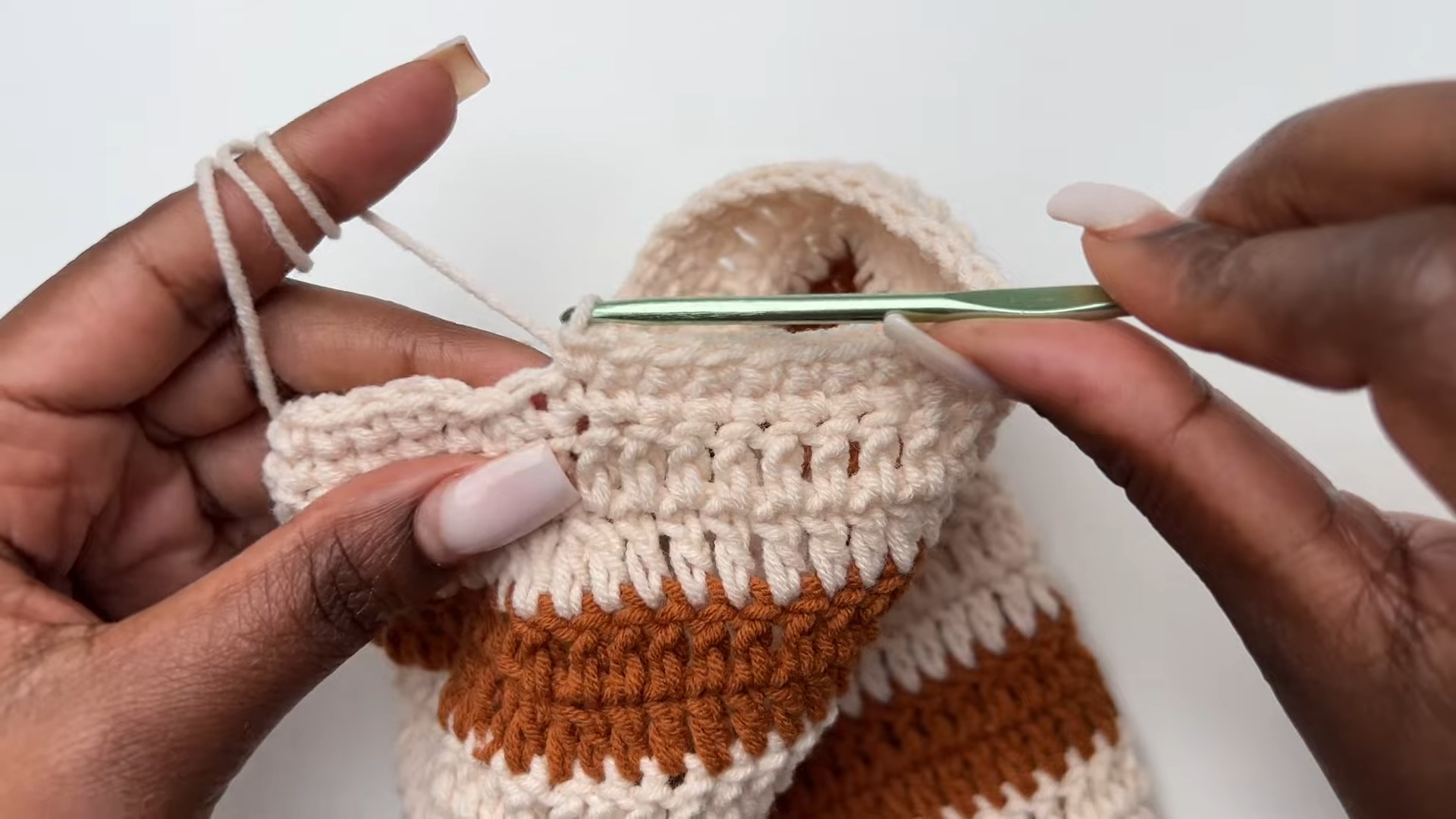
Sleeves are worked separately in joined, turned rounds. The first rounds establish the sleeve width, while periodic DC2TOG decreases gradually narrow the sleeve toward the wrist.
Begin the Sleeve
Reattach the yarn at the exact middle stitch of the underarm chain.
Round 1: CH 2, turn; DC in each stitch around the armhole opening, including the sides of the corner DC posts to help prevent gaps; join with a SL ST to the top of the CH 2.
Rounds 2–3: CH 2, turn; DC in each stitch around; join with a SL ST.
Round 4: CH 2, turn; DC in the first stitch, DC2TOG over the next 2 stitches; DC around until 3 stitches remain; DC2TOG over the next 2 stitches, then DC in the final stitch; join with a SL ST.
Continue the Sleeve
Sleeve Body: Continue working joined, turned DC rounds, repeating the decrease round every 4th round, or every 3rd round for a slimmer fit; stop when the sleeve is approximately 1.5 inches shorter than the desired total sleeve length.
The choice between every third and every fourth round gives you useful control over the final sleeve shape. A more frequent decrease creates a slimmer sleeve, while spacing the decreases farther apart leaves more room.
Add the Sleeve Cuffs
The cuff changes from double crochet to single crochet for a simpler, slightly firmer finish.
Round 1: CH 1, turn; SC in every stitch around; join with a SL ST to the first SC.
Round 2: CH 1; SL ST into the same stitch to create a slight reduction; SC in each remaining stitch around; join with a SL ST.
Continue the Cuff
Rounds 3+: CH 1, turn; SC in every stitch around; join with a SL ST; repeat until the cuff measures approximately 1.5 inches, changing colors if desired to coordinate with the cardigan stripes.
Repeat the complete sleeve and cuff process for the second sleeve.
Finish the Neckline, Fronts & Hem
The cardigan’s raw outer edge is finished with continuous single crochet rounds. The first round establishes the edge, while the following rounds build a neat border around the entire opening.
Round 1: Attach Cream yarn at the top right corner of the neckline; SC evenly around the neckline; at the top left corner work 3 SC into the corner stitch; work down the front panel edge, placing 2 SC at the end of each DC row, with one in the middle of the stitch and one at the top/joining space; work 3 SC in the bottom corner stitch; SC across the entire bottom hem; work 3 SC in the next bottom corner stitch; SC up the opposite front panel using 2 SC per row edge; join with a SL ST to the starting stitch.
The two sc stitches along each row edge help fill the height of the double crochet rows without leaving the front edge too sparse.
Rounds 2–3: CH 1; SC in every stitch around the entire cardigan, working 3 SC in every corner stitch; join with a SL ST.

Add the Buttonholes
The fourth edging round is worked in Brown in the demonstrated version. For the sample, the buttonholes are placed on the right panel, following the traditional placement described in the tutorial.
If you are using a different stripe arrangement, you can still choose your preferred button-band color.
Round 4: Switch to Brown; SC around until reaching the position of the bottom-most buttonhole on the right panel; CH 2, skip 2 stitches, SC in the 3rd stitch; SC in the next 10 stitches; repeat the (CH 2, skip 2, SC in next) sequence to create 6 total buttonholes; continue placing SCs around the remainder of the cardigan and join with a SL ST.
Space the six buttonholes evenly before beginning this round. If you prefer a different number of buttons, adjust the spacing rather than placing the openings too close together.
Round 5: SC around the entire cardigan; when reaching each buttonhole, work 2 SC directly into the CH-2 space; join with a SL ST and fasten off.
The two SC stitches worked into each opening help reinforce the buttonhole edge while keeping the opening defined.
Attach the Buttons
Lay the cardigan flat with the front panels aligned. Place the left front panel underneath the right front panel.
Using a needle and matching thread or yarn, sew the buttons securely onto the left panel, positioning each button directly opposite its corresponding buttonhole.
Check every button as you sew it. Fasten the button through its matching opening before moving to the next one so the front edges remain parallel and the cardigan does not bunch between closures.

Final Fit Check
Try the cardigan on after all the major pieces are joined and the buttons are attached. Check the neckline, bust width, body length, underarm area, and sleeve taper.
The advantage of this top-down method is that many of the important fit decisions were made while the cardigan was still being worked. Your reference garment, yoke depth, underarm chains, body length, and sleeve decreases all contribute to the final fit, so comparing those measurements as you go can save substantial correction work later.
Weave in all remaining loose ends securely on the inside of the cardigan and trim the excess yarn.
Your custom top-down raglan cardigan is ready to wear.