Crochet Child’s Raglan Sweater with Herringbone Texture
Want a sweater that can grow with your child? This mustard-yellow crochet design lets you adjust body width and length while keeping its neat raglan shape.
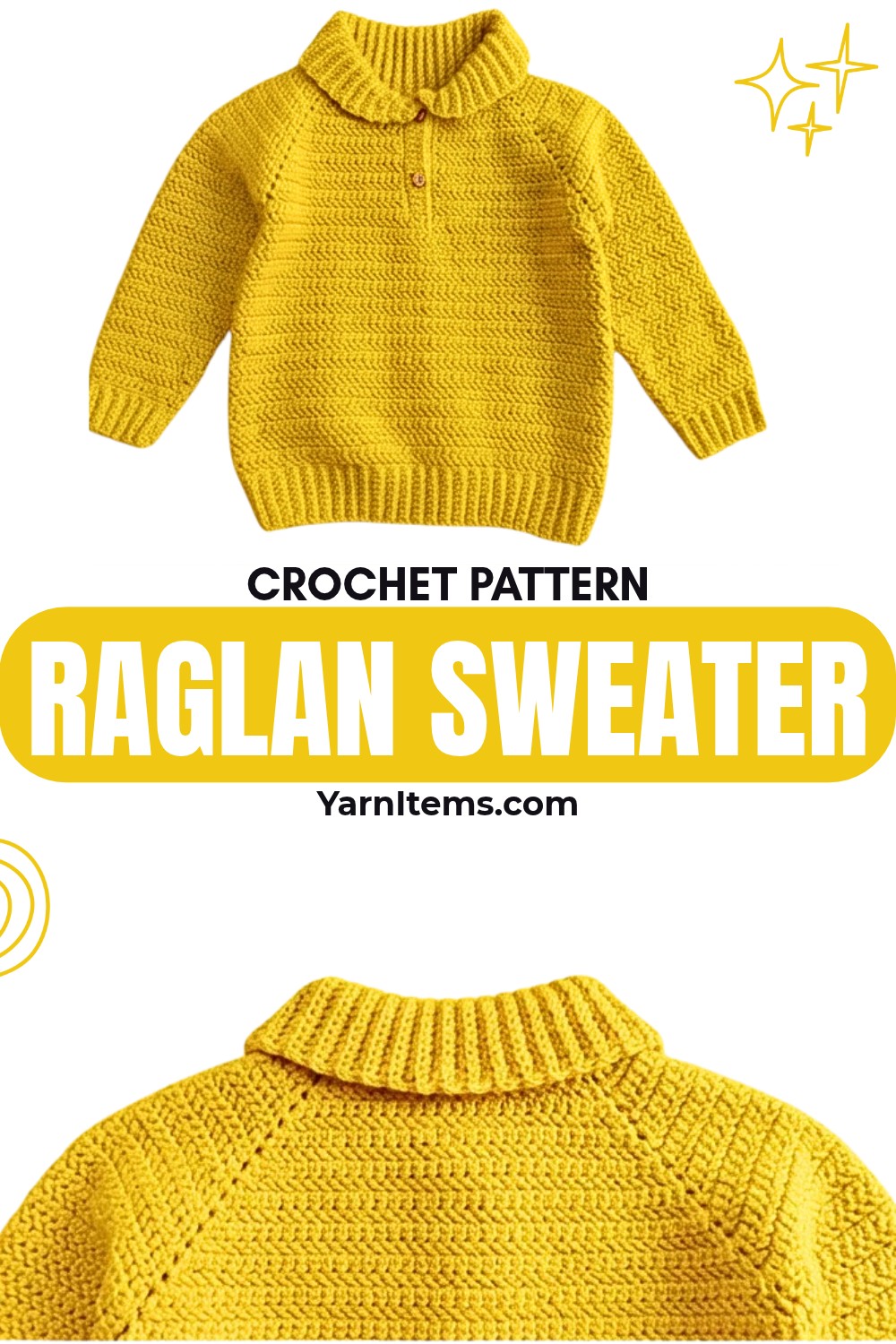
Warm mustard yarn and herringbone texture give this child-sized crochet sweater cozy everyday appeal, while its button opening makes dressing simple. Tapered sleeves, neat borders, and shaped collar bring clean detail to its relaxed crochet raglan style.
Worked from neckline downward, this pattern makes it easier to check chest width and adjust length while you crochet. Keep close track of four yoke corners and remember to turn after every body and sleeve round so crochet herringbone texture stays consistent.
Credit Mom’s Crochet & Craft
Materials & Tools Needed
- Yarn: Ganga Acrowools Olivia Yarn, double knit, wool-like acrylic — approximately 280 grams in mustard yellow
- Hook: 3.50 mm crochet hook
- Measuring tape
- Yarn needle: For sewing seams and weaving in yarn tails
- Scissors
- Stitch markers: Highly recommended for beginners
- 1 button
Finished Size
This sweater fits approximately 4- to 5-year-old or 5- to 6-year-old children.
- Length from armhole to bottom: 10 inches
- Total length from shoulder: 10.5 inches
- Chest width before joining: 13 inches when laid flat
- Chest width after joining armholes: approximately 12.5 inches
For additional width, begin with more foundation chains and distribute extra chains proportionally among front, back, and shoulder sections. For more length, add rows to body or sleeves. Child’s own measurements can guide both sleeve and body length adjustments.
Abbreviations
- ch: Chain
- st(s): Stitch(es)
- sc: Single Crochet
- dc: Double Crochet
- sl st: Slip Stitch
- ch-1 sp: Chain-1 space
- BLO: Back Loop Only
- Hhdc: Herringbone Half Double Crochet

Herringbone Half Double Crochet
Yarn over, insert hook into stitch, and pull up loop. Pull first loop directly through second loop on hook. Yarn over and pull through remaining two loops.
How to Start with Yoke
Yoke forms upper portion of sweater and sets chest width through four corner spaces. Mark each ch-1 space as you work Row 1 so you can identify every increase point easily in following rows.
Foundation Chain: Ch 74. This should measure approximately 15.5 inches.
Row 1: Skip first 2 chs; these do not count as sts; work 1 Hhdc in 3rd ch from hook and 10 more Hhdc for 11 front-panel sts total; in next ch work (1 Hhdc, ch 1, 1 Hhdc) for Corner 1 and mark ch-1 sp; work 1 Hhdc in each of next 12 chs for Shoulder 1; in next ch work (1 Hhdc, ch 1, 1 Hhdc) for Corner 2; work 1 Hhdc in each of next 22 chs for Back Panel; in next ch work (1 Hhdc, ch 1, 1 Hhdc) for Corner 3; work 1 Hhdc in each of next 12 chs for Shoulder 2; in next ch work (1 Hhdc, ch 1, 1 Hhdc) for Corner 4; work 1 Hhdc in each remaining 11 chs for Front Panel.
Row 2: Ch 1, turn; ch 1 does not count as st; work 1 Hhdc in each st across; whenever you reach ch-1 sp at any corner, work (1 Hhdc, ch 1, 1 Hhdc) in ch-1 sp; repeat across all 4 corners and all sts; do not work into turning chain.
Rows 3-14: Repeat Row 2 until 14 rows are complete, or until chest measurement across back from corner to corner reaches approximately 13 inches.
At this point, pause and measure rather than automatically adding more rows. Yoke width determines how sweater will sit around child’s chest and arms, so this is useful point for comparing work with actual measurement.

Create Button Plackets
Button plackets are added before body is joined. One side stays plain, while opposite side receives double crochet row that creates openings for button.
Left Placket – Row 1: Join yarn at top of left front edge; ch 1 and work 20 sc evenly down front raw edge.
Left Placket – Row 2: Ch 1, turn; work 1 sc in each st across; fasten off.
Right Placket – Rows 1–2: Join yarn to right front edge; work 20 sc evenly for 2 rows, matching left placket; make sure final row ends on front side of work for clean finish.
Right Placket – Row 3: Ch 1, turn; work 1 dc in each st across; this dc row serves as buttonhole row because buttons can slip between tall dc posts.
Bring Body Together
With yoke complete and front opening prepared, armholes can now be joined so remaining rounds form one continuous body.
Row 15: Lay piece flat with right placket overlapping left placket; join yarn at left armhole ch-1 sp; bring front and back ch-1 sps of left armhole together; ch 1 and work 1 Hhdc through both ch-1 sps to join armhole; turn and work Hhdc across back panel until right armhole; join right armhole by working 1 Hhdc through both ch-1 sps; turn and work Hhdc across right front panel; at overlapping plackets, work Hhdc through both layers to close them together, working through 4 overlapping sts consisting of 2 sc rows and 2 dc rows; continue Hhdc across left front panel; join with sl st to first st.
Rows 16-41: Ch 1, turn; work 1 Hhdc in each st around; join with sl st to first st; turn work after every round to maintain continuous herringbone texture; repeat until 41 rows are complete from neckline, or until desired length is reached.
Important check: Turning after every round is essential here. If one round is worked without turning, herringbone texture can change direction and interrupt continuous appearance.

Shape Bottom Border
Bottom border uses short rows worked through BLO, giving edge flexible ribbed texture.
Row 1: At bottom edge, ch 10; skip first ch from hook; work 1 sc in each next 9 chs.
Joining: Sl st into next 2 sts along main bottom edge; turn.
Row 2: Work 1 sc in BLO of each 9 sc sts; turn.
Row 3: Ch 1; work 1 sc in BLO of each 9 sc sts; sl st into next 2 sts along main edge; turn.
Repeat Rows 2-3: Continue around entire bottom edge.
Finish Border: When beginning is reached, sew first and last rows together from inside using yarn needle for clean finish.

Work Sleeves
Sleeves begin at underarm and narrow gradually toward cuffs. Decreases remove extra width while keeping sleeve shape comfortable.
Row 1: Join yarn at center of underarm; work 1 Hhdc in each st around armhole opening; decrease 1 st at beginning and 1 st at end by working 2 sts together to reduce bulk; 38 sts should remain; join with sl st to first st.
Row 2: Ch 1, turn; work 1 Hhdc in each st around; join with sl st.
Decrease Rounds: Every 5th row, decrease 2 sts by working 2 sts together at beginning and end of row to taper sleeve.
Continue Sleeves: Work rows, turning after each row, until 28 rows total are complete; 28 sts should remain.
Row 29: Ch 1; do not turn; work 1 sc in each st around for 28 sc; join with sl st.
Finish Sleeve Cuffs
Cuff follows same BLO border idea used along bottom edge, but with 7 sc stitches across each short row.
Sleeve Border – Row 1: Ch 8; skip first ch; work 1 sc in each next 7 chs; sl st into next 2 sts along sleeve edge; turn.
Sleeve Border – Row 2: Work 1 sc in BLO of each 7 sts; turn.
Sleeve Border – Row 3: Ch 1, turn; work 1 sc in BLO of 7 sts; sl st into next 2 sts along sleeve edge; turn.
Repeat: Continue around cuff until beginning is reached; sew border edges together.
Repeat complete sleeve process for second sleeve.

Give Neckline Its Shape
Collar uses short rows rather than simply working evenly around neckline. This creates rounded shaping and gives collar more defined width around neck.
Preparation Row: Join yarn at top right neckline edge; ch 1 and work sc evenly around neckline; leave 4 corner sts unworked to create rounded shape; 76 sts should remain.
Build First Collar Section
Row 1: Ch 2, turn; skip first ch; work 2 sc in next ch; sl st into next 2 sts along neckline; turn.
Row 2: Work 2 sc in first st, 1 sc in next; turn.
Continue Increase Section: Increase 1 st at outer edge of each row and sl st into next 2 neckline sts to anchor collar; continue until collar segment reaches 26 sts wide.
Work Middle
Work evenly across back of neck with 1 sc in each st and no increases until reaching 26th stitch from opposite end.
Shape Opposite Side
Work short rows while decreasing 1 st at outer edge of each row, mirroring increases from beginning; continue until 1 or 2 sts remain at end of neckline; sl st to finish and fasten off.
Final Finishing
Weave in all loose yarn tails using yarn needle.
Sew small button onto left placket, aligning it with one of gaps between double crochet posts on right placket. Check that button passes through opening comfortably before securing final stitches.
For fit adjustments, use child’s measurements rather than relying only on listed row counts. More foundation chains can increase width when distributed proportionally among front, back, and shoulder sections. Additional body or sleeve rows can increase length.
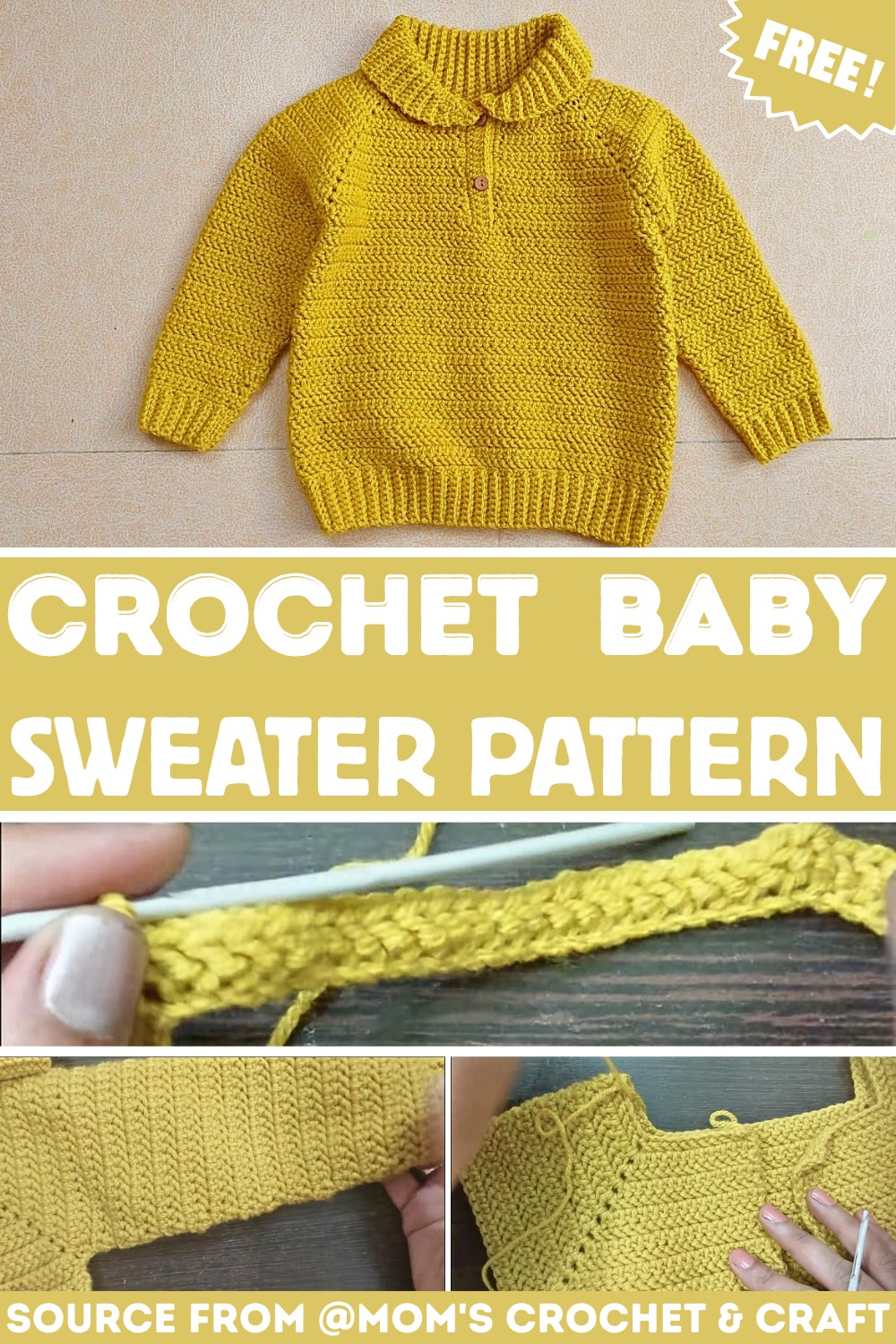
One final check is especially useful before wearing: confirm that four yoke corners remain clearly defined, stitch counts are consistent, and body and sleeve sections were turned after each required round. These details have the biggest effect on keeping raglan shape and herringbone texture looking even.