Crochet Sunflower Blanket Bouquet Pattern with Leaf Border
Need a blanket that doubles as a beautiful floral display? This sunflower design uses a round beige base, a leafy border, and dimensional blooms.
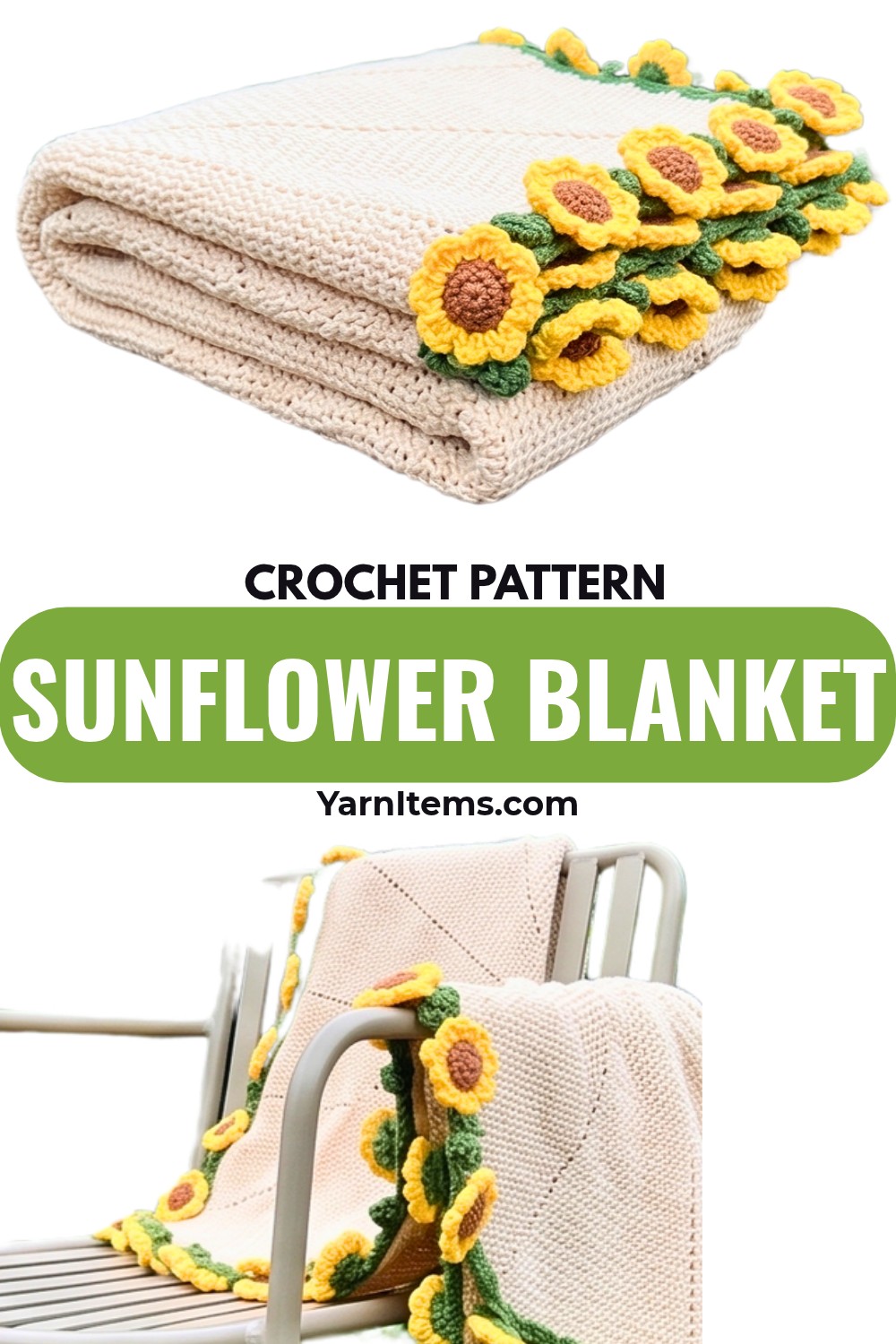
A cozy blanket can be much more than something warm to wrap around your lap, especially when its border is designed to become part of the finished display. This Crochet Flower Blanket Bouquet combines a soft beige round blanket with green leaves and bright, dimensional crochet sunflowers, giving the edge a cheerful garden-like appearance.
The crochet pattern builds the blanket in clear stages, from the mathematical increases of the beige center to the green leaf border and the individual stuffed flowers. You’ll also see how the blanket size can be adjusted before the border is added, how the sunflower centers and petals are formed, and where each flower should be attached so the gathered blanket creates its crochet bouquet effect.
Credit Myna Crochet
Choose the Blanket Size Before Adding the Border
The beige blanket body is worked from the center outward, so this is the stage where you have the most freedom to adjust the finished size. The supplied pattern continues through 32 rounds, creating a cozy lap-sized blanket.
If you want to make the blanket larger or smaller, the repeat rounds can be added or removed before starting the green border. This matters because the green edging is worked directly around the finished blanket edge, and the flowers are later matched to the leaves created there.
Once you are happy with the beige base, finish that section before moving on to the green border.
Materials & Tools
- Yarn: 5-ply cotton yarn, approximately 2 mm thick
- Beige for the blanket body
- Green for leaves and flower bases
- Brown for sunflower centers
- Yellow for sunflower petals
- Crochet Hook: 3.0 mm (5/0)
- Soft toy stuffing or Polyfill
- Yarn needle
- Stitch markers
- Scissors
Abbreviations
- MR: Magic Ring
- ch: Chain
- slst: Slip Stitch
- sc: Single Crochet
- hdc: Half Double Crochet
- dc: Double Crochet
- tr: Treble Crochet
- inc: Single Crochet Increase – 2 sc in the same stitch
- dcinc: Double Crochet Increase – 2 dc in the same stitch
- st(s): Stitch(es)
- [ ] or ( ): Repeat the instructions within the brackets as directed
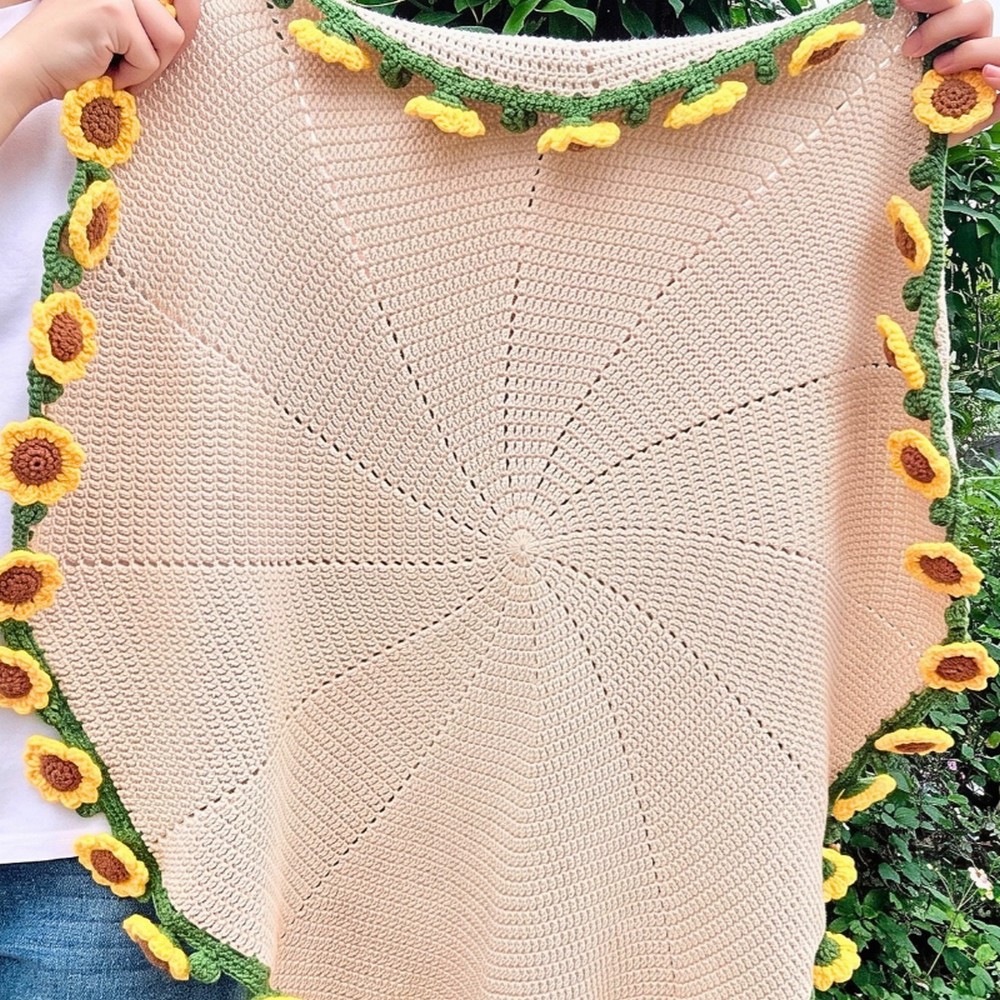
Crochet the Beige Blanket Body
Start with Beige yarn and the 3.0 mm hook. The blanket grows outward through a repeating increase structure, with each round adding one more dc before the increase.
Foundation: Make a magic ring and ch 2.
Round 1: Work 12 dc into the magic ring. Join with a slst to the first dc, then ch 2. (12 sts)
Round 2: (dcinc, ch 1) exactly 12 times around. Join with a slst, then ch 2. (12 groups)
Round 3: (dc, dcinc, ch 1, skip the 1st stitch of the next group) exactly 12 times. Join with a slst, then ch 2.
Round 4: (2 dc, dcinc, ch 1, skip 1st st) exactly 12 times. Join with a slst, then ch 2.
Round 5: (3 dc, dcinc, ch 1, skip 1st st) exactly 12 times. Join with a slst, then ch 2.
Round 6: (4 dc, dcinc, ch 1, skip 1st st) exactly 12 times. Join with a slst, then ch 2.
Round 7: (5 dc, dcinc, ch 1, skip 1st st) exactly 12 times. Join with a slst, then ch 2.
Round 8: (6 dc, dcinc, ch 1, skip 1st st) exactly 12 times. Join with a slst, then ch 2.
Round 9: (7 dc, dcinc, ch 1, skip 1st st) exactly 12 times. Join with a slst, then ch 2.
Round 10: (8 dc, dcinc, ch 1, skip 1st st) exactly 12 times. Join with a slst, then ch 2.
Round 11: (9 dc, dcinc, ch 1, skip 1st st) exactly 12 times. Join with a slst, then ch 2.
Round 12: (10 dc, dcinc, ch 1, skip 1st st) exactly 12 times. Join with a slst, then ch 2.
Continue the Increase Pattern
From here, the same mathematical sequence continues. For any given round n, use:
Round n: [(n-2) dc, dcinc, ch 1, skip 1st st] × 12 times.
Continue this repeat until you reach 32 rounds.
Round 32: (30 dc, dcinc, ch 1) exactly 12 times. Join with a slst and cut the yarn.
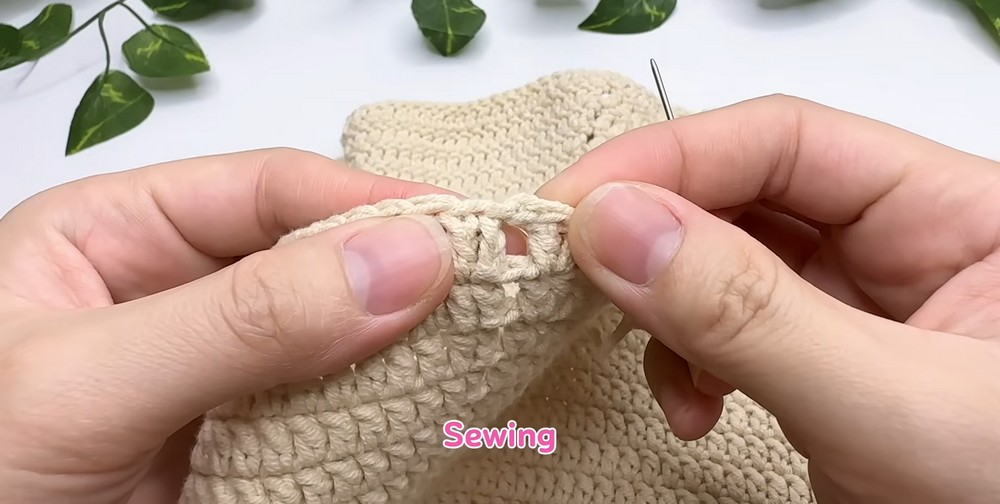
Use the yarn needle to neatly sew and weave in the final tail before beginning the green border.
Turn the Edge Into Green Leaves
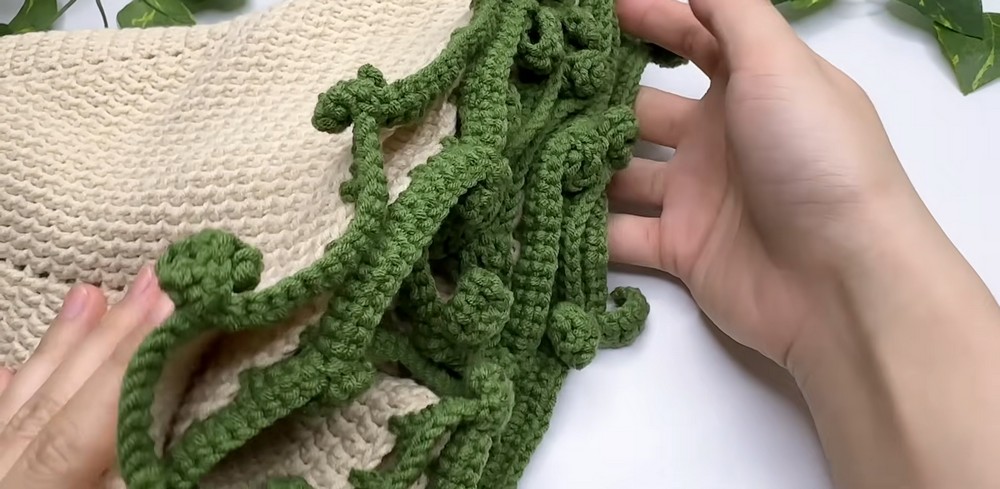
The green border is what gives the blanket its floral framework. Rather than attaching the flowers directly to the beige fabric, the border first creates a repeating foundation and then develops individual long leaves from it.
Switch to Green yarn.
Round 1: Attach the green yarn to the edge of the blanket. Ch 1. Work (sc, ch 3, skip 2 sts) repeatedly all the way around the blanket edge.
Round 2: Work [sc in the stitch, (3 sc into the ch-3 space)] repeatedly all the way around the blanket.
Shape the Long Leaves
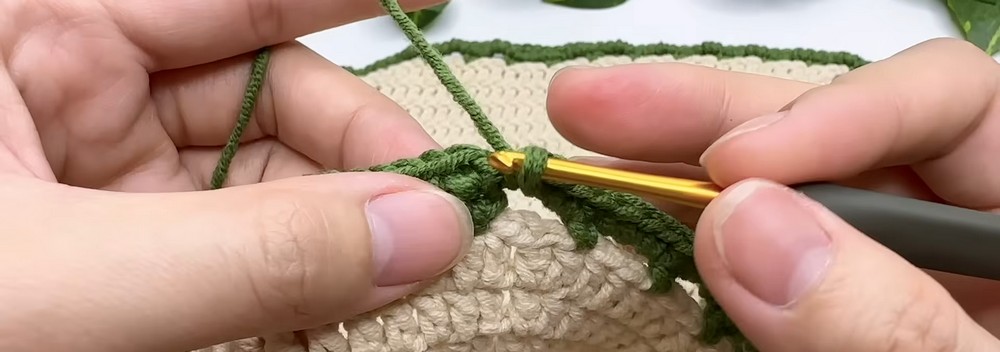
Round 3: Work {[slst, (ch 8; working down the chain: sc, hdc, dc, 2 tr in one chain, dc, hdc), slst back into the edge], then work 15 sc along the blanket edge} repeatedly around the blanket.
The long chain is shaped with progressively taller stitches, which gives the leaf its pointed, curved appearance. After completing each leaf, the 15 sc section creates the spacing before the next one.
Keep the leaf rhythm consistent around the entire edge because each finished leaf will later receive one sunflower.
Fasten off and cut the Green yarn.
Make the Sunflower Centers and Bases
The flowers are made separately, then joined through their Brown center and Green base before the Yellow petals are crocheted around them.
You will need enough sunflowers to correspond with the leaves around your blanket border.
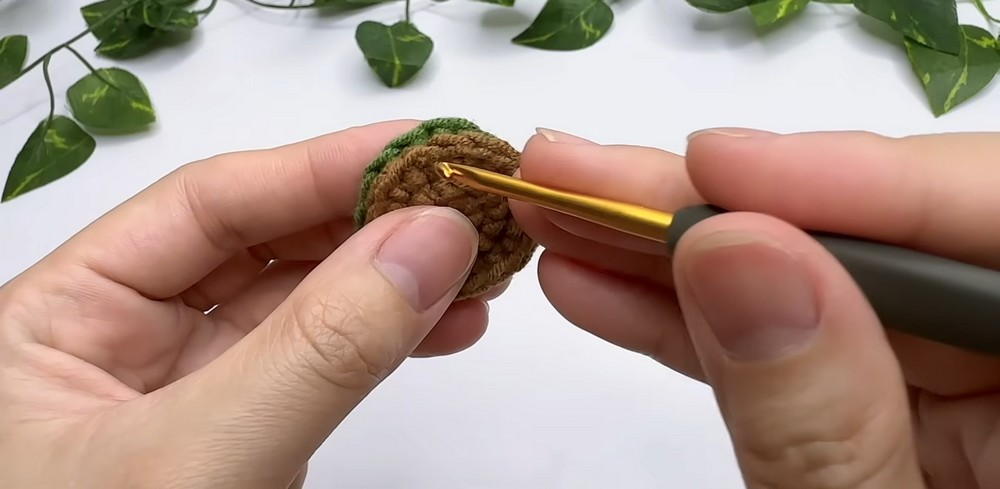
Brown Pistil
Using Brown yarn:
Round 1: 6 sc in a magic ring. (6 sts)
Round 2: 6 inc. (12 sts)
Round 3: (sc, inc) 6 times around. (18 sts)
Slst, ch 1, and cut the yarn.
Green Flower Base
Switch to Green yarn and repeat the same three rounds used for the Brown pistil:
Round 1: 6 sc in a magic ring. (6 sts)
Round 2: 6 inc. (12 sts)
Round 3: (sc, inc) 6 times around. (18 sts)
Do not cut the Green yarn immediately if you are using it for the transition, or follow the petal joining step.
Add the Yellow Sunflower Petals
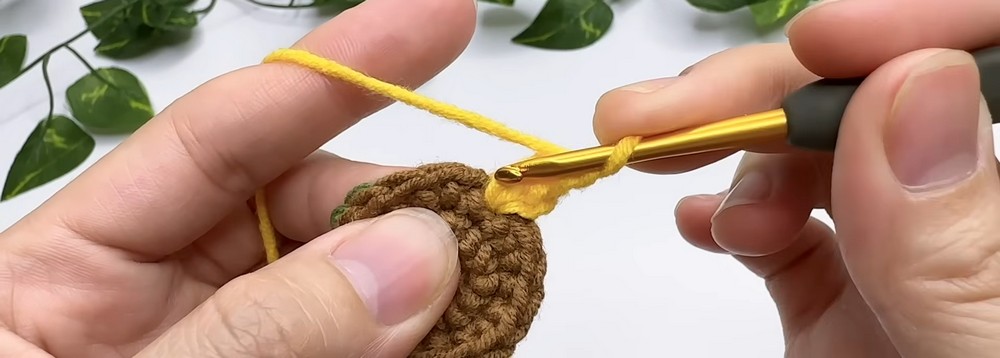
Place the Brown pistil and Green base back-to-back with their wrong sides touching. The Yellow petals are crocheted through both layers, which joins the two circular pieces while creating the flower shape.
Attach Yellow yarn and work the following sequence 9 times around: [ch 1, hdc, dc into the first stitch, ch 1, dc, hdc, ch 1 into the next stitch, slst]
This produces 9 petals per sunflower.
Add the Stuffing Before Closing the Flower
Stuff the flower while there is still an opening. Before completely closing the final two petals, pause and insert the soft toy stuffing into the center.
Add enough stuffing to give the sunflower a rounded, dimensional appearance without overfilling it.
Finish the remaining petals, slst, cut the yarn, and weave in the ends securely.
Match Each Sunflower to a Leaf
The border and flowers now come together in a simple one-to-one arrangement: one sunflower for each long green leaf.
Lay the completed beige blanket flat and spread the green border so the leaves are easy to see. Gather the finished stuffed sunflowers and place one flower at the tip of each leaf.
Before sewing, check the placement around the entire blanket. This makes it easier to keep the flowers evenly positioned and prevents accidentally attaching a flower to the wrong part of the border.
Sew the Flowers in Place
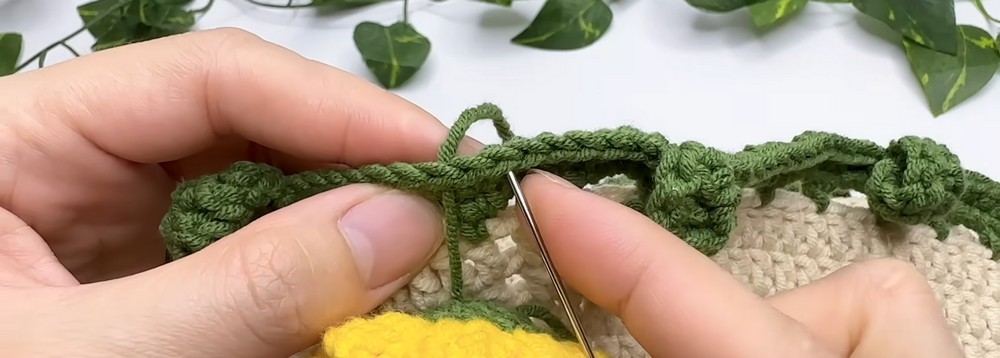
Thread the yarn needle with a long strand of Green yarn. Carefully sew the green back base of each sunflower securely to its corresponding leaf.
Keep the stitches firm enough that the flowers stay upright rather than drooping away from the border.
Once every sunflower is attached, snip any remaining yarn tails and weave them deeply into the crochet fabric so they are hidden.
A Bouquet Effect From the Finished Blanket
When the blanket is spread flat, the result is a warm beige throw framed with green leaves and bright sunflowers. The flowers create a cheerful floral edge without requiring separate pieces to be joined throughout the blanket.
When the blanket is gathered and folded from the center outward, the sunflower-covered edge comes together at the top, creating the distinctive appearance of a wrapped bouquet.
The same idea also leaves room for color changes. Keep the classic sunflower combination of Brown centers and Yellow petals, or use different flower colors around the edge to create daisies, roses, or another favorite floral theme.