Crochet Hydrangea Bouquet Blanket Pattern For Babies
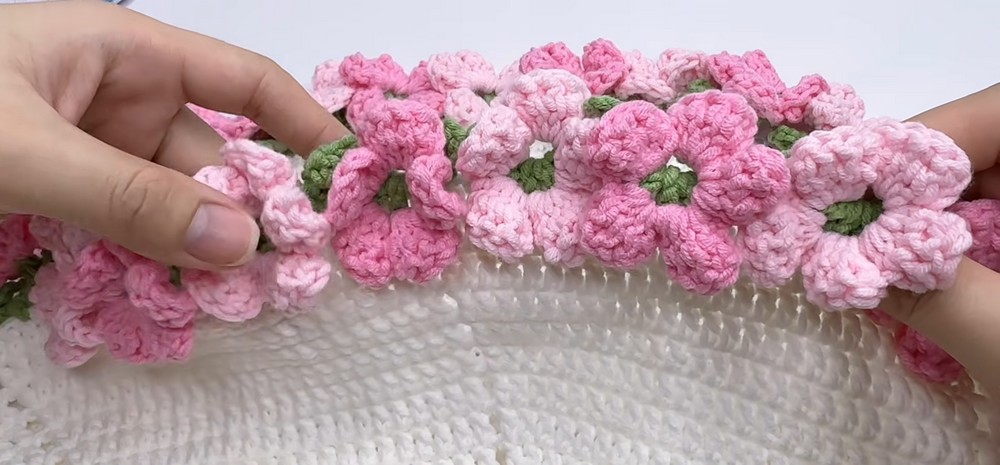
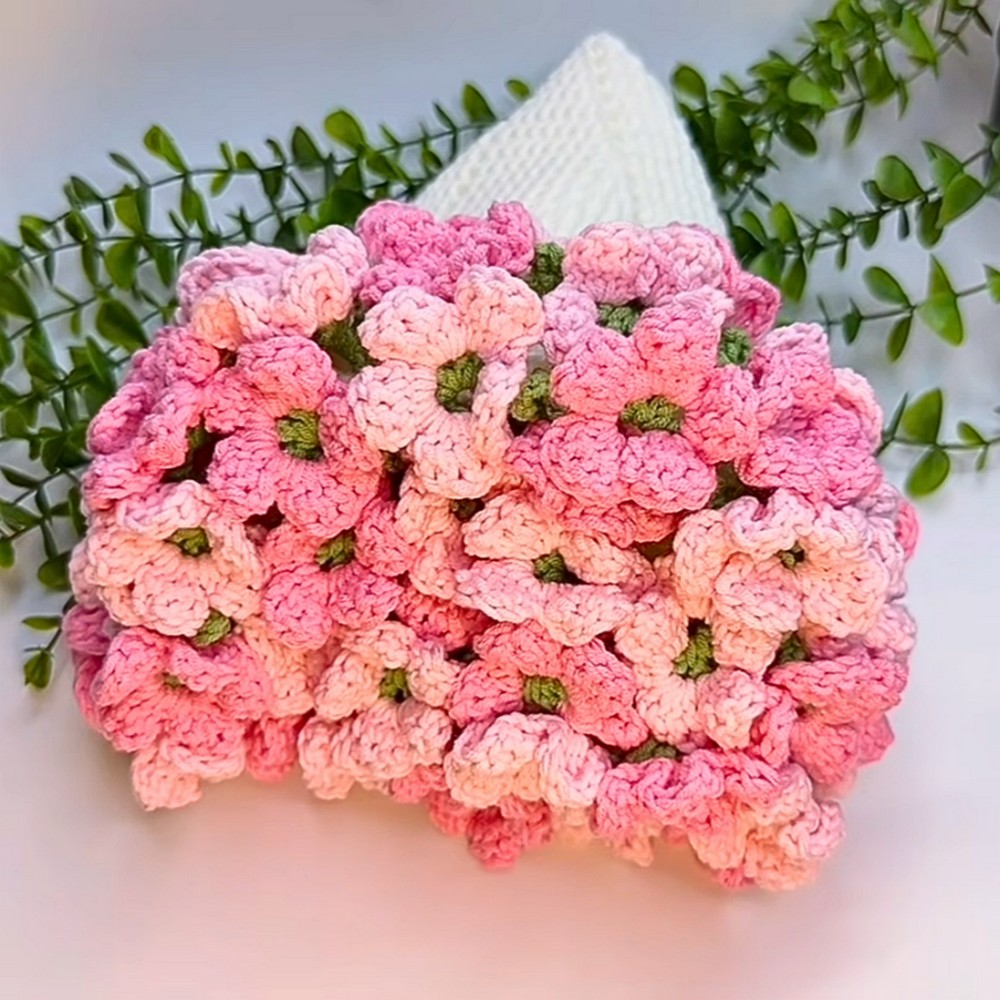
Here’s a swirled crochet bouquet blanket with a soft white center and a ruffled hydrangea border, where pink five-petal flowers bloom between leafy green loops.
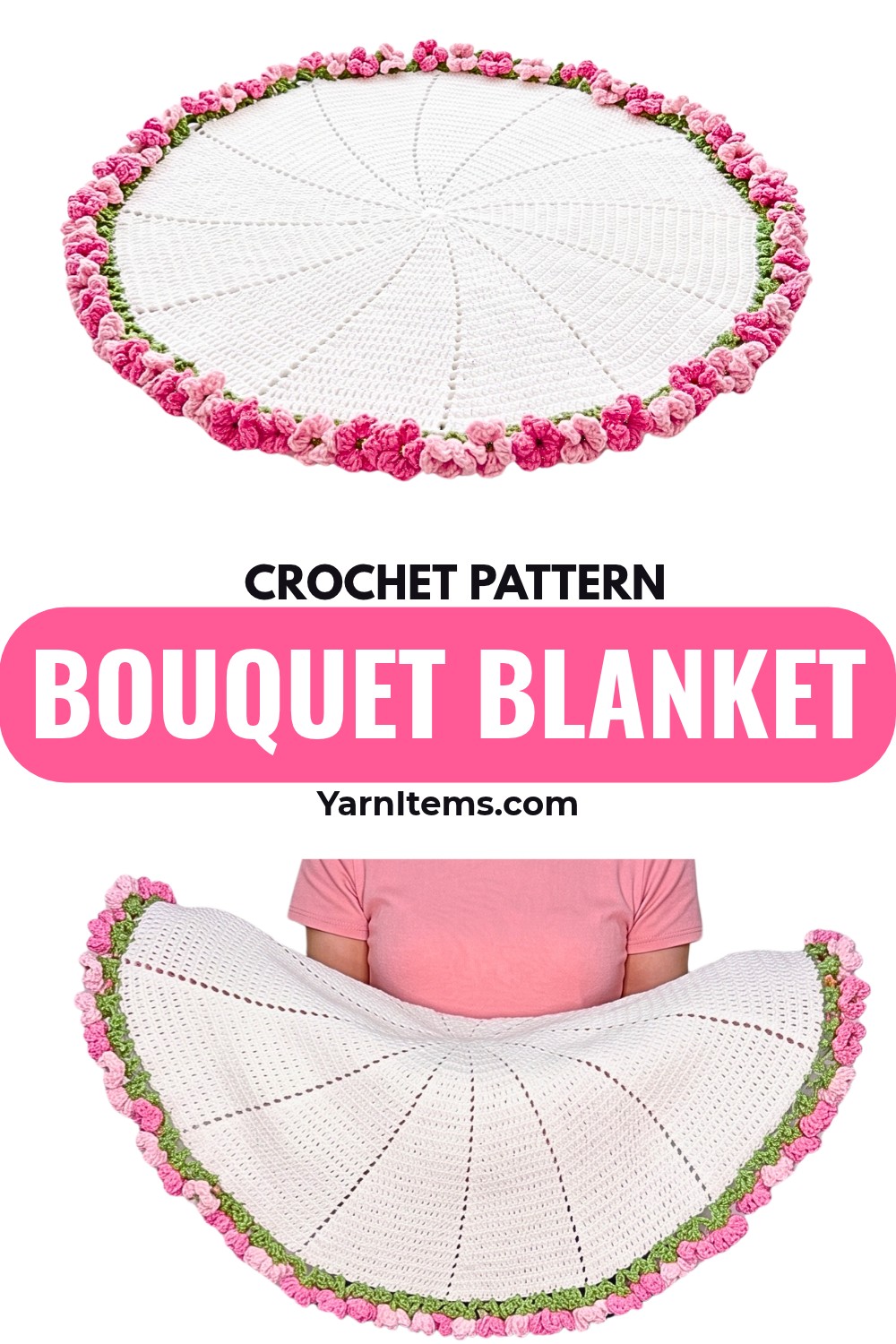
One glance at this round crochet blanket reveals two different textures working together: a gently spiraling white center and a full floral border made to resemble a hydrangea bouquet. The circular shape makes it especially sweet as a baby bouquet blanket or lapghan, while the dimensional edge gives a simple center a much more decorative finish.
You can work the base through the creator’s 28 rounds for the demonstrated crochet blanket, or stop earlier or continue farther using the same increase formula. The border uses green yarn for the leaf-and-loop framework, followed by dark and light pink crochet flowers worked directly into those loops. The tutorial also explains where the border needs a little securing so the finished edge keeps its shape instead of becoming heavy or uneven.
Credit Myna Crochet
Understand the Swirl Before You Start
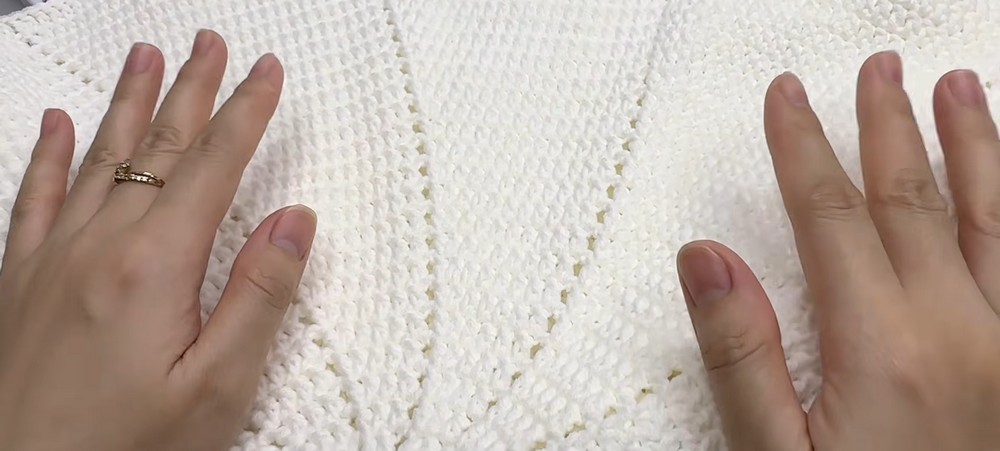
The white blanket base is built around 12 repeating sections. The first few rounds establish the increase pattern, and each new round adds one more dc before the increase.
The useful formula for the later rounds is: Rn: slst, ch 2, [ (n-2) dc, dc inc, ch 1, skip 1st ] × 12 times.
Here, n means the round number you are currently working. So the number of ordinary dc stitches in each section increases as the round number rises.
For example, Round 5 uses 3 dc before its increase. Round 6 therefore moves to 4 dc, and the same progression continues outward. This is what creates the characteristic 12-point swirl rather than a plain expanding circle.
The creator completes 28 rounds for the white base. If you want a smaller lapghan or baby blanket, you can stop earlier; for a larger blanket, continue the same formula beyond Round 28.
Yarn and Hook
- Yarn: Milk Cotton Yarn, 5-ply / 2 mm, in White, Green, Dark Pink, and Light Pink
- Crochet Hook: 3.5 mm
- Notions: Scissors, yarn needle, and stitch markers
Crochet Terms Used
- MR: Magic ring
- ch: Chain
- sk: Skip
- slst: Slip stitch
- sc: Single crochet
- dc: Double crochet
- tr: Treble crochet
- inc: Increase, working 2 stitches into the same stitch; typically a dc increase in this pattern
- st: Stitch
Work the White Swirl Base
Start with White yarn and establish the 12 repeating sections. The early rounds are written out individually so you can see exactly how the increase moves from one round to the next.
Once the pattern is familiar, Rounds 6 onward can be read directly from the formula rather than memorized one by one.
Round 1: 12 dc in a magic ring. Join with slst.
Round 2: slst, ch 2, (dc inc, ch 1) × 12 times.
Round 3: slst, ch 2, (dc, dc inc, ch 1, skip 1st) × 12 times.
Round 4: slst, ch 2, (2 dc, dc inc, ch 1, skip 1st) × 12 times.
Round 5: slst, ch 2, (3 dc, dc inc, ch 1, skip 1st) × 12 times.
Continue the Same Increase Formula
Rounds 6 to 28: Continue increasing outward. The creator provides this exact formula for all subsequent rounds: Rn: slst, ch 2, [ (n-2) dc, dc inc, ch 1, skip 1st ] × 12 times. (n represents the number of the round you are currently working.)
The important part is the relationship between the round number and the number of ordinary dc stitches. Each round adds one more dc to every section before the increase.
As the blanket grows, watch the twelve sections rather than only the outside circumference. If one section appears to be missing an increase, the swirl can become uneven even though the blanket is still growing.
The creator completes 28 rounds in total for the white blanket base. Fasten off the White yarn.
Give the Edge Its Leaf Framework
The green border is more than a decorative finish. Its first two rounds establish the spaces where the hydrangea flowers will later be worked, so accurate spacing here makes the flower placement much easier.
Join Green yarn to the outer edge of the completed white blanket.
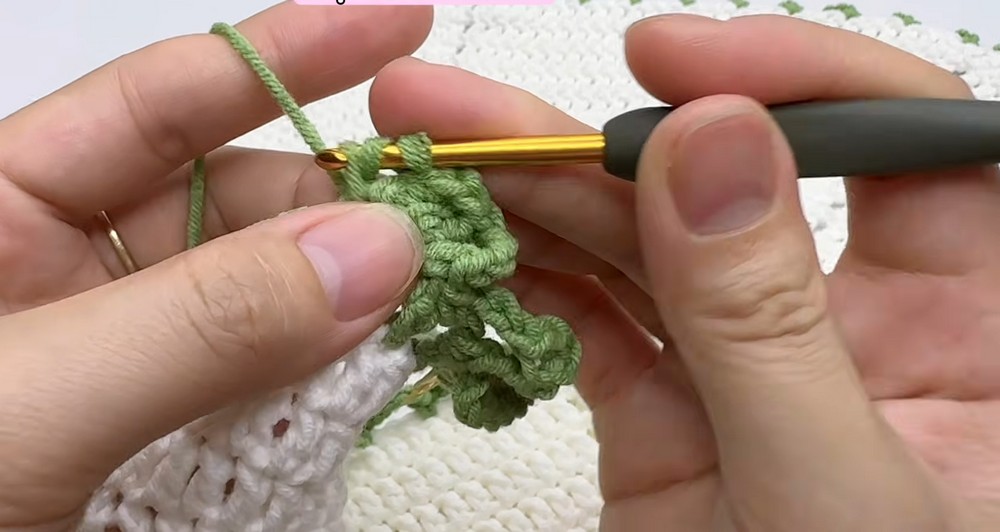
Round 1: (sc, ch 5, skip 2 st) × repeat around the entire border.
This creates a sequence of green stitches separated by chain loops. Keep these loops open and even because they become the framework for the next border round.
Round 2: {[sc, ch 3, (dc, ch 1) × 3, dc, ch 3, sc], (sc, ch 7, skip 3 st, slst, ch 3, sc)} × repeat around.
This round creates the alternating structure of leaf bases and open chain loops. The open loops are particularly important because the flowers will be crocheted directly into them.
Slst to join and fasten off the Green yarn.
Where the Flowers Go
Before changing to pink yarn, take a moment to identify the alternating loops created by Round 2.
The green border contains two visual elements: the areas shaped for the leaves and the more open loops intended for the flowers. The hydrangeas are not sewn on later as separate pieces; they are crocheted directly into the border loops.
That means the accuracy of the green round determines how naturally the pink flowers will sit around the blanket.
Add the Hydrangea Flowers
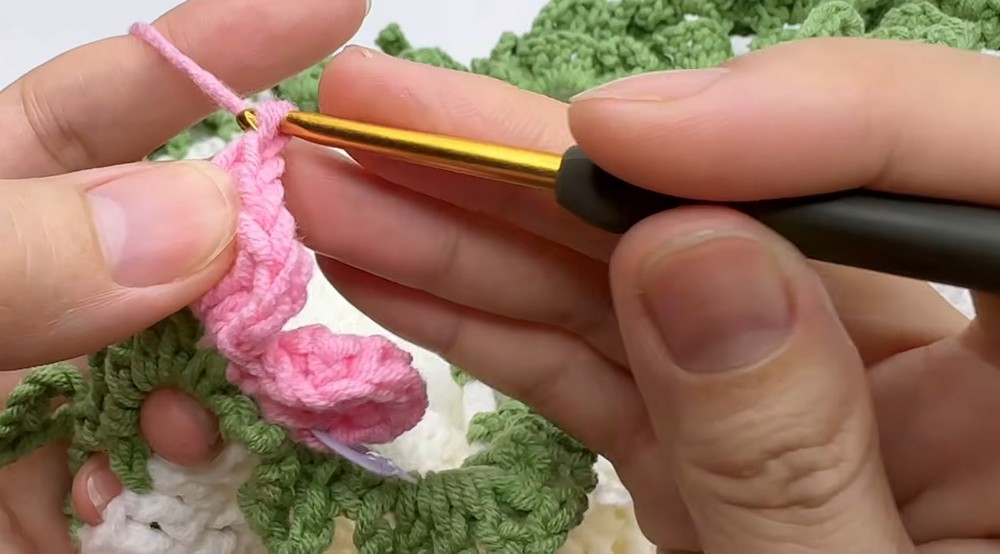
The floral edge uses two shades of pink. Dark Pink is worked into its designated loops first, followed by Light Pink in the alternating loops.
Each flower uses the same five-petal sequence, so once the first one is complete, the remaining flowers follow the same rhythm.
Dark Pink Flowers
Attach Dark Pink yarn to the designated loops on the border.
Flower Petals: (sc, ch 2, 4 tr, ch 2, sc) × 5 times.
This creates one five-petal hydrangea cluster. The four treble stitches give each petal its height, while the surrounding chains and sc stitches define the spaces between petals.
Slst, ch 1, and cut the yarn.
Light Pink Flowers
Attach Light Pink yarn to the alternating border loops.
Flower Petals: (sc, ch 2, 4 tr, ch 2, sc) × 5 times.
Use the same five-petal sequence as the Dark Pink flowers. Because the Light Pink flowers are placed in the alternating loops, the two shades work together across the green border rather than forming one continuous row of identical flowers.
Slst, ch 1, and cut the yarn.
Help the Heavy Border Sit Properly
Once the flowers and leaves are complete, the edge may have more texture and weight than the white center. A small amount of sewing helps control that extra dimension.
Secure the Green Leaves
Thread a yarn needle with matching yarn. Subtly sew the edges of the green leaves down to the white blanket base.
The aim is to tack the leaves, not flatten their entire shape. Keep enough of the raised portion visible so the leafy border retains its dimensional appearance.
Secure the Pink Flowers
Use the same approach with the pink flowers. Tack the petals gently against the green leaves so each bouquet section holds its intended position.
This step is especially useful where a flower or leaf tends to lift too far away from the blanket. A few discreet stitches are enough to stabilize the border without hiding its texture.
Finish the Back
Weave in all remaining loose tails on the back/wrong side of the blanket and trim any excess yarn.
The finished blanket has a white 12-point swirl center surrounded by a green leafy framework and alternating dark- and light-pink five-petal hydrangea clusters. If you want to make another version, changing the two flower shades to lavender, baby blue, or cream can give the same border a completely different floral character.