Fall Into Autumn Blanket – Jacob’s Ladder Crochet Pattern
Need a blanket with more than a simple color change? This autumn-inspired pattern combines two-row color bands with 17 braided Jacob’s Ladder loops.
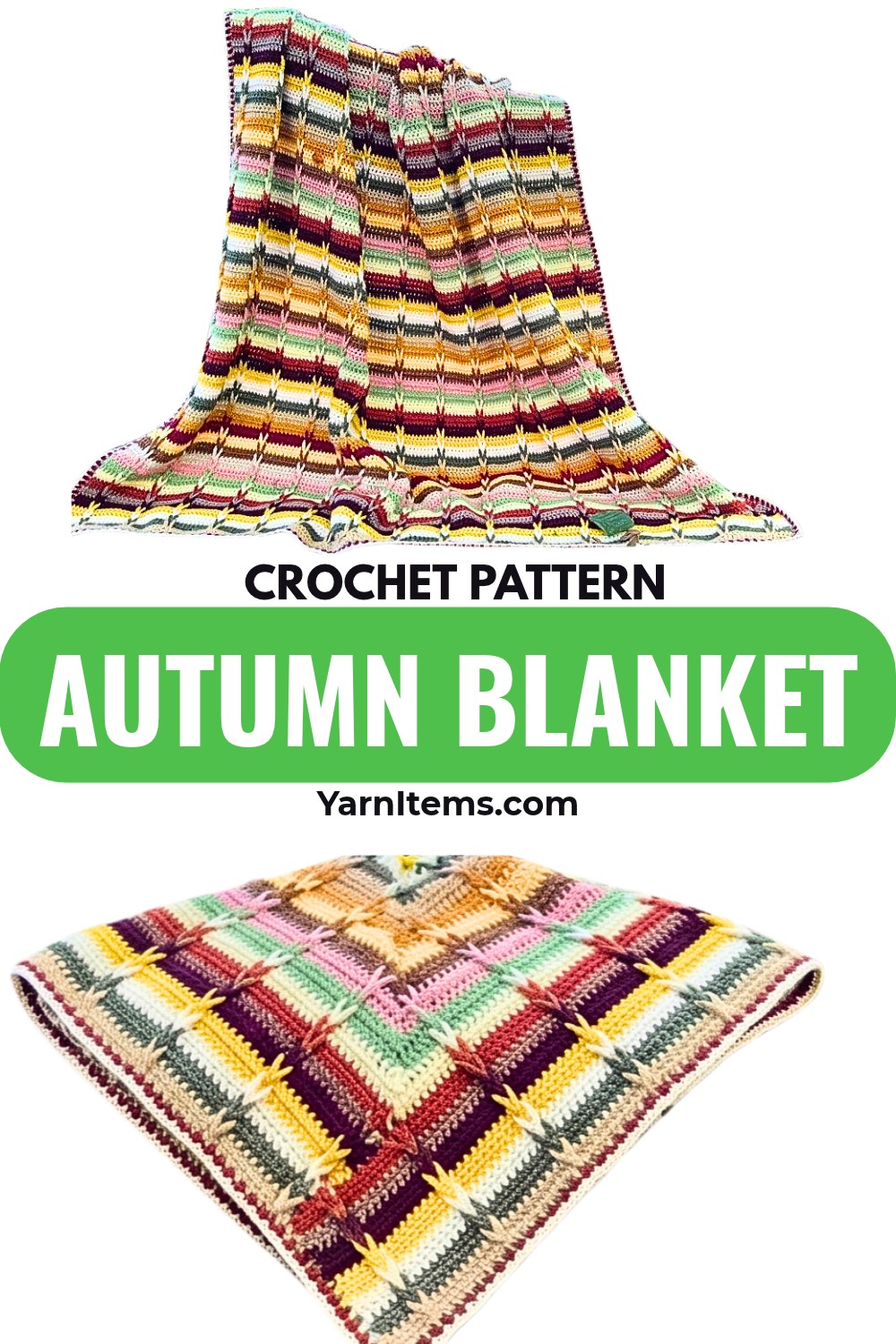
Autumn colors become even more eye-catching in this textured crochet blanket, where vertical Jacob’s Ladder braids run through the fabric like raised woven strands. The effect comes from a clever series of chain-10 loops that remain loose while the crochet blanket grows, then are linked together to create the distinctive 3D texture.
The starting chain and loop placement determine the crochet blanket’s width and the position of its 17 ladders, while changing colors every two rows gives the seasonal palette its striped rhythm. You’ll work the main body first, keep the loops loose as you build the height, braid them before the top edge is completed, and finally secure each braid before adding the three-round mesh border.
Credit Ophelia Talks Crochet
The Ladder System
There are two repeating rows behind the Jacob’s Ladder effect: a Loop Row, where the chain-10 loops are created, followed by a Solid Row of double crochet. The loops hang from specific stitches and stay loose on the front of the work while you continue building the blanket.
The important part is not to accidentally crochet over a hanging loop during a Solid Row. When you reach one of the stitches carrying a loop, move the loop forward and work the double crochet into the hidden top “V” of the stitch. The loop needs to remain free so it can later be pulled through the loop from the previous Loop Row.
Width and Color Planning
The supplied pattern begins with 187 chains and creates exactly 17 ladders. To change the width, add or subtract chains in multiples of 11.
The video uses autumnal DK-weight colors such as Khaki, Mocha, Claret, and Stone. The main blanket colors change every two rows. Placing contrasting shades beside one another helps the raised ladders remain visible.
Materials & Tools Needed
- DK weight yarn in multiple colors; the video uses an autumnal palette including shades such as Khaki, Mocha, Claret, and Stone
- 3.5 mm crochet hook, or the hook size appropriate for your DK yarn tension
- Stitch markers, including enough to secure all 17 ladder loops before the final border
- Scissors
- Yarn needle for weaving in ends
Crochet Terms
- ch = chain
- st(s) = stitch(es)
- sl st = slip stitch
- sc = single crochet
- dc = double crochet
- Loop-dc = Work 1 dc in the indicated stitch, chain 10, then insert the hook back into the body of the double crochet just made, yarn over, and pull through to make a slip stitch; this creates the hanging loop used for the Jacob’s Ladder braid.

Start the Main Blanket Body
The tutorial counts the foundation chain as Row 1, so the first actual stitch row is called Row 2. Keeping this numbering in mind will help the written instructions match the tutorial.
Row 1 (Foundation): Make a slip knot. Chain 187. Place stitch markers as needed to help count the foundation chain; the supplied guide suggests 3 groups of 50 chains plus 37 chains at the end.
Row 2 (First Loop Row): Ch 1 (turning chain, does not count as a stitch), skip the ch-1, place 1 dc in the 187th chain, place 1 dc in each of the next 4 chains, make a Loop-dc in the next chain, place 1 dc in each of the next 10 chains, make a Loop-dc in the next chain, repeat the sequence of 10 dc followed by 1 Loop-dc across until exactly 5 chains remain, then place 1 dc in each of the last 5 chains. (187 dc; 17 chain-10 loops hanging on the front)

Check the First Loop Row
Before moving on, make sure there are 17 hanging chain-10 loops across the front of the blanket. The five regular DC stitches at both ends help define the position of the first and last loop sections, so this is a useful point to check your count before continuing.
Row 3 (Solid Row): Ch 1, turn, place 1 dc in the first st and 1 dc in each st across; whenever you reach a stitch with a loop attached, push the chain loop forward and work the dc directly into the hidden top “V” of that stitch without trapping the loop; on the final pull-through of the last dc, cut the old yarn and pull the new color through to complete the stitch and change colors. (187 dc)
The loop should stay visible and loose on the front rather than becoming caught inside the Solid Row. The color change happens on the final pull-through of the last stitch, preparing the blanket for the next Loop Row.
Row 4 (Second Loop Row in New Color): Ch 1, turn, place 1 dc in the first 5 sts, make a Loop-dc in the 6th st, place 1 dc in the next 10 sts, make a Loop-dc in the next st, repeat the 10-dc and Loop-dc sequence across until 5 sts remain, then place 1 dc in each of the last 5 sts.
The new loops should line up with the loop positions established in Row 2. This alignment is what allows the loops to form continuous vertical ladders later.
Row 5 (Solid Row): Repeat Row 3, keeping every hanging loop free from the stitches and changing to the next color on the final pull-through of the last dc.
Rows 6–135: Continue repeating the 2-row pattern of one Loop Row followed by one Solid Row, changing colors every 2 rows on the final pull-through of the Solid Row. Continue until Row 135 is complete, leaving all chain-10 loops hanging loosely on the front of the work as the blanket grows in height.

Braid the Jacob’s Ladders
The braiding happens before the final top rows, while the loops are still available to be linked together. Lay the blanket completely flat so you can see the full length of each hanging loop and keep the chains from twisting.
Starting at the bottom edge, take the loop from Row 4 and pass it through the center of the loop from Row 2. Then take the loop from Row 6 and pass it through the loop from Row 4. Continue this same sequence upward, pulling each new loop through the preceding loop until you reach the top.
Repeat this process for all 17 ladder columns, keeping each chain flat rather than twisted. When you reach the top of the blanket, use stitch markers to secure the final loop of every braid so the ladders stay in place while you work the top edge.

What the Braid Should Look Like
Each ladder should now appear as a continuous raised chain running vertically through the blanket. The important orientation is: newer loop → through previous loop → continue upward.
If a chain becomes twisted while you braid, straighten it before pulling the next loop through. This keeps the finished ladder neat and clearly defined.

Secure the Top of Every Ladder
Once all 17 ladders are braided and temporarily secured, the final two rows permanently anchor them to the blanket.
Row 136 (Solid Prep Row): Attach your final color to the last st of Row 135. Ch 1, turn, place 1 dc in each stitch across, leaving the braided loops alone while they remain secured with stitch markers on the front. (187 dc)
Row 137 (Anchoring Row): Ch 1, turn the blanket so the loops are facing you, place 1 dc in the first 5 sts, remove the stitch marker from the first loop, yarn over and insert the hook through the next (6th) stitch and through the center of the braided loop at the same time, pull the yarn through and complete the dc normally to anchor the braid, place 1 dc in the next 10 sts, anchor the next loop in the following stitch using the same method, repeat across, then finish with 1 dc in the last 5 sts and fasten off.
The important placement here is that the hook passes through both the stitch and the center of the braided loop. That connection permanently holds the top of each ladder in place.

Frame It With the Mesh Border
The border uses three colors—Mocha, Claret, and Stone—and follows the same basic mesh rhythm around the top, bottom, and raw side edges. Keep an eye on the fabric while working the raw edges; laying the blanket flat periodically helps you see whether the border is sitting evenly.
Round 1 (Mocha): Make a slip knot with Mocha on your hook and, with the front of the blanket facing you, join in any corner stitch; in the corner work (2 sc, ch 2, 2 sc); along the top and bottom edges work ch 1, skip 1 stitch, sc in the next stitch and repeat across; along the raw edges work sc evenly around the posts of the edge stitches, aiming for roughly 3 sc for every two rows of dc, while chaining 1 between sc stitches to maintain the mesh look; work (2 sc, ch 2, 2 sc) in every corner; join with a sl st to the first sc and fasten off.
When working the raw edges, the goal is to keep the fabric flat rather than forcing a rigid stitch count. If the edge begins to pucker, lay the blanket flat and check the spacing before continuing.
Round 2 (Claret): Join Claret in any ch-1 space along a side; work 1 sc into the ch-1 space, ch 1, skip the next sc, and work 1 sc into the next ch-1 space, repeating along the sides; at each corner ch-2 space, skip the two sc stitches before the corner, work (2 sc, ch 2, 2 sc) in the corner space, ch 1, and skip the next two sc stitches; join with a sl st to the first sc and fasten off.
Round 3 (Stone): Join Stone in any ch-1 space; repeat the same mesh sequence as Round 2—sc in the ch-1 space, ch 1, skip the next sc—around all sides; work (2 sc, ch 2, 2 sc) in every corner ch-2 space; join with a sl st to the first sc and fasten off.
Final Check
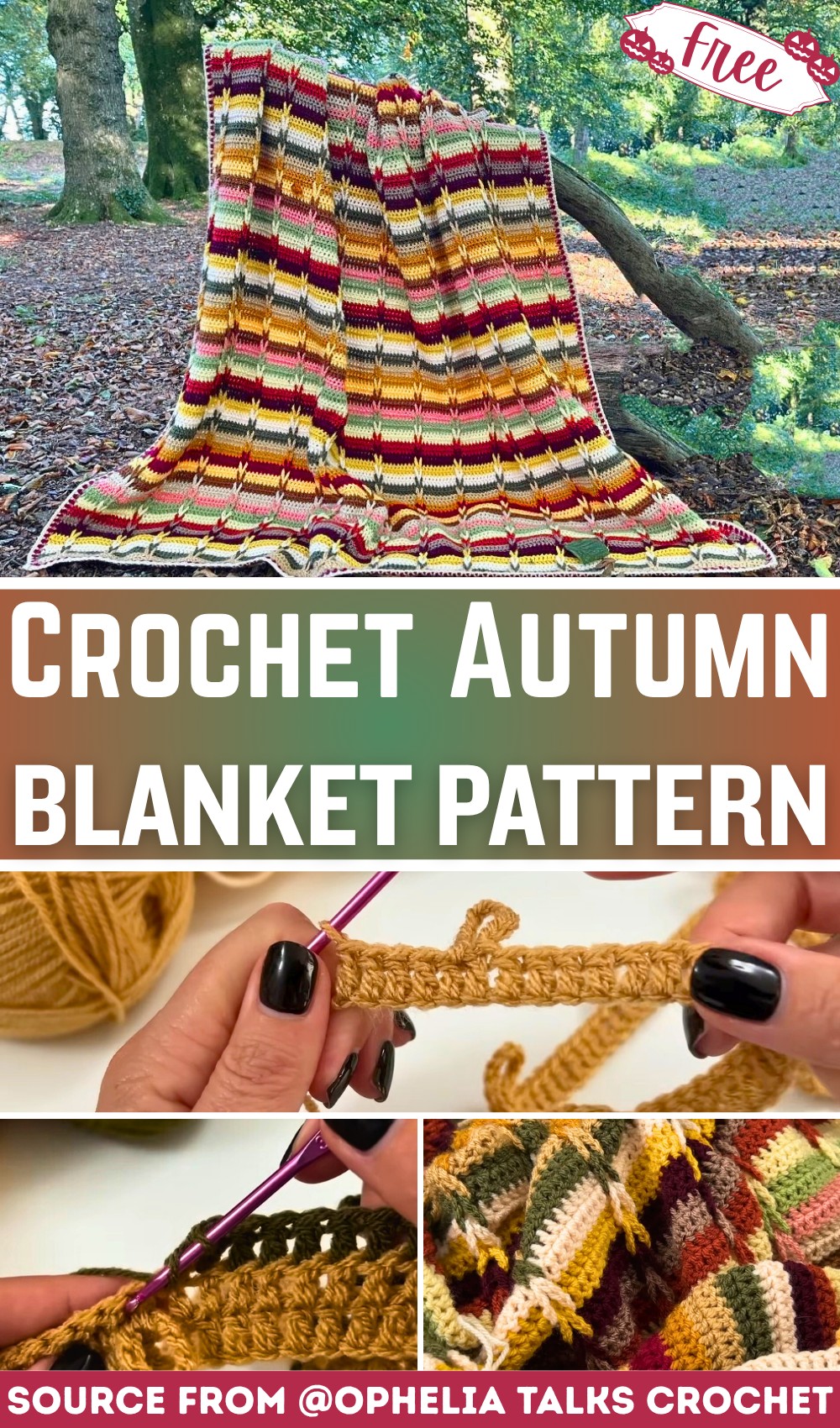
Before trimming away any remaining tails, look across the blanket and check the three main features: the 17 vertical Jacob’s Ladder braids should remain visibly raised, the top anchors should hold the braids securely, and the three-round mesh border should sit flat around the blanket.
Use the yarn needle to weave in all remaining ends. The completed piece combines the autumn color changes with the thick, braided ladder texture for a distinctly dimensional seasonal blanket.