Customizable Top-Down Crochet Raglan Sweater Pattern
Use your head measurement to begin this customizable crochet sweater, then build the yoke outward until the fit and shape are right.
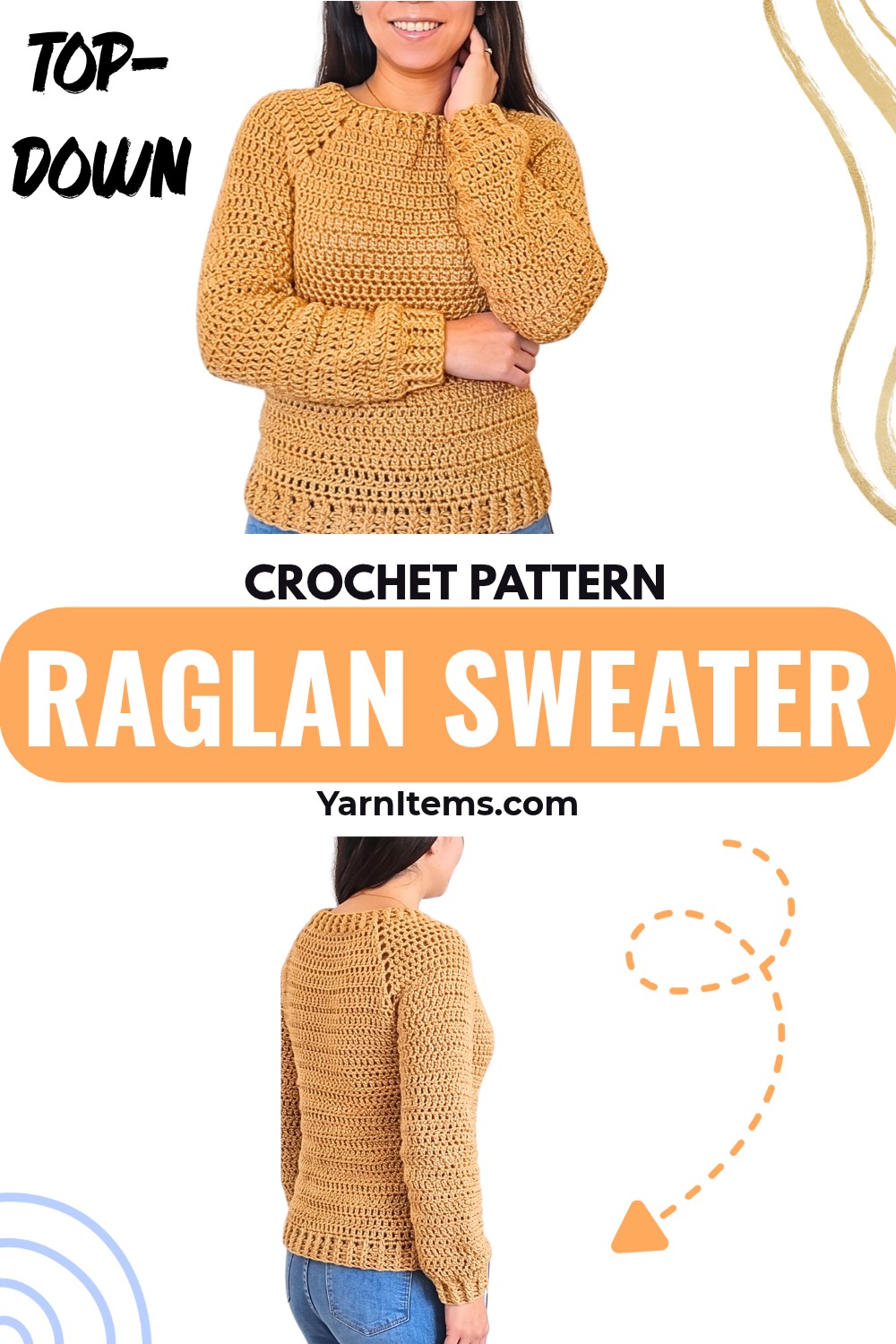
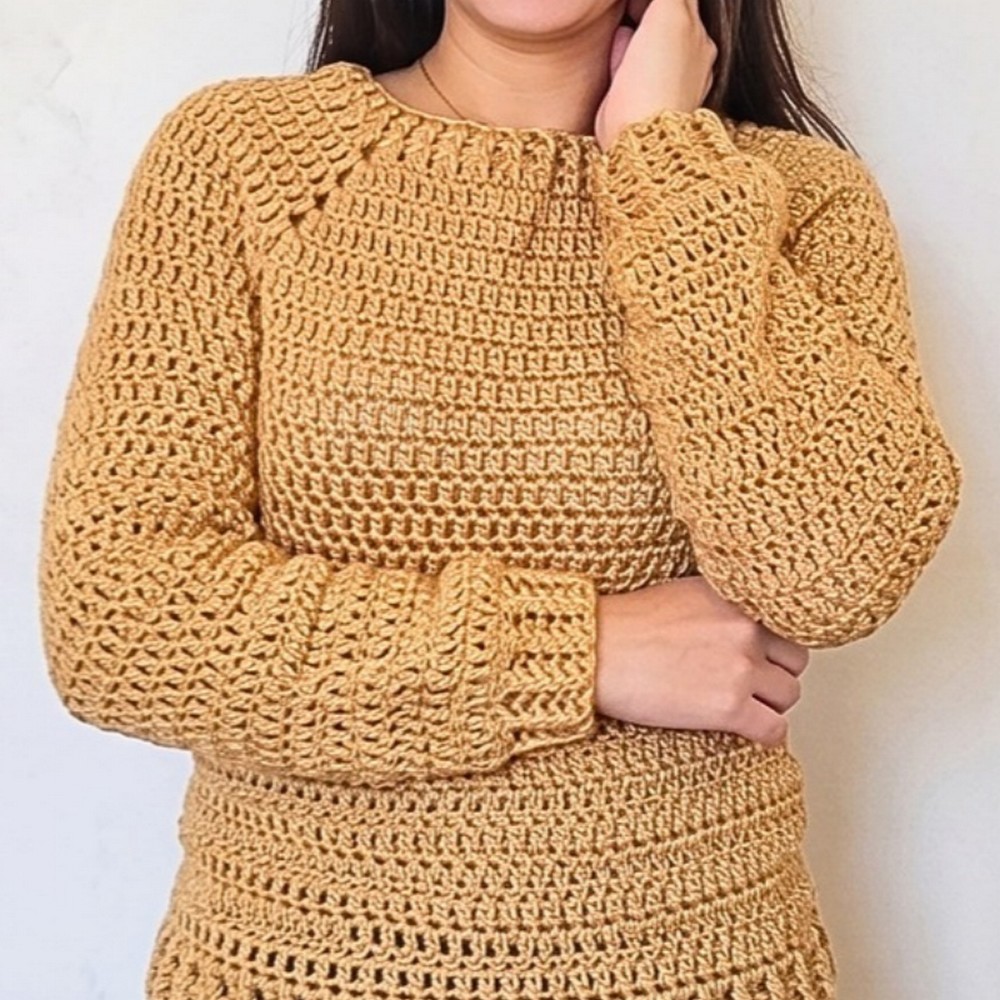
A top-down raglan crochet sweater has the advantage of taking shape from the neckline downward, so you can watch the fit develop instead of waiting until several separate pieces are finished. The simple double-crochet fabric is paired with ribbed cuffs and hem, giving the sweater an easy everyday shape with enough room to adapt the length and proportions.
This tutorial follows the full process from measuring and dividing the starting chain to growing the yoke, separating the sleeves, shaping the body, and adding the ribbed details. The size S measurements are included as a reference, while the starting chain, yoke depth, body length, and sleeve length can be adjusted according to the person wearing the crochet sweater.
Credit Tejidos Joss Ropa
Start With the Fit
Before choosing your stitch count, take the head measurement of the person who will wear the sweater. This measurement determines the starting chain, and the chain count needs to be adjusted to a multiple of 10. For the tutorial’s size S, the starting chain is 70 stitches and measures about 55 cm.
The yoke is where the sweater gains its width. Four corner spaces create the raglan increase points, while the sections between them form the back, front, and two shoulders. For the size S example, the 70-chain division gives 14 stitches to each shoulder and 21 stitches to both the front and back. Each additional yoke round adds 2 stitches to each section, so the yoke can continue growing until it reaches the desired armhole depth.
For the size S reference, the yoke depth is about 20 cm, the body measures about 40 cm across the chest/torso, and the total shoulder-to-bottom length is about 47 cm. The sleeve measures about 40 cm before the cuff and about 45 cm including the 5 cm cuff. These measurements are references rather than fixed limits.
Materials & Tools
- Yarn: 100% premium acrylic yarn, light #3/DK weight, approximately 170 meters per 100g skein. The tutorial uses Tren King by Revés Derecho.
- Amount: Approximately 450g for size S. The amount can change with size and yarn weight; thinner yarn generally uses less and thicker yarn more.
- Crochet Hook: 6 mm. The instructor uses a larger hook than the yarn label recommends because they crochet tightly and want the stitches to drape nicely.
- Notions: Scissors and a yarn needle for weaving in ends.
Pattern Terms
- Ch: Chain stitch
- Sl St: Slip stitch
- Dc: Double crochet
- FPdc: Front-post double crochet
- BPdc: Back-post double crochet
Build the Raglan Yoke
The most important part of the beginning is getting the foundation division right. Once the four corner spaces and four sections are established, the repeated increase rounds become much easier to follow.
Foundation Chain: Measure the wearer’s head circumference and chain to that measurement, adjusting the total to a multiple of 10; for size S, use 70 chains measuring about 55 cm. Divide 70 by 2 to get 35, divide 70 by 5 to get 14 stitches for each shoulder, then subtract 14 from 35 to get 21 stitches for both the front and back. Add 4 extra chains for the four corner increase spaces, giving 74 foundation chains to join. Keep the chain flat and untwisted, then sl st to the first chain to form the ring.
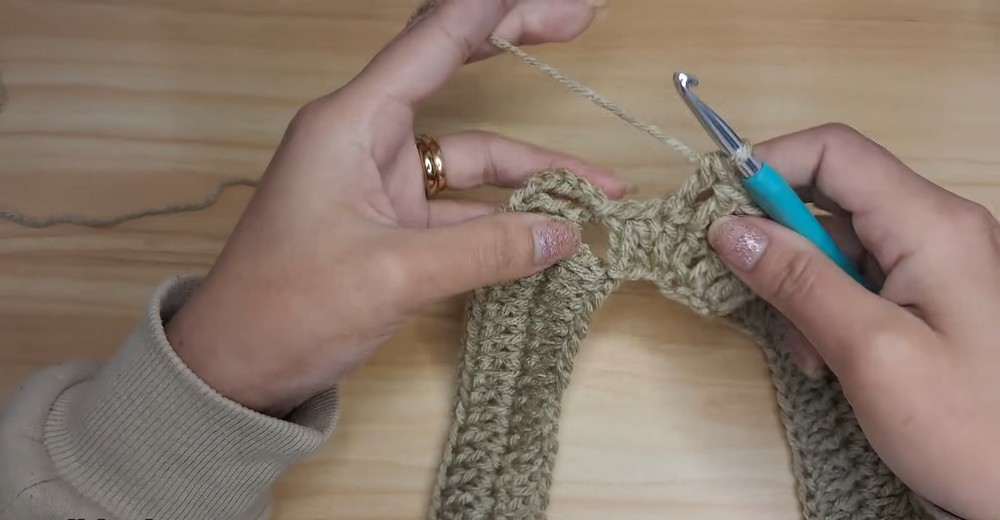
Round 1: Ch 5 (counts as 1 dc + 2 ch), work 1 dc in the same starting chain space, work 1 dc in each of the next 21 chains for the back, work [1 dc, 2 ch, 1 dc] in the next chain for the second corner, work 1 dc in each of the next 14 chains for the first shoulder, work [1 dc, 2 ch, 1 dc] in the next chain for the third corner, work 1 dc in each of the next 21 chains for the front, work [1 dc, 2 ch, 1 dc] in the next chain for the fourth corner, work 1 dc in each of the remaining 14 chains for the second shoulder, then sl st to the 3rd chain of the beginning ch-5.
The four corner spaces are the points that allow the sweater to widen. Before moving on, check that you can identify all four corners and that the front, back, and two shoulder sections are positioned around the neckline.
Round 2: Sl st over into the 2-ch corner space, ch 5 (counts as 1 dc + 2 ch), work 1 dc in the same corner space, work 1 dc in each dc across to the next corner, work [1 dc, 2 ch, 1 dc] in the 2-ch corner space, repeat the dc stitches across the next section and [1 dc, 2 ch, 1 dc] in each remaining corner space, then continue around and join as established.
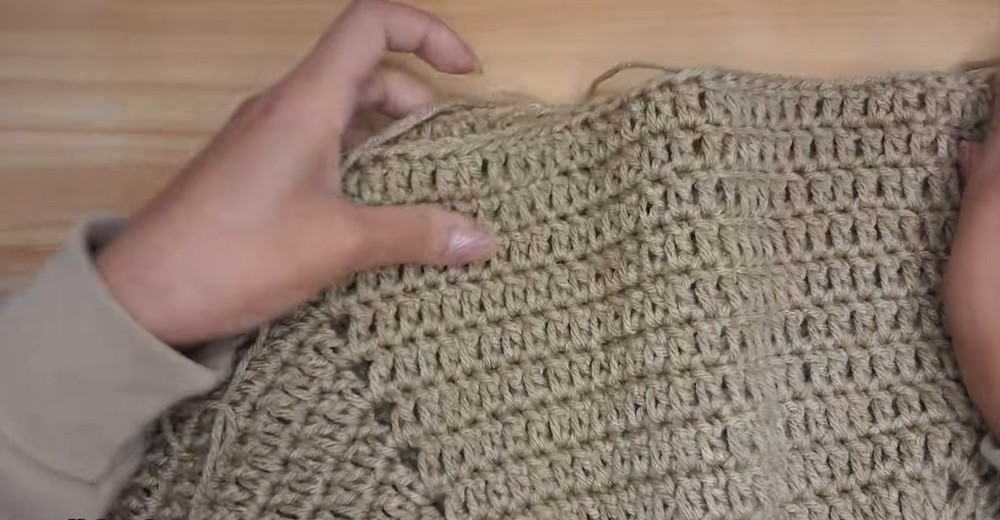
Yoke Increase Rounds: For every following round, sl st into the next 2-ch corner space, ch 5 (counts as 1 dc + 2 ch), work 1 dc in that same corner, work 1 dc in each dc across to the next corner, work [1 dc, 2 ch, 1 dc] in the corner space, and repeat this pattern around all four sections before joining. Each round adds 2 stitches to each section; continue until the yoke reaches the desired armhole depth, about 20 cm from the top for the size S reference.
At this point, the shape should resemble a growing circular yoke rather than a finished sweater body. The corner spaces should remain easy to identify because they are responsible for the continued width increase.
Separate the Body and Sleeves
Once the yoke has reached the depth you want, the next step changes the sweater from one growing yoke into separate body and sleeve areas. Take a moment here to make sure the front and back sections are where you expect them to sit.
Body Division: Finish the current yoke round and sl st to the 3rd beginning chain, then sl st into the first space and across to the first post after the corner space. Work dc across the front/back panel; when you reach the corner separating the body from a sleeve, insert the hook through the current corner space and simultaneously through the opposite corner space, then pull them together with 1 dc to bridge the armhole gap. Repeat the same separation at the second sleeve, then join with a sl st to the 3rd chain of the beginning.
The bridged corner spaces close the underarm opening so the front and back can continue as one body. Check both sides before continuing: the two sleeve openings should be separated from the body and should be positioned at matching points.
Work the Body
The body is worked in turned rows rather than continuing around in a spiral. This detail matters because turning keeps the seam straight instead of allowing it to travel diagonally.
Body Rows: After joining the body, ch 3 (counts as the first dc), turn the work inside out, work 1 dc in each stitch across, and turn at the end of every round; continue until the body reaches the desired length, with about 47 cm from shoulder to bottom as the size S reference, then join with a sl st.
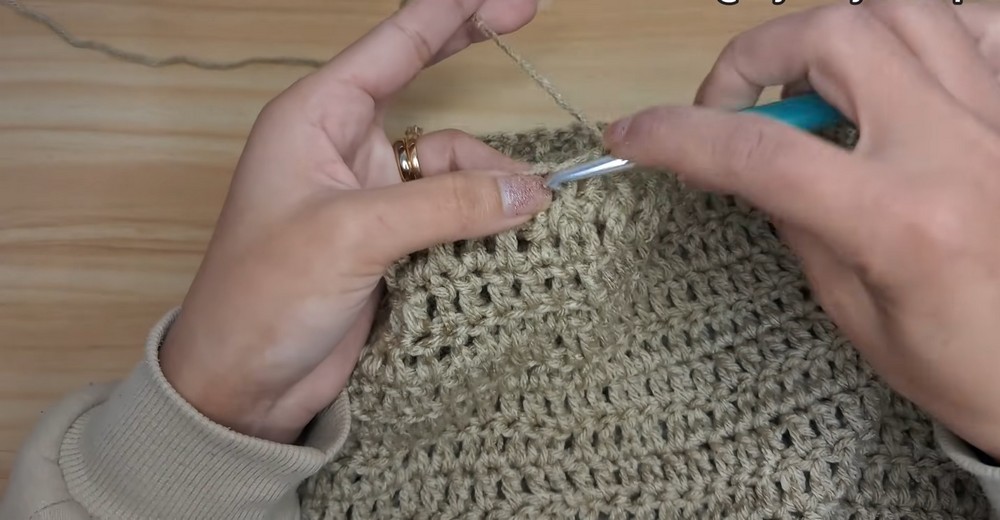
Bottom Ribbing: Keeping the yarn attached, ch 3, turn, and alternate 1 FPdc and 1 BPdc around the entire bottom circumference, then join with a sl st.
Ribbing Rounds: Ch 3 and work 3 more rounds while keeping FPdc over FPdc and BPdc over BPdc, without decreases, for 4 ribbed rounds in total and about 6 cm of ribbing; join with a sl st, cut the yarn leaving a long tail, and weave/backtrack the tail securely through the stitches with a yarn needle before trimming.
When checking the hem, look for clearly defined raised and recessed ribs. Keeping each FPdc over the previous FPdc and each BPdc over the previous BPdc is what maintains that texture.
Shape the Sleeves
The sleeve opening is now ready to become a full sleeve. Work the first sleeve completely before repeating the same process on the other side so you have a finished reference for the second one.
Sleeve Body: Make a slip knot and join the yarn at the center bottom of the armhole opening, ch 3 (counts as 1 dc), work 1 dc in each stitch around the sleeve opening—36 stitches for the size S example—then join with a sl st.
Sleeve Rows: Ch 3, turn the work, and work 1 dc in each stitch around, turning at the end of every round to prevent the seam from skewing diagonally; continue for 23 rounds, stopping about 5 cm short of the desired full arm length for the cuff, then join with a sl st.
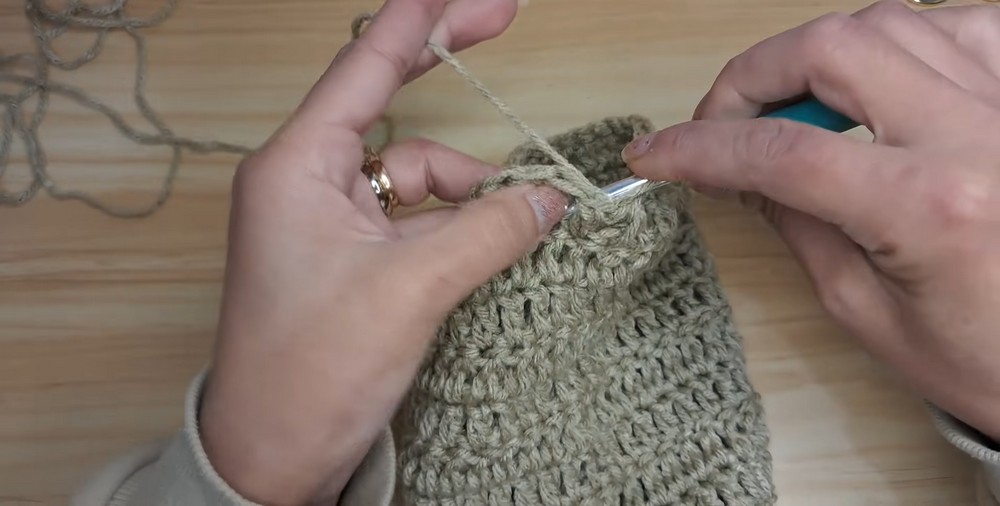
Keep the stitch count consistent between both sleeves. If the first sleeve has 36 stitches, check the second sleeve against it rather than relying only on visual comparison.
Cuff Decrease Round: Ch 3, then alternate 1 FPdc and 1 BPdc around the cuff while skipping every alternate stitch as described in the tutorial to create the built-in decrease and draw the cuff inward, then join with a sl st.
Cuff Ribbing: Ch 3 and work 3 additional rounds following the established FPdc and BPdc pattern without further decreases, creating about 5 cm of cuff ribbing; join, cut the yarn, and weave in the end.
Repeat the complete sleeve process for the second sleeve. Before moving to the neckline, compare the two sleeves for length, stitch count, and cuff shape.
Add the Collar
The neckline is the last major area to receive its ribbed texture, so the sweater can now be checked as a complete garment before the remaining ends are hidden.
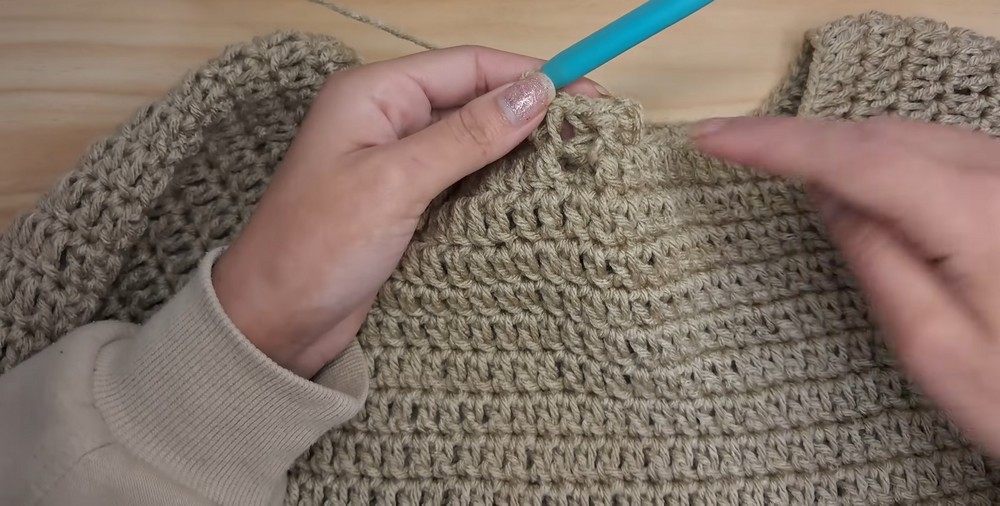
Collar Ribbing: Choose the back center of the neckline, attach the yarn with a slip knot, ch 3 (counts as 1 dc), then work 2 rounds of alternating FPdc and BPdc around the entire neckline without decreases; join with a sl st, fasten off, and weave in all remaining loose yarn tails.
The finished collar should sit evenly around the neckline without the ribbing being pulled inward by decreases. Since no decreases are made for these two rounds, keep the stitch placement consistent around the opening.
Size Adjustments
The same top-down formula can be adapted for children, teens, and adults. Start by adjusting the foundation chain to the wearer’s head measurement while keeping the chain count as a multiple of 10. From there, use the yoke depth as your next fitting check, then adjust the body and sleeve lengths according to the intended fit.
For a size S reference, use the tutorial measurements as checkpoints: about 20 cm for yoke depth, 40 cm across the body, 47 cm total body length, 40 cm sleeve length before the cuff, and approximately 45 cm for the sleeve including its cuff.