Made-to-Measure Top-Down Crochet Raglan Sweater Pattern
Need an adaptable crochet sweater? Start at the neckline, shape four raglan corners, then customize body and sleeves simply by trying it on as you go.
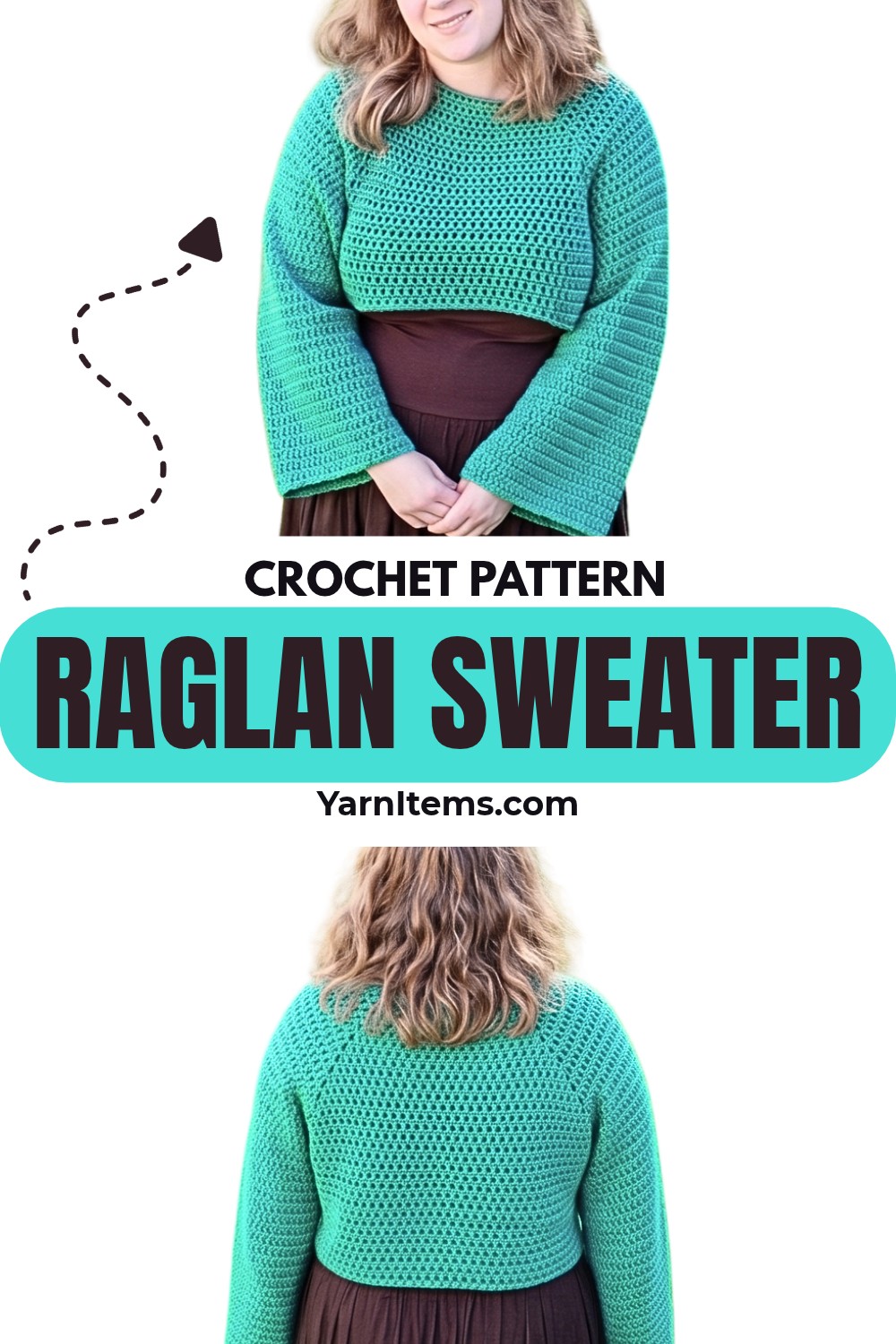
Starting at the neckline lets you shape this crochet sweater directly around your measurements instead of relying on fixed sizing. Double crochet creates simple fabric, while four raglan corners gradually give room for front, back, and sleeves.
Try the crochet sweater on during yoke shaping rather than waiting until finishing. Starting stitch count must be divisible by 6, and matching underarm chains on both sides will keep sleeves and body balanced. Once those points are set, body and sleeves continue with straightforward double crochet rounds.
Credit cozyromy
Materials & Tools
- Yarn: Any weight or yarn type can work. Creator used 400 g of DK weight / 8-ply acrylic-wool blend for an Australian size 16–18 cropped sweater. Have enough yardage for the chosen size and length.
- Crochet Hook: Hook size suited to your yarn. Creator used 5.0 mm.
- Stitch Markers: At least 4; earrings or scrap yarn can also work.
- Scissors
- Tapestry Needle: For weaving in loose ends
Choosing Gauge and Fabric
Make a swatch before beginning if possible. A smaller hook creates tighter fabric, while a larger hook produces more open, airy fabric.
Because this sweater is made to measure, fabric density affects both drape and final measurements. Check your swatch against desired fabric before committing to neckline length.
Size and Customization
This is made-to-measure, so the method can work from baby sizes through plus sizes.
Adjust Width
Neckline begins from your own comfortable neck measurement. Raglan stitch distribution then creates space for front, back, and sleeves.
Change Stitch Style
- Double Crochet: Stitch used in tutorial
- Single Crochet: Creates denser fabric
- Treble Crochet: Creates airier fabric
Shape Sleeves
Sleeves can be:
- Long and baggy, as shown in tutorial
- Cropped
- Flared
- Tapered by making 1 decrease every other round
Adjust Fit and Length
Body can be cropped, full length, or oversized.
Underarm chain count controls sleeve looseness. More chains create more room, while fewer chains create closer fit. Body and sleeve length can both be extended simply by continuing rounds.
Abbreviations
- CH: Chain
- ST(S): Stitch(es)
- SL ST: Slip stitch
- SC: Single crochet
- DC: Double crochet
- FDC: Foundation double crochet
- Stacked SC: Stacked single crochet, used as a starting DC substitute. Work SC in first stitch, then SC into left front loop of newly made SC.
- INC: Corner increase – 1 DC, CH 1, 1 DC worked in same stitch or space

How to Begin Neckline
Foundation creates complete neckline circumference, so fit should be checked before joining. Neck opening needs to slide comfortably over head without feeling restrictive.
Foundation: Tie slip knot and CH 3.
Foundation Double Crochet: Yarn over, insert hook into first CH, pull up loop, pull through 1 loop to create bottom chain, pull through 2 loops, then pull through final 2 loops. Repeat by working into the bottom “V” of the previous stitch until the neckline reaches a comfortable measurement around the neck and can slide easily over your head.
If FDC feels difficult, use regular chain and work DC into each chain instead.

Check Your Stitch Count
Count every completed stitch carefully.
Total stitch count MUST be divisible by 6.
For example, 54 stitches ÷ 6 = 9.
If the count does not divide evenly by 6, add or remove stitches before joining. This calculation controls raglan distribution, so correcting it now prevents uneven sections later.
Join: Make sure the foundation is not twisted; SL ST into the top of the first stitch to join in round.
Mark Raglan Corners
Divide total stitch count by 6. Call the resulting number X.
Distribution is:
- Back: X stitches
- Sleeve 1: X stitches
- Sleeve 2: X stitches
- Front: 2X stitches
Use four stitch markers to identify corner points.
Marker 1: Starting from the joining seam, count X stitches and place the first marker in the Xth stitch.
Marker 2: Skip X stitches without counting the marked stitch; place the second marker in the stitch immediately after the skipped section.
Marker 3: Return to joining seam and work opposite direction; count X stitches and place third marker in Xth stitch.
Marker 4: Skip X stitches and place fourth marker in stitch immediately after skipped section.
Marker Check
Before beginning increases, confirm X stitches sit between markers around each sleeve and back section, while front contains 2X stitches.
This check is worth doing twice. Incorrect marker placement will shift raglan corners and make later body or sleeve separation uneven.

Build Raglan Yoke
Each marked corner becomes an increase point. Working 1 DC, CH 1, 1 DC into each corner gradually expands fabric while preserving four raglan sections.
Round 1: Begin with Stacked SC or CH 2 and DC in same stitch; work DC in each stitch until first marker; remove marker and work 1 DC, CH 1, 1 DC in marked stitch; place marker onto newly created CH-1 space; continue DC until next marked stitch and repeat same Corner INC; continue around all four corners; SL ST to top of first stitch to join.
Round 2: Begin with Stacked SC or CH 2; work DC in each stitch until reaching CH-1 corner space; work 1 DC, CH 1, 1 DC in corner space; continue around and repeat same increase in every corner; SL ST to join.
Do not skip the hidden first stitch immediately after each corner space. This small placement point can easily reduce stitch count if missed.
Rounds 3+: Continue repeating Round 2, working DC between corner increases and 1 DC, CH 1, 1 DC in every CH-1 corner space.
Try sweater on every 4-5 rounds. Stop yoke increases when front corners comfortably reach underarm area or sit where you want body and sleeves to separate.
Fasten off with CH 1, cut yarn, and pull yarn through loop tightly.

Raise Back Neckline
Back extension adds extra height across back so sweater sits more comfortably over shoulders instead of pulling toward front neckline.
Back Extension – Row 1: Reattach yarn with SL ST into back right CH-1 corner space; work Stacked SC or CH 2 into space; DC across back of sweater until opposite back CH-1 corner space; work 1 DC into that space.
Row 2: Turn; work Stacked SC or CH 2; DC across row.
Rows 3–5: Continue working back and forth in the same manner for approximately 5 rows, or until front and back lengths line up evenly when sweater is laid flat and folded at shoulders.
Lay sweater flat before stopping. Even alignment at shoulders is more useful than following row count blindly.
Connect Underarms
Underarm chains create extra space between body and sleeve. This is where you can deliberately change sweater looseness.
Underarm 1: From the final stitch of the back extension, CH 5–12. Tutorial uses CH 12 for baggier sleeves; choose chain count according to desired fit. SL ST into corresponding front corner space on same side and fasten off.
Underarm 2: Attach yarn at opposite back corner; chain exactly same number used for first underarm; SL ST into corresponding front corner space and fasten off.
Keep both underarm chain counts identical unless intentionally making asymmetrical fit.

Crochet Sleeves
Sleeves begin from the middle of the underarm chain, helping place the joining point beneath the armpit where it is less noticeable.
Sleeve Round 1: Attach yarn with SL ST to middle of underarm chain; work SC into first half of underarm chains, such as 6 SC when using CH 12; work 1 DC into front corner space; continue DC around armhole opening; work 1 DC into back corner space; along rough edge of back-extension rows, evenly work 2 DC into side of each DC row; SC into remaining half of underarm chains, such as 6 SC when using CH 12; SL ST to first SC to join.
Spacing along rough row edge matters here. You are joining stitches to row sides, so forcing identical placement without considering available space can make the armhole edge ripple. Distribute DC evenly enough for fabric to lie flat.
Sleeve Round 2: Work Stacked SC or CH 2; DC into every stitch around; SL ST to join.
Following Rounds: Continue Stacked SC or CH 2 followed by DC in every stitch around; SL ST to join after each round.
Continue until sleeve reaches desired length.
For baggy sleeves, maintain straight rounds. For taper, add 1 decrease every other round. For cropped sleeves, stop earlier.
Repeat complete sleeve process for second side.
Count sleeve rounds as you work so both sleeves finish at matching length.
Complete Body
Body is worked after sleeve openings are established.
Body Round 1: Attach yarn with SL ST into middle of underarm area, working into bottom of SC stitches or chains created for sleeve opening; work Stacked SC or CH 2; DC across underarm chains; work 1 DC in corner space; continue DC in every stitch around body; ensure underarm section contains same number of DC as original chain amount, such as 12 DC under each arm when using CH 12; SL ST to join.
Body Rounds: Work Stacked SC or CH 2; DC into every stitch around; SL ST to join.
Continue rounds until body reaches desired length. Fasten off with CH 1, cut yarn, and pull through loop.
Optional Color Changes
Tutorial uses solid color, but stripes can easily be added.
To change color, switch yarn during the final pull-through step of the final SL ST from any round. This places new color at joining point and allows next round to begin cleanly.
Finish and Block
No sewing is required for this top-down raglan because body and sleeves are worked directly from joined sections.
Weave in Ends
Turn sweater inside out so wrong side faces outward. Use a tapestry needle to weave loose yarn tails securely through the back of the stitches. Trim excess after each end is anchored.
Wet Blocking
- Soak finished sweater in warm water for 20 minutes. Add wool wash if desired.
- Gently squeeze out excess water. Do not wring or twist.
- Roll sweater inside clean, dry towel and press gently to absorb remaining moisture.
- Lay sweater perfectly flat and shape it to desired dimensions while drying.
Blocking can relax stitches and add drape, especially when using wool or wool-blend yarn.

Fit Checks That Matter Most
Try sweater on several times during making rather than waiting until final round.
After neckline: Confirm opening comfortably passes over head.
During yoke: Check that front corners reach your intended underarm position. If corners sit too high, continue increases. If they extend too far downward, stop earlier.
Before sleeves: Compare both underarm chain counts. Matching numbers help keep sleeve placement symmetrical.
During body: Check length while garment is worn. Stop when hem reaches preferred cropped, standard, or oversized position.
This made-to-measure approach is what makes pattern adaptable across many sizes. Instead of changing entire stitch formulas, you adjust measurements at points where garment shape naturally allows it.