Short-Sleeved Crochet Sweater – Stylish and Light for Wear
Here’s a two-color granny stitch sweater designed around your measurements, with easy neckline shaping and adjustable short sleeves.
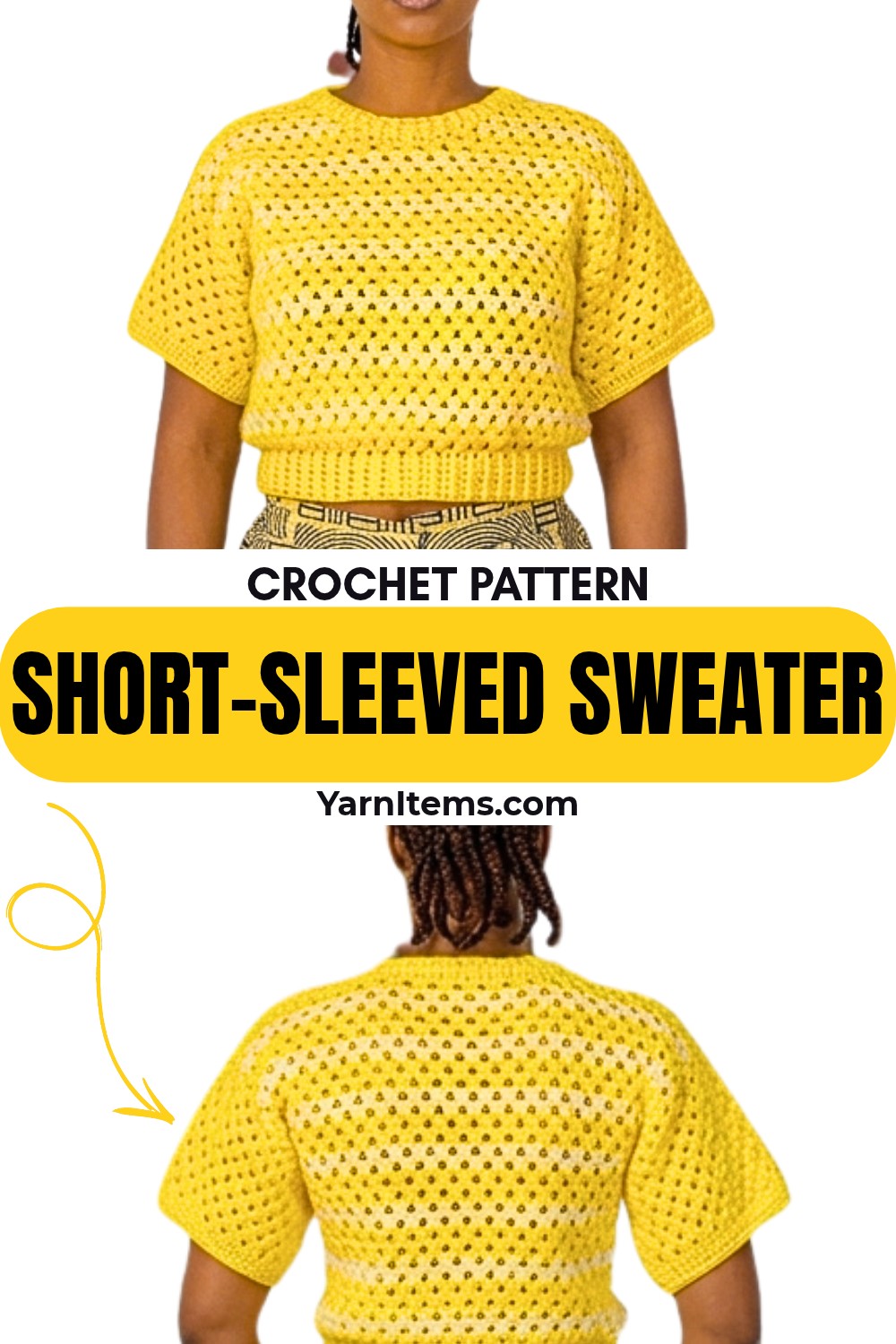
Classic granny clusters give this crochet sweater its recognizable texture, while two contrasting colors create a clean, eye-catching finish. The medium-weight yarn keeps the fabric comfortable and substantial, and the simple panel-based shape makes it easy to adjust the finished width and length.
Short sleeves, textured neckline ribbing, and a matching bottom band give the relaxed silhouette a more polished finish.
Sizing starts with one important measurement: your bust. Half of that measurement determines the width of each front and back panel, while the number of rows controls the length before neckline shaping begins.
Once both panels are complete, the shoulders and sides are seamed, the armholes are marked, and crochet granny-stitch rounds are worked directly around each opening. Keeping those measurements consistent from one panel to the next makes the final fit much easier to control.
Credit FTK Crochet
Why You’ll Love This Pattern
- Made to fit your style: Adjust the sweater’s length, neckline, sleeve length, and colors to create a version that feels like yours.
- Simple stitches, satisfying progress: The familiar granny-stitch rhythm makes each row easy to follow, while the growing fabric gives you a clear sense of progress.
- A great confidence builder: Once you get into the repeating rows, the pattern becomes comfortable and predictable, making it easier to stay motivated as your sweater grows.
- Easy to make your own: Keep the cheerful yellow-and-cream combination or experiment with your favorite shades for a completely different look.
- Comfortable with a handmade touch: The relaxed granny-stitch fabric gives the sweater a cozy feel while the adjustable details let you shape it around the fit you want.
Materials & Tools Needed
- Yarn: Medium-weight yarn in two colors, such as yellow and cream.
- Crochet Hook: 4.0 mm crochet hook.
- Measurement Tape: Useful for checking panel width, sweater length, neckline size, and armhole placement.
- Stitch Markers: Used to mark the neckline, shoulders, and armhole positions.
- Tapestry Needle: For joining the panels and weaving in yarn ends.
- Scissors
Choose Your Size Before You Begin
This sweater is demonstrated in a Medium size for a 37-inch bust, but the same method can be adjusted to other measurements.
Divide your total bust measurement by two to determine the approximate width needed for each front and back panel.
For example: 37-inch bust ÷ 2 = 18.5-inch panel width
For the sample, an 18.5-inch panel requires approximately 73 chains.
Measure your foundation chain rather than relying only on the chain count, because yarn, tension, and hook size can all affect the finished width.
Adjusting the Length
Add or remove rows before beginning the neckline shaping. Once the neckline decreases have started, the upper portion of the panel is divided into shoulders, so making major length changes becomes less convenient.
Adjusting the Neckline
The sample leaves 3 center clusters unworked, creating an opening approximately 2.5 inches wide.
For a wider neckline, leave approximately 3.5–4 inches of the center unworked, making sure the remaining shoulder sections stay balanced.
Adjusting the Sleeves
Sleeve length is controlled by the number of granny-stitch rounds worked around the armhole. Add or remove rounds before working the final straight dc and sc rounds.

Pattern Abbreviations
US crochet terms are used throughout:
- ch = chain
- st(s) = stitch(es)
- sl st = slip stitch
- sc = single crochet
- dc = double crochet
- fpdc = front post double crochet
- bpdc = back post double crochet
- cluster = 3 double crochet stitches worked into the same space
Front Panel
Make 1 front panel.
Foundation Chain: Create a starting chain measuring approximately half of your total bust measurement.
For the 37-inch Medium sample, make 73 chains.
Row 1: Ch 3 (counts as 1 dc); place 2 dc into the 4th ch from the hook to create the first cluster; skip 2 chs, place 3 dc in the next ch; repeat from * across; finish with 3 dc in the final chain.
Check that your first row reaches the intended panel width before continuing. If the measurement is off, adjusting the foundation chain now is much easier than trying to compensate with later rows.
Row 2: Ch 3, turn; skip the first cluster; place 3 dc into the space between the clusters of the previous row; place 3 dc into every space across; at the end, skip the final 2 sts and place 1 dc into the 3rd ch of the turning chain.
Optional Color Change
To change colors, ch 1, cut the yarn, and tie off. Reattach the new color to the first stitch on the opposite side.
Keep your color changes consistent if you want the two panels to align visually after seaming.
Row 3: Ch 3, turn; place 2 dc directly into the first space beside the turning chain; place 3 dc in each space across; finish by placing 3 dc into the last space.
Rows 4- 25: Repeat Rows 2 and 3 sequentially until the panel reaches your desired length before the neckline.
Length Check: Hold the panel against your body when you are close to the desired length. Make any length adjustments now, before beginning the neckline shaping.
Shape the Front Neckline
The neckline is created by leaving the center clusters unworked and gradually decreasing toward the shoulder edges.

Mark the Neckline
Count the clusters across the top of the panel to locate the center.
For the sample, leave 3 center clusters unworked, creating an approximately 2.5-inch neckline opening. Mark the opening so the same number of clusters remains on each shoulder.
The sample leaves approximately 11 clusters, or 8 inches, per shoulder.
Balance Check: Count the clusters on both sides before starting Row 26. Uneven shoulder widths will be noticeable once the front is joined to the back.
Row 26: Ch 3, turn; work 3 dc in each space across until reaching the stitch marker; in the space directly before the stitch marker, place 1 dc instead of a full cluster; cut yarn if changing colors.
This partial cluster begins the gradual neckline decrease.
Row 27 – Decrease. Turn the work and reattach yarn at the inner neckline edge; ch 3; skip the first immediate space; place 3 dc in the next space; work regular clusters to the end of the row.
Row 28Ch 3, turn; work 3 dc in each space across; at the neckline edge, place 1 dc in the final space.
Rows 29–32: Continue repeating the neckline decrease pattern, working a total of 7 rows of decreases.
Keep the decreases on the neckline side rather than the outer shoulder side. This preserves the shoulder width while gradually shaping the opening.
Row 33 – Final Row: Work one final row straight across with no decrease at the neckline edge, using your starting base color to coordinate with the bottom hem; tie off.
Second Shoulder
Repeat Rows 26–33 on the opposite side of the neckline.
Before moving on, compare both shoulders side by side. They should have matching widths and corresponding color placement.
Back Panel
Make 1 back panel.
Foundation Chain
Create a foundation chain identical to the front panel.
For the sample, make 73 chains.
Back Panel Rows
Repeat Rows 2 and 3 for a total of 33 continuous rows, or work enough rows to match the completed front panel height.
Unlike the front, the back panel is worked straight across with no neckline decreases.
Panel Match: Place the front and back together before seaming. Check the overall height, shoulder widths, and color arrangement. Small differences are much easier to spot while the panels are still flat.
Join the Shoulders
Lay the front and back panels flat together.
Count the clusters along the top edges and align the corresponding shoulder sections. For the sample, approximately 8 clusters per shoulder are joined.
Use stitch markers to hold the sections in place before sewing.
Shoulder Seam
Thread the tapestry needle with a long yarn tail; seam through the bottom loops of the corresponding stitches on each panel, keeping the seam aligned across the shoulder.
This method creates a neat, reversible seam while allowing the granny clusters to remain clearly visible.
Avoid pulling the yarn too tightly. The shoulder should lie flat without gathering the fabric.

Seam the Sides and Mark the Armholes
Align the front and back side edges.
Measure the armhole opening from the shoulder seam downward. For the sample, approximately 9 inches on the front and 9 inches on the back creates an 18-inch armhole opening.
Place a stitch marker at the point where the armhole should begin.
Side Seam
Starting from the bottom hem, whip stitch the side edges together; continue upward until reaching the armhole marker; tie off securely.
Repeat on the opposite side.
Fit Check: Try the sweater on before adding the sleeves. If the armhole feels too tight or too loose, this is the easiest stage to move the stitch marker and adjust the opening.
Finish the Neckline with Ribbing
The neckline combines a simple foundation round with textured front-post and back-post stitches.
Neckline Round 1: Reattach yarn at a shoulder seam; ch 2; place 2 dc in every cluster space along the jagged neckline decreases; on the straight edges, place 1 dc in each stitch; join with a sl st to the starting stitch.
Work carefully around the decrease sections. Using 2 dc in each cluster space helps create a smooth edge across the stepped neckline rather than leaving large gaps.
Neckline Round 2: Ch 2; work 1 fpdc in the next st, 1 bpdc in the following st; repeat from * around; join with a sl st.
Neckline: Round 3Ch 2; work 1 fpdc into each fpdc from the previous round and 1 bpdc into each bpdc; join with a sl st and tie off.
Keep each fpdc over an fpdc and each bpdc over a bpdc. Maintaining this alignment is what creates the continuous ribbed texture.
Work the Short Sleeves
The sleeves are worked directly around the armholes in rounds.
Sleeve Round 1: Reattach the base color at the bottom underarm seam; ch 3 (counts as 1 dc); skip to the next space and place 3 dc; work 3 dc in each space around the armhole; at the end, place 2 dc into the first space containing the starting ch-3 to complete the final cluster; join with a sl st to the top of the ch-3.
Sleeve Round 2: Ch 3; place 2 dc in the same starting space; place 3 dc in each space around; join with a sl st.
Rounds 3- 10: Alternate Rounds 1 and 2 until you have completed 10 total sleeve rounds.
Try the sweater on after several rounds if possible. Sleeve length and opening size can vary with individual tension, so measuring the actual sleeve is more reliable than depending only on the round count.
Round 11: Ch 2; work 1 dc in every stitch around; join with a sl st.
This straight dc round creates a clean transition between the granny clusters and the final sleeve edge.
Round 12: Ch 1; work 1 sc in every stitch around; join with a sl st and tie off.
Repeat the complete sleeve process for the second armhole.

Finish the Bottom Hem
The bottom edge receives the same textured ribbing idea as the neckline.
Hem Round 1: Reattach yarn at the bottom hem side seam; ch 2 and place 1 dc in the same space; place 2 dc in every space between clusters around the bottom of the sweater; join with a sl st.
Hem Round 2: Ch 2; work 1 fpdc in the next st, 1 bpdc in the following st; repeat from * around; join with a sl st.
Rounds 3-6: Ch 2; work 1 fpdc into each fpdc and 1 bpdc into each bpdc; repeat until you have completed 6 total rounds of bottom ribbing; join with a sl st and tie off.
Ribbing Check: Keep the post stitches aligned from one round to the next. If an fpdc is accidentally worked as a bpdc, the ribbing pattern will shift and become visibly uneven.
Final Finishing
Weave in all remaining yarn tails neatly on the inside of the sweater.
Give the finished sweater a light blocking if desired. Blocking can help the granny clusters settle into place while relaxing the tension around the neckline and bottom ribbing.

Before wearing, check the shoulder seams, side seams, armhole openings, sleeve lengths, neckline, and bottom band. If you have customized the measurements, use the finished garment measurements as your final reference rather than relying solely on the sample’s stitch counts.