Golden Horizon Top-Down Crochet Sweater Pattern
Bring soft Herringbone texture and bold color blocks together in this top-down crochet sweater, with adjustable sizing and underarm ease built into its simple shape.
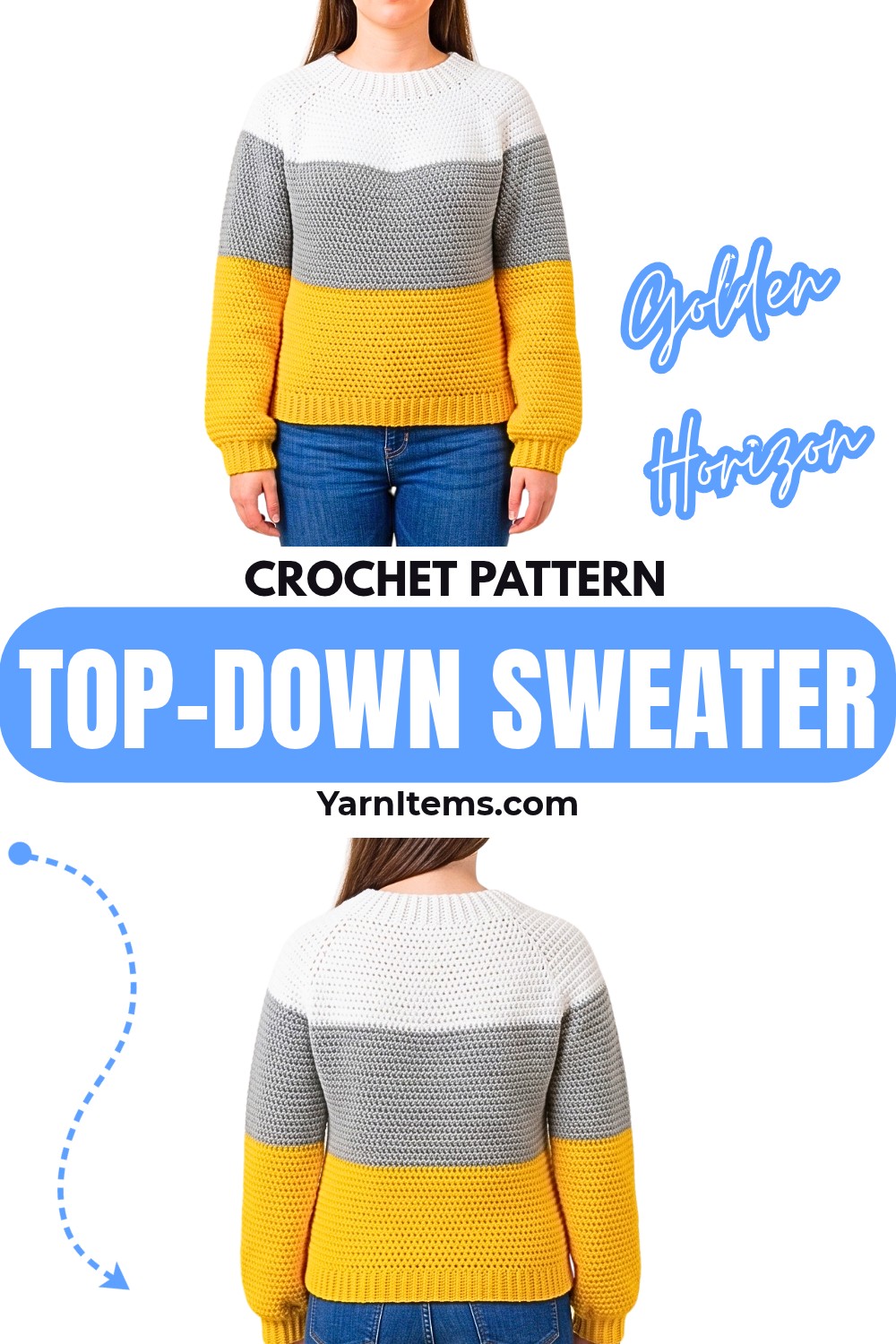
Golden Horizon combines three shades of worsted yarn with Herringbone Half Double Crochet for texture that resembles subtle knitted purl bumps. Light Gray begins at the neckline and yoke, Dark Gray carries through middle sections, and Mustard Yellow adds warmth toward the bottom of the body and sleeves.
Top-down crochet sweater shaping makes fit easier to monitor as you work. Neck ribbing can be sized around your head, increase rounds can stop once desired bust width is reached, and underarm chains can be adjusted for more or less movement. Sample follows Women’s Large measurements with approximately 213 crochet stitches around bust and 25 cm yoke depth.
Credit Lily’s Crochet Stitches
Materials & Tools
- Category 4 Medium Weight, 10-ply/Worsted, 100% acrylic yarn, approximately 100g per skein
- Light Gray yarn
- Dark Gray yarn
- Mustard Yellow yarn
- 5.0 mm crochet hook
- 4.5 mm crochet hook
- Stitch markers
- Measuring tape
- Yarn needle
- Scissors
Finished Size & Customization
Tutorial provides stitch counts for Women’s Large, with approximately 213 stitches around the bust and 25 cm yoke depth.
Top-down shaping makes several parts adjustable:
- Make neckline ribbing long enough to fit comfortably over your head.
- Stop increase rounds sooner for smaller sizing.
- Continue increase rounds longer for larger sizing.
- Once full bust width is reached, continue even HHDC rounds before separating sleeves.
- Use 6-8 underarm chains depending on desired ease.
- Add or remove sleeve rounds for preferred sleeve length.
- Add or remove body rounds for shorter or longer sweater length.
Checking bust width before sleeve separation is especially useful because this is your last major opportunity to adjust overall width without changing later sections.
Abbreviations & Stitch Guide
CH: Chain
SC: Single Crochet
BLO SC: Back Loop Only Single Crochet
SL ST: Slip Stitch
HHDC: Herringbone Half Double Crochet
INC: Increase – 2 HHDC worked into same stitch
ST(S): Stitch(es)
REP: Repeat
For HHDC, yarn over, insert hook into stitch, pull up loop and pull directly through first loop on hook like a slip stitch, then yarn over and pull through remaining two loops.
Right side of HHDC displays horizontal bumps that resemble knit purl stitches. Keep these bumps facing outward when checking finished sweater orientation.

Start Neck Ribbing
Use 4.5 mm hook with Light Gray yarn.
Foundation: CH 9.
Row 1: SC in 2nd CH from hook and in each CH across. (8 SC)
Row 2: CH 1, turn; SC in very first ST, BLO SC in next 7 STS. (8 SC)
Rows 3–80: REP Row 2 until reaching 80 rows, or continue until desired neck circumference is reached.
Joining: Fold ribbing in half with short ends together; SL ST or SC ends together to form continuous circle; do not fasten off.
Neck ribbing determines opening size, so check circumference before moving forward. It should pass comfortably over head without feeling excessively loose.

Build Yoke & Begin Herringbone Texture
Switch to 5.0 mm hook.
Foundation Round: CH 1; evenly place 1 SC into the edge of each ribbing row around the neckline. (80 SC for 80 ribbing rows.) SL ST to first SC to join; place stitch marker in first stitch.
Round 1: CH 2; work 1 HHDC in each SC around; do not join with SL ST, as following rounds are worked continuously in spiral; move stitch marker to first stitch of each new round. (80 HHDC)
Working continuously removes visible joining lines from the yoke. Keep marker easy to see because it identifies the beginning of every spiral round.
Round 2: *HHDC in next 3 STS, INC (2 HHDC) in 4th ST; REP from * around.
Round 3: HHDC in each ST around.
Round 4: *HHDC in next 4 STS, INC in 5th ST; REP from * around.
Round 5: HHDC in each ST around.
Round 6: *HHDC in next 5 STS, INC in 6th ST; REP from * around.
Continuation: Alternate one no-increase round with one increase round; with every new increase round, add one regular HHDC before each increase, progressing to increase every 7th stitch, then every 8th stitch, and continuing similarly.
This gradual spacing distributes increases across the yoke rather than concentrating extra stitches in one area. Keep checking stitch count if something begins to ripple or pull.

Change Colors & Check Yoke Fit
Tutorial uses 16 rows of Light Gray before changing to Dark Gray.
For sample Women’s Large sizing, stop increasing after 14 total increase rows. Once yoke reaches approximately 25 cm depth and desired bust width, work even rounds of 1 HHDC in every stitch with no further increases until sleeve division.
Do not rely only on row count when adapting sizing. Measuring across bust and checking how yoke sits around shoulders gives more useful information than matching sample counts exactly.
Divide Sleeves and Body
For sample Large, use approximately 213 stitches and mark sections as follows:
- Front: 78 STS
- First Sleeve: 28 STS
- Back: 78 STS
- Second Sleeve: 28 STS
Division Round: Starting at marker, HHDC across Front section (78 STS); at first Sleeve marker, CH 8 for underarm ease and skip 28 Sleeve STS; HHDC directly into first ST of Back section and HHDC across Back (78 STS); at second Sleeve marker, CH 8 and skip 28 Sleeve STS; HHDC into first ST of Front section to join body in round.
Check both sleeve sections before continuing. Front and back should contain matching stitch counts, while both sleeve sections should be equal.

Continue Body
Body Rounds: HHDC in every ST around, placing 1 HHDC into each underarm chain; continue continuous HHDC rounds until desired body length is reached.
Tutorial uses 20 rows of Dark Gray, followed by 20 rows of Mustard Yellow for body color blocking.
Underarm chains become part of body circumference, so make sure every chain is worked into on following rounds. Missing one can create an unwanted opening or alter body stitch count.
Add Bottom Hem Ribbing
Switch to 4.5 mm hook.
Row 1: From bottom edge, CH 9; SC in 2nd CH from hook and in each CH back toward body. (8 SC)
Row 2: SL ST into next 2 STS along sweater bottom edge; turn.
Row 3: Skip two SL STs just made; BLO SC in next 7 STS, SC in last ST. (8 SC)
Row 4: CH 1, turn; SC in first ST, then BLO SC in next 7 STs.
Continuation: REP Rows 2–4 around entire bottom edge; when beginning is reached, SL ST final row and starting chain together; fasten off.
BLO stitches create raised horizontal ridges that contrast nicely with HHDC texture. Keep ribbing tension consistent so bottom edge remains even around entire sweater.

Crochet Sleeves
Make 2 sleeves using 5.0 mm hook.
Round 1: Attach yarn at underarm using matching color; pull up loop and SC in first ST, then HHDC in each ST around armhole opening; if wide gaps appear near underarm chains, place 2 HHDC into those openings to close them; place stitch marker at round beginning. Target: 56 STS.
Rounds 2–42: Work continuous spiral rounds of HHDC; if stitch count becomes 57, make an invisible decrease by crocheting 2 HHDC together so both sleeves maintain 56 STS; work 42 total rows, or continue to desired sleeve length; change to Mustard Yellow after completing 9 rows of Dark Gray.
Count completed rows on first sleeve before starting second sleeve. Matching row totals will help keep cuffs level.
If underarm area has visible gaps during first sleeve round, address them immediately with 2 HHDC in wide openings rather than leaving holes to close later.
Shape Wrist Ribbing
Switch to 4.5 mm hook.
Row 1: From sleeve edge, CH 9; SC in 2nd CH from hook and in each CH back down. (8 SC)
Row 2: SL ST into next 3 STS along sleeve edge; turn.
Row 3: Skip 3 SL STs; BLO SC in next 7 STS, SC in last ST.
Row 4: CH 1, turn; SC in first ST, BLO SC in next 7 STS.
Continuation: REP Rows 2–4 around wrist; SL ST ribbing ends together; pull yarn through to inside and tie secure knot.
Three slip stitches per ribbing section create a slightly narrower cuff than the bottom hem, giving the wrist edge more taper.
Repeat complete sleeve and cuff process for second side.
Finish Color Changes & Loose Ends
Top-down shaping means most of the sweater remains seamless, so finishing mainly involves securing yarn tails from color changes and ribbing joins.
Turn sweater inside out and use a yarn needle to weave all loose ends securely through the wrong side. Trim excess after tails are firmly secured.
Before wearing, confirm the correct right side is facing outward. HHDC side with visible horizontal Herringbone bumps should be outside.
Relax Herringbone Texture
Acrylic yarn can benefit from gentle finishing that helps stitches relax and improves drape.
Block the finished sweater by hanging it or gently steaming it to loosen acrylic fibers and relax HHDC texture. Avoid excessive heat, especially when steaming acrylic, since high heat can permanently alter yarn fibers.
Once the sweater has relaxed, check the bottom hem, cuffs, and neckline for even edges. Top-down shaping also makes it easy to assess final proportions before first wear.

Fit Checks Worth Making
Golden Horizon is easiest to customize at three points: neckline, yoke, and underarms.
Check neckline before leaving ribbing. Measure yoke depth and bust width before sleeve separation. Finally, choose 6–8 underarm chains based on desired movement and ease.
For smaller sizing, stopping increase rounds earlier reduces overall circumference. For larger sizing, continue increase rounds until bust width is reached, then work even HHDC rounds.
Color placement can also be changed without changing stitch pattern. Light Gray, Dark Gray, and Mustard Yellow create tutorial color blocks, while different combinations can give the same Herringbone texture an entirely different look.