Crochet Granny Stitch V-Neck Baby Sweater Pattern for 0–3 Months
This granny stitch V-neck crochet sweater brings texture and softness together in one tiny handmade layer, with simple length adjustments for growing little ones.
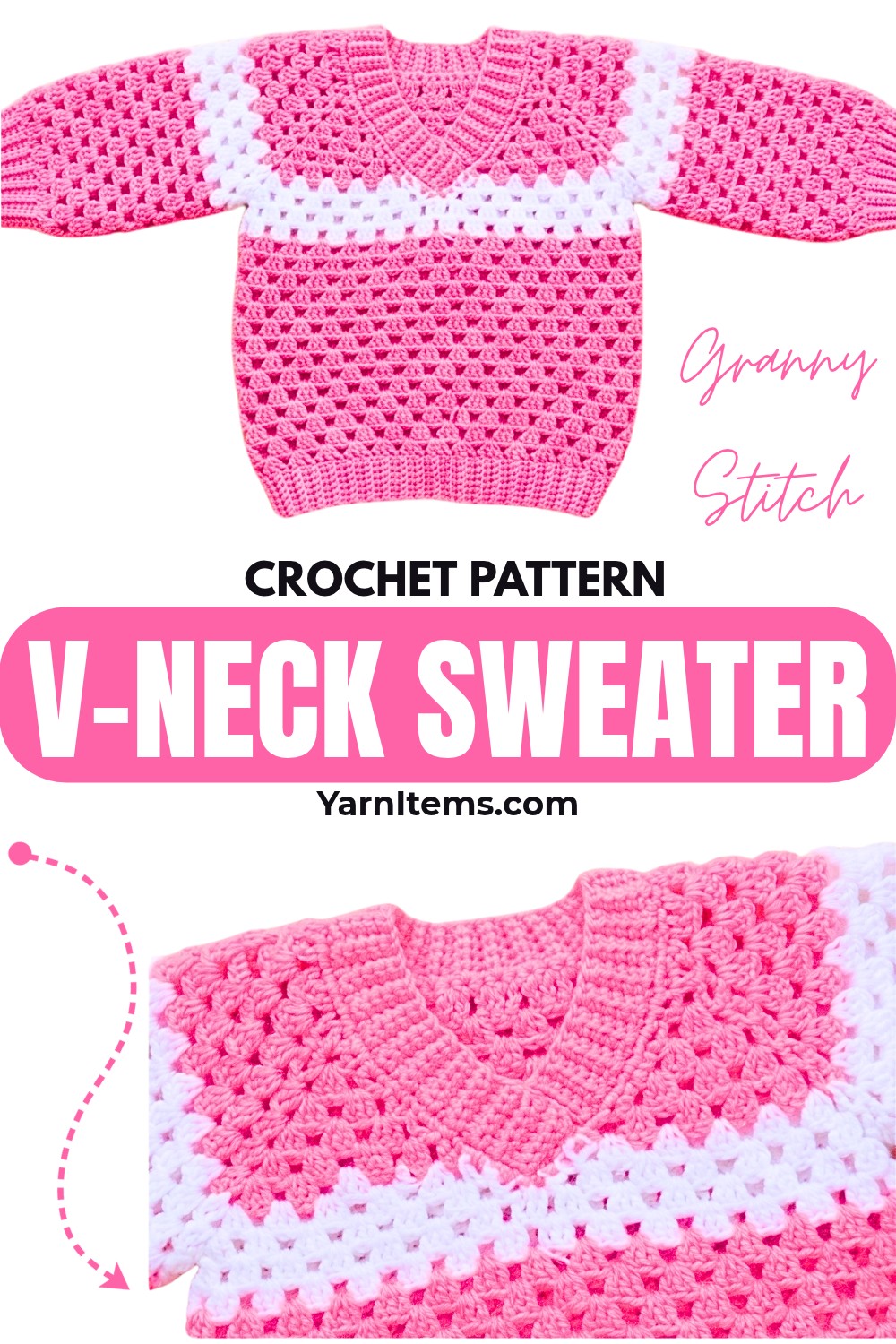
This 0–3 month V-neck baby crochet sweater brings classic granny-stitch texture into tiny proportions. Lightweight yarn keeps it soft and comfortable, while repeated double crochet clusters create open, familiar texture across the yoke, body, and sleeves. Ribbed edges add structure along the bottom, cuffs, and neckline.
Before starting, keep finished measurements in mind: about 26 cm total length, 25 cm sleeve length, and 24 cm chest width. The pattern uses two hook sizes, with 3.5 mm handling the main crochet work and 2.5 mm creating narrower ribbing. Length can also be adjusted by adding or removing repeat rounds before ribbing begins.
Credit ZoeCrochetR
Materials & Tools
- Yarn: Lightweight yarn. Tutorial uses Nigerian-brand yarn in 40g skeins, with approximately 60–70g needed in total.
- 3.5 mm crochet hook: Used for yoke, body, and sleeves.
- 2.5 mm crochet hook: Used for bottom, sleeve, and neckline ribbing.
- Yarn needle
- Scissors
Finished Size & Easy Adjustments
Finished sweater measures approximately 26 cm in total length, 25 cm in sleeve length, and 24 cm across chest for size 0–3 months.
Length can be changed without altering the main stitch pattern. Add or remove body rounds before beginning bottom ribbing to make sweater shorter or longer. Sleeve length can be adjusted in same way before cuff ribbing starts.
Pattern uses one solid color, but changing yarn color at round joins can create stripes while keeping granny-stitch texture.
Abbreviations
ch = chain
st(s) = stitch(es)
sl st = slip stitch
sc = single crochet
dc = double crochet
BLO = back loop only
sk = skip
V-stitch = 1 dc, ch 1, 1 dc in same stitch or space
Granny cluster = 3 dc in same space

Begin the V-Neck Yoke
Use a 3.5 mm hook for this section.
Foundation: Make a slip knot and ch 56.
Row 1: Sk 3 ch, which counts as first dc; ch 1, 1 dc in same 4th ch to create first corner V-stitch; Sleeve 1: (ch 1, sk 1 ch, 1 dc in each of next 3 ch) repeat 3 times; Second Corner: ch 1, sk 1 ch, V-stitch in next ch; Back Panel: (ch 1, sk 1 ch, 1 dc in each of next 3 ch) repeat 5 times; Third Corner: ch 1, sk 1 ch, V-stitch in next ch; Sleeve 2: (ch 1, sk 1 ch, 1 dc in each of next 3 ch) repeat 3 times; Fourth Corner: ch 1, sk 1 ch, V-stitch in next ch; Front Edge: 1 dc into very last chain.
Row 2: Ch 3 and turn, counting as first dc; 1 dc in same first st; ch 1, skip to corner ch-1 space and work V-stitch; (ch 1, 3 dc in next ch-1 space) across each side until next corner; work V-stitch in every corner ch-1 space; after final corner, ch 1 and 2 dc into top of turning chain.
Rows 3-8: Repeat Row 2; continue increasing V-neck front by placing 2 dc in the very first and very last stitch of every row, 3 dc in every ch-1 space along sides, and one V-stitch in all 4 corners. By Row 8, the yoke should measure approximately 8 cm square.
As yoke grows, keep checking that corner V-stitches remain easy to identify. These spaces control where sleeve and body sections expand, so consistent placement keeps shape even.

Divide Armholes and Body
Row 9: Ch 3 and turn; 1 dc in same first st; (ch 1, 3 dc in next ch-1 sp) across to First Corner; make 1 dc in First Corner space, skip all sleeve stitches, fold work, insert hook through both First Corner and Second Corner spaces and make 1 dc to lock them together, then make third dc only into Second Corner space; (ch 1, 3 dc in next ch-1 sp) across back to Third Corner; repeat armhole joining with 1 dc in Third Corner, 1 dc through both Third and Fourth Corner spaces, and 1 dc in Fourth Corner; continue (ch 1, 3 dc in next sp) across front edge to end, placing 2 dc in final st; sl st directly into top of beginning ch-3 to close V-neck and turn yoke into pullover shape.
Joining both corner spaces together is what closes each sleeve opening. Keep work folded neatly while making joining dc so armhole edges line up rather than twisting.
Round 10: Sl st into first ch-1 space; ch 3, counting as dc, and 2 dc into same space; (ch 1, 3 dc in next ch-1 space) around entire body; sl st into top of beginning ch-3.
Round 11: Ch 4, counting as 1 dc and ch 1; skip to next ch-1 space and make 3 dc; repeat (ch 1, 3 dc) around; at starting point, place 2 dc into space at base of starting ch-4, then sl st into 3rd chain to complete final 3-dc cluster.
Rounds 12–16: Alternate Round 10 and Round 11 until reaching a total of 16 rows from very top; on final Round 16, do not ch 1 between 3-dc clusters.

Add Bottom Ribbing
Switch to 2.5 mm hook.
Step 1: From finishing point of body, ch 7.
Step 2: Starting in 2nd ch from the hook, work 1 sc into each of 6 chains.
Step 3: Sl st into next 2 sts along sweater edge.
Step 4: Turn work; skipping two slip stitches, make 1 sc in the BLO of each of the 6 sc stitches back up the ribbing.
Step 5: Ch 1, turn; work 6 sc in BLO down ribbing, then sl st into next 2 sts along sweater edge.
Step 6: Repeat Steps 4 and 5 around entire bottom edge.
BLO creates raised horizontal ridges that give the bottom edge its stretchy ribbed appearance. Keep each ribbing section at 6 sc so the edge remains consistent around the sweater.

Crochet Sleeves
Switch back to 3.5 mm hook.
Round 1: Attach yarn in underarm joining space; ch 3 and place 1 dc in same corner space; ch 1, then work (3 dc, ch 1) into each ch-1 space around sleeve opening; finish with 1 dc in starting space and sl st to top of initial ch-3 to complete cluster.
Round 2: Sl st into next space; ch 3, 2 dc in same space; (ch 1, 3 dc) in each space around; sl st to join.
Round 3: Ch 4; (3 dc, ch 1) in each space around; finish with 2 dc in final space and sl st to 3rd ch to join.
Rounds 4-15: Alternate starting methods from Rounds 2 and 3 until reaching a total of 15 sleeve rows; on final row, do not ch 1 between clusters.
For matching sleeves, count completed rows on first sleeve before beginning second one. This small check helps keep both cuffs at the same height.

Sleeve Cuff Ribbing
Switch to 2.5 mm hook.
Use same ribbing method as sweater bottom: ch 7, work 6 sc back in BLO, anchor ribbing to sleeve edge with 2 sl sts, turn, and continue around cuff until complete.
Repeat entire sleeve sequence for second sleeve.
Finish V-Neck Edging
Round 1: Reattach yarn at bottom interior point of V-neck; ch 1; working around rough V-neck edge, place 2 sc into side of every dc row; sl st to first sc to join.
This foundation round helps create an even edge before narrower ribbing is added. Keep 2 sc beside each dc row so the neckline does not pull inward or flare excessively.

V-Neck Ribbing
Switch to 2.5 mm hook.
Use the same basic ribbing technique as the body, but make each ribbing section with 5 sc instead of 6. Make a chain, work 5 sc back toward neckline, sl st into next 2 sts on neck edge; turn, work 5 sc in BLO upward; ch 1, turn, work 5 sc in BLO downward; continue this process entirely around V-neck.
Close Ribbing Seams
For bottom edge and sleeve cuffs, turn sweater inside out and align first and last ribbing rows. Slip stitch or sew stitch-for-stitch to close each ribbed edge.
Work carefully across matching stitches so seams stay flat. Ribbing should meet evenly without pulling one side higher than the other.
Secure V-Neck Overlap
At the bottom center of the V-neck, lay one ribbed edge over the other to form an overlapping V shape. Turn the sweater inside out and use a tapestry needle to sew the crossover securely from inside.
Check the front of the sweater before tightening the final stitches. Overlap should sit flat against chest and keep V shape neat.
Weave In Loose Ends
Secure final knots, weave remaining yarn tails through wrong side with tapestry needle, and trim excess yarn.
A neat inside finish keeps loose ends from catching while preserving a clean appearance outside.

Fit & Finishing Checks
Before calling the sweater finished, compare body and sleeve lengths with intended measurements. Check bottom ribbing, cuffs, and neckline for even tension, then make sure V-neck overlap lies flat.
For size 0–3 months, finished measurements should be approximately 26 cm total length, 25 cm sleeve length, and 24 cm chest width. If adjusting length for another size, make changes through additional or fewer repeat rounds before starting corresponding ribbing.
For color changes, switch yarn during the final pull-through step of the final sl st of any round. This keeps the color transition positioned neatly at the round join.