Crochet Mesh Cardigan Pattern with Adjustable Sleeves & Buttonholes
Try this airy mesh cardigan with easy treble spaces, adjustable sleeve shaping, and a button band that can be customized for different button sizes.

Lightweight and open, this crochet mesh cardigan makes an easy layering piece with plenty of room to personalize the fit.
Its treble-and-chain mesh creates an airy fabric, while the sleeves can be gradually tapered toward the wrist or kept wider depending on how you alternate the rounds. A simple single crochet border gives the edges a cleaner finish, and the buttonholes can be adjusted when your buttons need a little more room.
Once the main body crochet panels and underarm seams are complete, the remaining work follows a straightforward finishing sequence.
Each sleeve is built directly from the underarm opening, the border travels around the front, neckline, and bottom edge, and the button band is worked afterward so the closures can be positioned exactly where you want them. Checking the sleeve fit as you go is especially useful because you can add length or change the amount of taper before fastening off.
Credit Granny Gaia
Materials & Tools Needed
- Yarn: Number 2 weight yarn (Sport weight)
- Crochet Hook: 3.0 mm
- Buttons: Approximately 1 cm in diameter, or another size suited to your cardigan
- Stitch markers
- Yarn needle: For sewing buttons and weaving in ends
- Scissors
Crochet Abbreviations
This pattern uses standard US crochet terminology.
- ch: Chain
- sc: Single crochet
- tr: Treble crochet
- sl st: Slip stitch
- st(s): Stitch(es)
- sp(s): Space(s)
- rep: Repeat

Before Starting the Sleeves
The main body panels and underarm seam should already be completed before beginning this portion of the cardigan.
Sleeve shaping is controlled by the rounds you choose. Normal Rounds maintain the width, while Decrease Rounds remove the final chain space at the join to gradually tighten the sleeve. This means you do not have to decide on the entire sleeve shape before you begin.
If you want a closer fit, alternate Normal and Decrease Rounds. If you prefer a roomier sleeve, replace some or all of the decrease rounds with Normal Rounds.
Sleeves – Make 2
Each sleeve begins at the bottom of the underarm seam and is worked around the sleeve opening using a simple treble mesh.
Normal Round – Maintains Width
Normal Round: Attach yarn at the bottom of the underarm seam; ch 4, which counts as the first tr, then work 1 tr into the next st; ch 2, tr into the next st; rep around the entire sleeve opening, placing exactly 1 tr directly across the center of the underarm seam to close any gap; at the end, ch 2 and sl st directly into the top of the beginning ch 4.
The extra attention at the underarm center is important. If the seam leaves a visible opening, placing one treble directly in that center point helps close the gap without changing the rest of the mesh pattern.
Decrease Round – Tapers the Sleeve
Decrease Round: Ch 4, which counts as the first tr, then work 1 tr into the next st; ch 2, tr into the next st; rep around the sleeve opening; after the final tr, do not make the usual ch 2 and instead sl st immediately into the top of the beginning ch 4 to create the decrease.
The missing final chain space is what makes this round tighter than the Normal Round. No separate decrease stitch is needed.
Alternative Round – Add Length Without Decreasing
Adding-Length Round: Ch 6, which counts as 1 tr plus ch 2; tr into the next st; ch 2, tr in the next st; rep around the entire sleeve; at the end, ch 2 and sl st into the 4th chain of the beginning ch 6.
Use this option when the sleeve needs additional length but you do not want to make it narrower.
Choose the Sleeve Shape as You Go
One possible sequence is:
Round 1: Normal Round
Round 2: Decrease Round
Round 3: Normal Round
Round 4: Decrease Round
After these rounds, try the cardigan on and check both the sleeve length and wrist fit. If the sleeve already feels comfortable, ch 1 and fasten off. If it needs more length, continue with another Normal Round or the Adding-Length Round rather than automatically adding another decrease.
For a wider sleeve, simply substitute the Decrease Rounds with Normal Rounds.
Repeat the complete sleeve process for the second sleeve, matching the number and type of rounds used on the first.
Sleeve Fit Check
Check the sleeve before fastening off completely. Look at three things:
- Length: Does the cuff finish where you want it?
- Wrist width: Does the opening feel comfortable without pulling?
- Upper-arm width: Does the sleeve have enough room when your arm bends?
Making this decision while the sleeve is still being worked gives you more control than trying to correct the fit after both sleeves are finished.
Border & Edging
Turn the cardigan right side out before beginning the border.
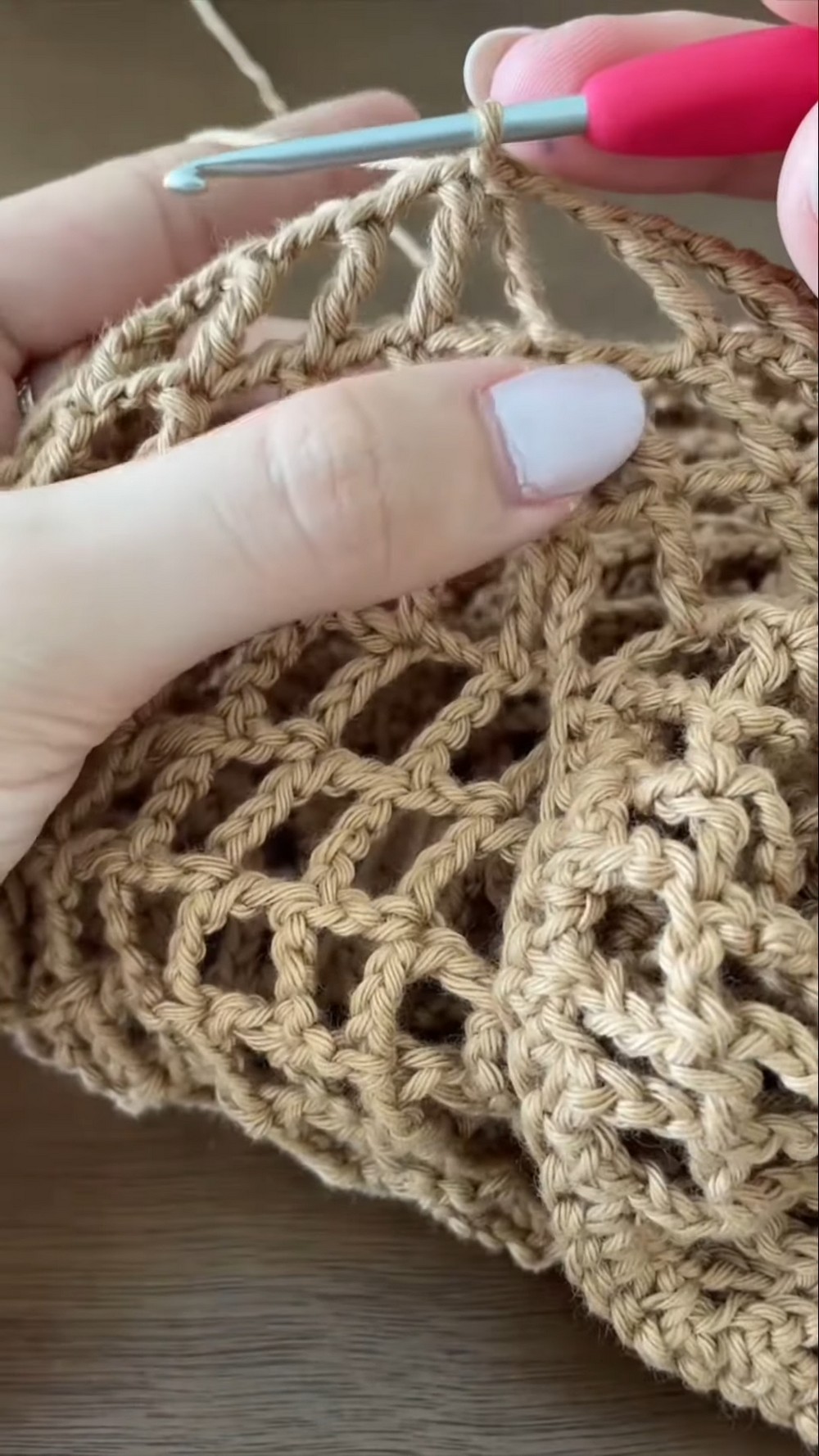
The first edging round creates an even single crochet foundation around the two front edges, neckline, and bottom hem. Because different parts of the cardigan contain different-sized spaces, even placement matters more than simply putting the same number of stitches everywhere.
Border Placement Guide
- Place 2 sc into large chain spaces.
- Place 1 sc into smaller chain spaces or around tr posts.
- Place 1 sc in standard stitches.
Work Around the Cardigan
Border Round: Attach yarn at the bottom front corner; ch 1 and work sc evenly up the front inner edge, placing 2 sc in large chain spaces, 1 sc in smaller chain spaces or tr posts, and 1 sc in standard stitches.
Shape Around the Neckline
Neckline Corner: At the upper corner where the neckline shaping begins, work 1 sc into the corner st, 6 sc into the large chain space, and 1 sc into the following small chain space.
Continue working sc evenly around the back neckline and down the opposite front edge.
Continue Along the Bottom
Bottom Hem: When you reach the opposite bottom front corner, continue the border across the bottom hem by placing 1 sc into each chain stitch completely across the bottom.

Join the Border
Join: After returning to the starting corner, sl st into the very first sc made; ch 1.
Keep the Border Flat
Watch the front edge as you work. Too many sc stitches can cause the edge to ruffle, while too few can pull it inward. The large-space, small-space, and standard-stitch placement guide helps keep the edging balanced across the different sections.
Button Band & Buttonholes
The buttonholes are worked along one front edge, while the opposite edge receives the buttons.
Lay the cardigan flat before marking anything. Decide where you want the buttons to sit, then place stitch markers at matching heights on both front edges. The markers help you keep the closures evenly spaced.
Mark the Button Positions
Place stitch markers evenly along one front edge for the buttons. Put corresponding markers on the opposite front edge, which will become the buttonhole side.
Buttonhole Row
Row 1: Starting at the bottom corner of the buttonhole side, work 1 sc in each st until reaching the first stitch marker; at the marker, ch 2, skip 2 sts, and sc into the 3rd st; continue working 1 sc in each st and repeat the ch-2, skip-2 buttonhole at every remaining stitch marker; after the final buttonhole, continue working sc evenly around the neckline and down the opposite button side, ignoring the button-side markers for now and placing 1 sc in every stitch.
Test Each Buttonhole
Before moving too far beyond a buttonhole, slide the actual button through the opening. It should pass through without forcing the stitches apart, but it should not be so loose that the button slips out easily.
If your buttons are larger than approximately 1 cm, adjust the opening rather than trying to force them through a two-chain space.
For a larger button, you can use ch 3 or ch 4 at the marked location and skip the corresponding number of stitches.

Final Border Row
Once the first buttonhole row has been worked around the cardigan, the second row reinforces the openings and gives both front edges the same finished appearance.
Row 2: When you reach the bottom edge of the button side, ch 1 and turn; work sc in every st all the way back up the button side, around the neckline, and down the buttonhole side; when reaching each ch-2 buttonhole space, work exactly 2 sc directly into the chain space, then continue with 1 sc in each st to the end.
Finish: Ch 1 and fasten off.
The two sc worked into each buttonhole space help maintain the edge while keeping the opening usable.
Attach the Buttons
Turn the cardigan so the right side is facing out, with the underarm joining seam sitting on the inside.
Thread your yarn needle and sew the buttons securely onto the marked positions on the button-band side.
After attaching each button, pass it through its corresponding buttonhole before moving to the next one. This simple check confirms that the two front edges meet at the correct height without pulling or bunching.
Final Finishing
Weave in all remaining yarn tails securely on the inside of the cardigan. Trim excess yarn only after each end has been properly secured.
Give the front edges and sleeves a gentle adjustment so the mesh settles naturally, then fasten the buttons and check the overall fit once more.
Button & Sleeve Check
Before calling the cardigan finished, test every closure and move your arms through the sleeves. The buttons should sit evenly down the front, each buttonhole should release easily without stretching, and the sleeve taper should feel comfortable at the wrist.
If you prefer more room through the sleeves, remember that the pattern allows the decrease rounds to be replaced with Normal Rounds. If a larger button is being used, the buttonhole opening can likewise be widened with additional chains.

Your lightweight crochet mesh cardigan is now ready to wear.