Crochet Top-Down Raglan Sweater with V-Stitch Texture
Looking for one raglan design that adapts to your measurements? This V-stitch sweater can become a breezy summer top with simple length and ribbing changes.
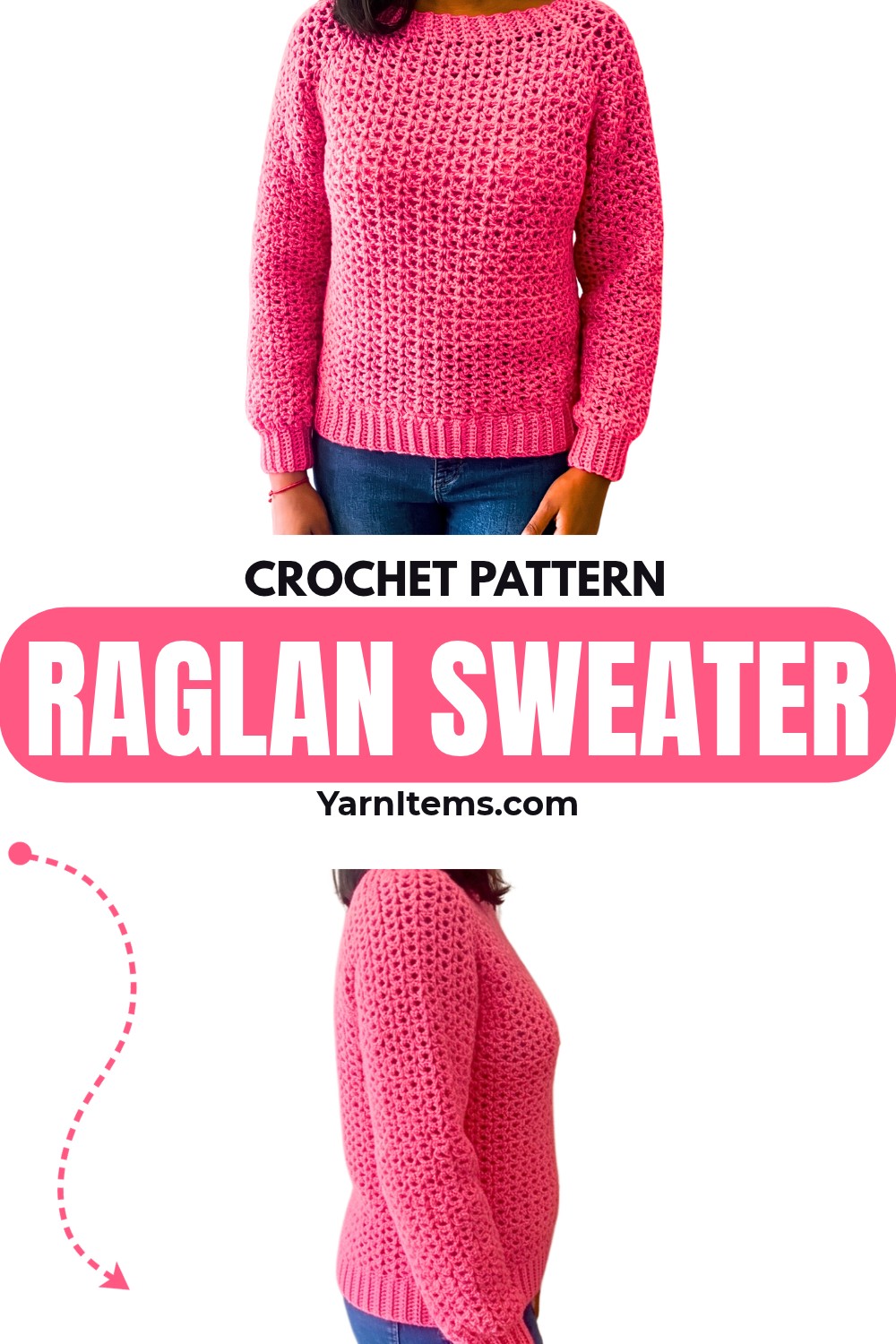
Soft worsted-weight yarn and open V-stitches give this crochet raglan sweater a light texture with plenty of room for movement. Ribbed neckline, hem, and cuffs add stretch and definition, while top-down shaping keeps sizing flexible from beginning to end.
Start by measuring crochet sweater neckline ribbing around the wearer’s head, then build the yoke through alternating V-stitch rounds. Once armhole depth feels right, body and sleeves can continue to desired length, making this crochet pattern useful for both full sweaters and lighter summer tops.
Credit JKD Handmade
Materials & Tools
-
- Yarn: Category 3 light worsted yarn, double knit, or 4-ply/worsted-weight yarn
- Sweater yarn: Tutorial uses 100% acrylic yarn
- Top version yarn: Cotton yarn
- Yarn amount: Approximately 500g for a medium sweater; just over 250g for a medium top
- Smaller hook: Use the hook size recommended on the yarn label, such as 4 mm for double knit
- Larger hook: Use a hook two sizes larger than the smaller hook, such as 6 mm
- 4 stitch markers
- Measuring tape
- Scissors
- Yarn/wool needle
Size Planning Before You Crochet
This tutorial demonstrates Medium sizing, but neckline-based sizing can be adapted from children through adults.
Your starting neckline ribbing determines much of the final fit. Work enough ribbing rows for finished ribbing to stretch comfortably over wearer’s head without becoming overly loose.
For Medium, tutorial uses 72 ribbing rows. Each ridge represents 2 rows, so keep careful count while building neckline.
Yoke depth should also be measured rather than chosen only by row count. Continue V-stitch rounds until yoke folds comfortably in half and armhole depth reaches desired measurement. Medium example uses approximately 7.5 inches.
For summer-top styling, work initial armhole depth slightly longer for a looser fit. Use chain 5 instead of chain 11 for bottom and sleeve ribbings, and work short ribbing directly onto armhole opening instead of full-length sleeves.
Abbreviations
- ch: Chain
- sc: Single crochet
- dc: Double crochet
- sl st: Slip stitch
- blo: Back loop only
- V-stitch: (dc, ch 1, dc) worked into same stitch or space
- Corner A: 1 V-stitch
- Corner B: (V-stitch, ch 1, V-stitch) worked into same space

Build Stretchy Neckline Ribbing
Use a smaller hook for neckline ribbing. This section becomes a continuous collar edge, so its finished circumference needs to pass comfortably over the head.
Row 1: Make slip knot, ch 5; sc into 2nd ch from hook and each remaining ch across; 4 sts.
Row 2: Ch 1, turn; work sc in blo of all 4 sts.
Row 3 and onward: Repeat Row 2 until ribbing comfortably fits around head when unstretched.
Count rows carefully. There are 2 rows per ridge, and the tutorial uses 72 rows for Medium. Final row count should match your chosen yoke sizing chart, typically using an even row count so the V-stitch arrangement aligns correctly.
Join: Bring ribbing ends together; ch 1; sl st through 4 stitches along both ribbing edges to form a continuous circle.
Keep joining tension firm enough to close seam but not so tight that neckline loses stretch.

Set Up Yoke
Change to a larger hook.
Round 1: Work sc evenly around side edge of ribbing, placing exactly 1 sc into each ribbing row; for 72 ribbing rows, work 72 sc; join with sl st to first sc.
Four stitch markers now divide the neckline into sleeve, front body, sleeve, and back body sections.
Marker Placement for 72-stitch Base: Treat starting stitch as stitch 1; place markers in stitches 1, 15, 37, and 51.
Check marker positions before beginning V-stitch rounds. These markers establish four shaping points, so uneven placement will affect balance between front, back, and sleeves.

Shape Yoke with V-Stitches
Yoke alternates two different corner treatments. Keeping Round 2 and Round 3 separate in your count makes shaping easier to follow.
Round 2: Corner A
Round 2: Ch 2, counting as dc; skip next st; work V-stitch (dc, ch 1, dc) into following st; continue skipping 1 st and working V-stitch into next st until reaching marker; at marked stitch, work 1 V-stitch only for Corner A; move stitch marker into ch-1 space of newly formed V-stitch; continue same V-stitch sequence to next marker and repeat Corner A at each marked position; at end, skip last st, work 1 dc into base of starting ch-2, ch 1, and sl st into 2nd ch of starting ch-2 to join.
Corner A uses one V-stitch, so it creates initial shaping points without adding separate ch-1 spacing between two V-stitches.
Round 3: Corner B
Turn work.
Round 3: Sl st into corner ch-1 space; ch 2, ch 1, and dc into same space to form half of Corner B; work V-stitch into every ch-1 space across until reaching marker; at marked corner, work (V-stitch, ch 1, V-stitch) into same space for Corner B; move marker into middle ch-1 space between two V-stitches; continue across remaining sections, repeating Corner B at each marker; in starting corner space, work full V-stitch, ch 1, and sl st into 2nd ch of starting ch-3 to join.
Corner B expands each marked section more than Corner A. Moving markers into new middle ch-1 spaces keeps future increases positioned correctly.

Continue Yoke Shaping
Repeat Round 2: Turn; sl st into space; ch 2; work V-stitches in all spaces; at marked corners, work Corner A with 1 V-stitch; finish with dc, ch 1, and sl st to join.
Repeat Round 3: Turn; sl st into space; ch 2, ch 1, dc in same space; work V-stitches in all spaces; at marked corners, work Corner B with (V-stitch, ch 1, V-stitch); finish with V-stitch, ch 1, and sl st to join.
Continue repeating Rounds 2 and 3 in sequence until yoke folds nicely in half and armhole depth reaches desired measurement. Medium example uses approximately 7.5 inches measured straight down sleeve split.
At this stage, fabric should naturally fold along shoulder and sleeve divisions. If yoke feels too shallow, continue rounds; if it already reaches desired armhole depth, move into body.
Separate Sleeves and Begin Body
Body begins by skipping sleeve sections and connecting opposite corner spaces. This turns circular yoke growth into torso-only rounds.
Body Round 1: Turn; sl st into V-stitch space; ch 2, ch 1; skip all stitches belonging to first sleeve and move directly to next corner marker; work V-stitch into corner ch-1 space to create underarm join; continue V-stitches across body spaces to next corner; at second corner, work V-stitch, ch 1, skip sleeve stitches, and work V-stitch into final corner; finish with dc into starting space, ch 1, and sl st into 2nd ch of starting ch-2.
Underarm joins should sit directly between front and back body sections. Check both sides before continuing so sleeve openings remain balanced.
Body Round 2: Sl st into ch-1 joining space at underarm; turn; ch 2; work V-stitch in every space across; at opposite underarm join, work V-stitch directly into joining ch-1 space; finish with dc into starting joining space, ch 1, and sl st to join.
Body Round 3+: Turn; sl st into ch-space; ch 2; work V-stitches into all ch-1 spaces around; finish with dc into starting space, ch 1, and sl st to join; repeat until body reaches preferred length.
Turning after every round keeps fabric orientation consistent and preserves intended V-stitch texture.

Finish Bottom with Ribbing
Work a preparation round using the larger hook first, then change to a smaller hook for stretchy ribbing.
Preparation Round: Work 1 sc into every dc and 1 sc into every ch-1 space around bottom edge; sl st to join.
Change to smaller hook.
Row 1: Ch 11 for standard sweater; for children’s size, ch 9; for summer top, ch 5; sc into 2nd ch from hook and each ch back toward sweater edge; 10 sts for ch-11 version.
Joining: Sl st into next 2 unworked sc stitches along main sweater body.
Row 2: Turn; skip 2 sl sts just made; work sc in blo of all 10 ribbing sts.
Row 3: Ch 1, turn; work sc in blo of all 10 sts; sl st into next 2 body-edge sts; for tighter cinch, you may join into next 3 body-edge sts instead.
Repeat Rows 2–3: Continue around entire bottom edge until ribbing meets its starting point.
Ribbing should stretch across body edge without pulling fabric into gathers. If edge begins to cinch excessively, check joining stitch count.
Crochet Sleeves
Sleeves use the same V-stitch texture as the body, but each armhole is worked separately.
Round 1: Attach yarn at underarm space; ch 2, counting as dc; work V-stitches into every ch-space around armhole opening; finish with dc in starting space, ch 1, and sl st to join.
Round 2+: Turn; sl st into ch-space; ch 2; work V-stitches in all spaces around; finish with dc, ch 1, and sl st to join.
Repeat Round 2, turning after every round, until sleeve reaches desired length just short of wrist.
Turning each sleeve round is important because it keeps stitch direction consistent with body texture.
Add Sleeve Ribbing
Sleeve cuff uses smaller hook and same basic ribbing method as bottom hem, with one important difference during preparation.
Sleeve Preparation Round: Work 1 sc into each dc only around sleeve opening; skip all ch-1 spaces.
Change to smaller hook.
Sleeve Row 1: Ch 11; sc into 2nd ch from hook and each remaining ch back toward sleeve edge.
Joining: Sl st into next 2 unworked sc stitches along sleeve edge.
Sleeve Row 2: Turn; skip 2 sl sts; work sc in blo of all ribbing sts.
Sleeve Row 3: Ch 1, turn; work sc in blo across ribbing; sl st into next 2 sleeve-edge sts.
Repeat Rows 2–3: Continue around cuff until starting edge is reached.
For summer-top version, use ch 5 for short cuff and crochet this ribbing directly around armhole instead of continuing full sleeve.
Finishing Ribbing Seams
When ribbing reaches starting point, match both ends carefully before closing seam.
Option 1: Slip stitch ribbing edges together.
Option 2: Leave long yarn tail before fastening off, then use yarn needle to weave edges together back and forth for cleaner seam.
Keep ribbing edges aligned stitch-for-stitch. Uneven alignment can create visible twist around hem or cuff.
Fit Check Before Final Finishing
Before weaving in loose ends, try the sweater on or compare it with the wearer’s measurements.
Check neckline stretch first: ribbing should pass comfortably over head without becoming excessively loose.
Next, check yoke depth and armhole position. Body should fall naturally from underarm without pulling across chest.
Finally, check sleeve length and cuff snugness. Because body and sleeves are worked top-down, length can be adjusted simply by continuing or stopping rounds before finishing.
Turn Sweater and Secure Loose Ends
Fasten off remaining yarn.
Turn sweater to wrong side and weave all loose tails securely back and forth through stitches using yarn needle. Trim excess yarn only after each tail feels secure.
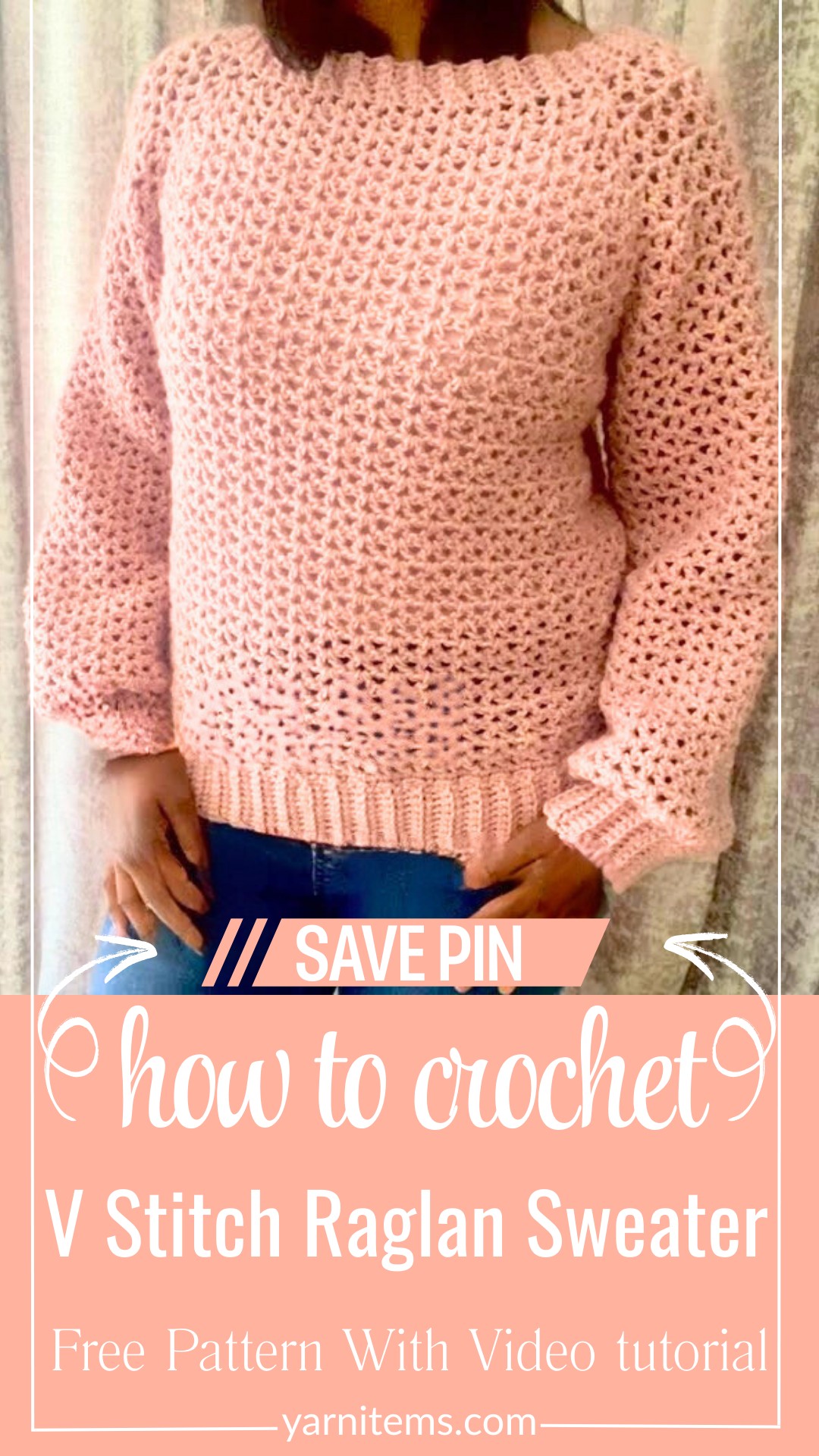
Your finished raglan sweater now has open V-stitch texture, stretchy ribbed edges, adjustable sleeve and body length, and neckline sizing that can be adapted for different wearers. For warmer styling, use acrylic yarn and full sleeves; for lighter seasonal wear, use cotton yarn, longer armhole depth, shorter ribbing, and optional short sleeves.